At the rate I’m creating new content, I may never catch up on my backlog of essay drafts because I try to post only once each day to avoid spamming my readers. Since tarot spread creation is a “fill-in” activity between my more involved literary efforts, they tend to languish in the queue, now more than ever since I returned to daily writing. So this post presents a compilation of several new spreads that I put together over the last couple of weeks that might otherwise never appear here.
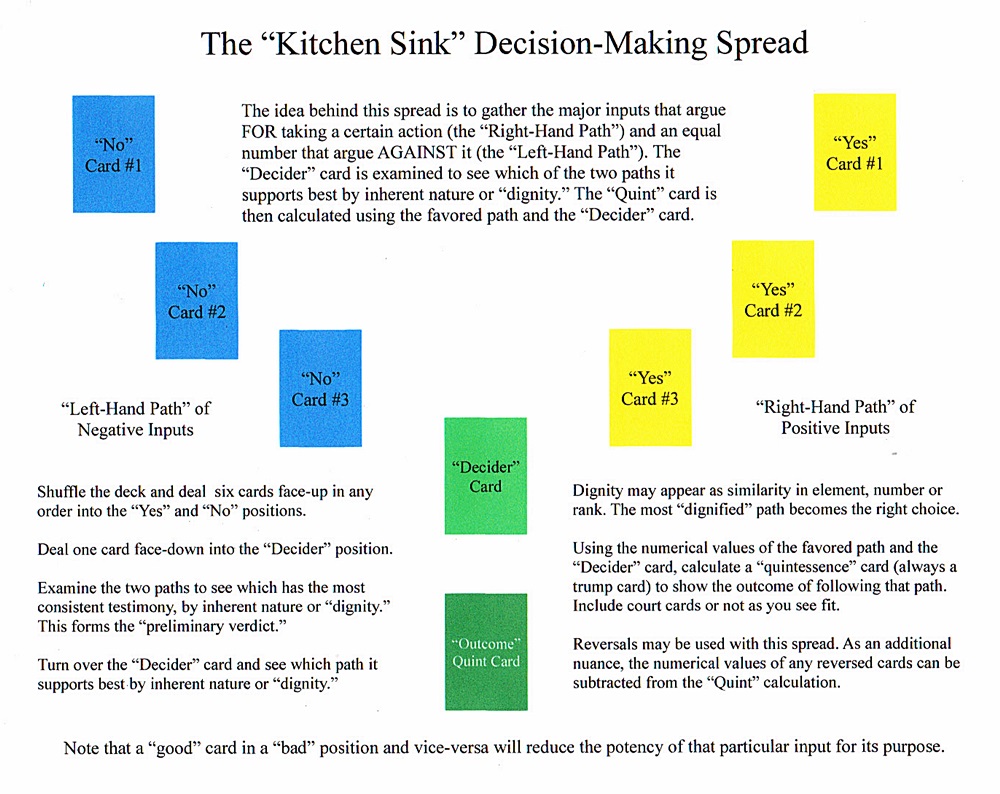
The “Kitchen Sink” Decision-Making Spread
When I run out of inspiration for my daily essays, I create tarot spreads. This one takes the “yes-or-no” decision-making approach up a notch.
“Tending the Garden” – A Problem-Solving Spread
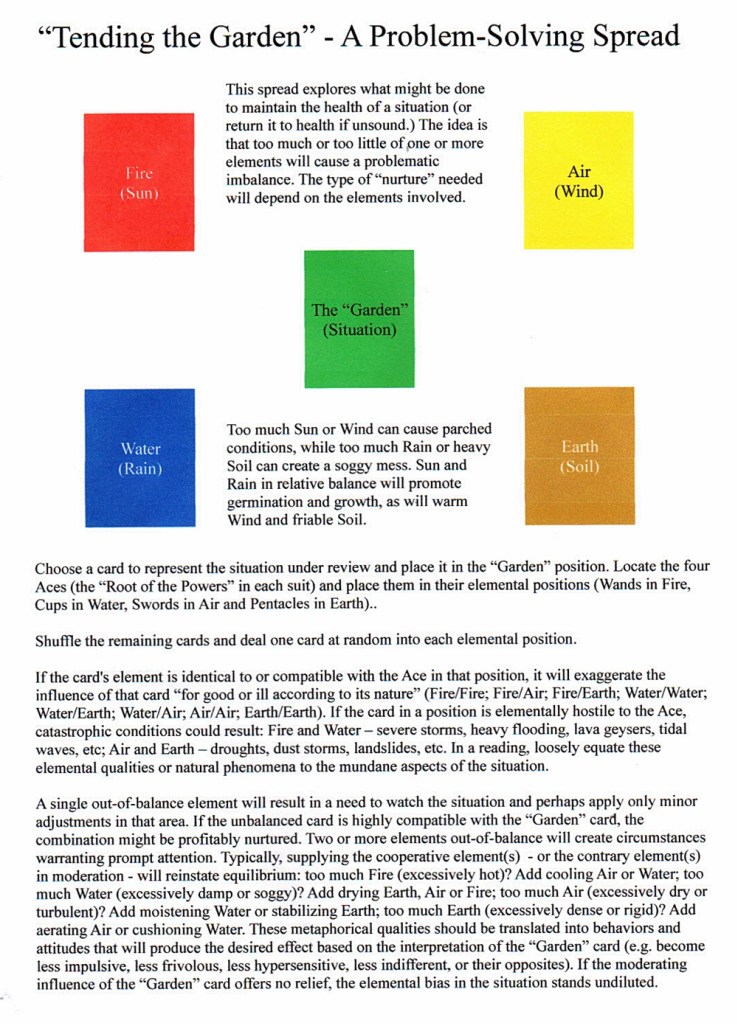
As Candide said at the end of Voltaire’s novel, when philosophy fails us (that is, when life hands us a bowl of pits or a bed of thorns) “we must cultivate our garden.”
This spread equates the qualities of the classical elements Fire, Water, Air and Earth to aspects of the querent’s situation (the Garden” of the title) in the interest of maintaining those aspects in healthy equilibrium or returning them to balance if they have become unstable. The idea is to characterize the elemental aspects as behaviors and attitudes that should be either reinforced or diminished in prominence.
“Color-Informed” Topic-Specific Spreads
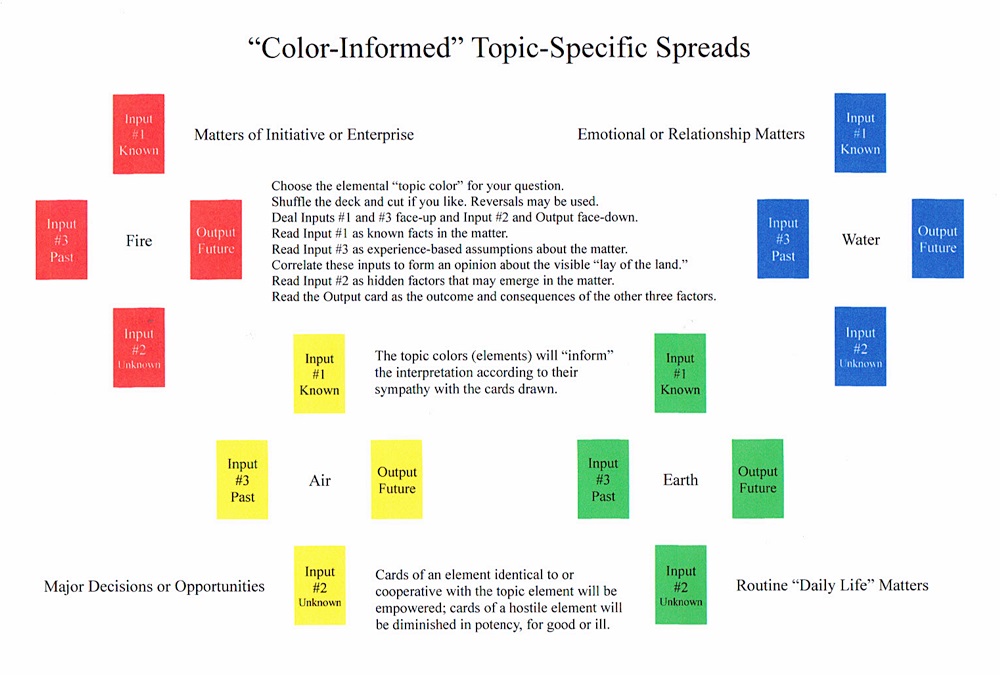
During an online conversation we were discussing truncated versions of the traditional Celtic Cross spread, specifically those resembling a “squat” four-armed cross with four card positions. The discussion led to the fact that many national flags have crosses on them, not all equal-armed; one that is so arranged is the Swiss flag with its white cross on a red field. This research brought me to the idea that the elemental colors might be used to provide an underlying “motif” for simple topic-specific spreads. This could be applied as a way to ascribe potency (or lack thereof) via elemental affinity or discord between the cards and the fundamental theme of the topic. The increase or decrease in power this would produce could add an extra layer of subtlety to the basic four-card reading.
I created a set of “color-informed” four-card spreads, one for each of the elements, but in my usual style I added a few twists to their interpretation. They all start with the seeker identifying which of the four general topic areas they want the reading to explore. After that each spread follows a fairly standard pattern of three input cards and one output (or outcome) card, although there are a few wrinkles in getting from Card #1 to Card #4. Here is the result:
The “Life’s One-Act Play” Mini-Drama Spread
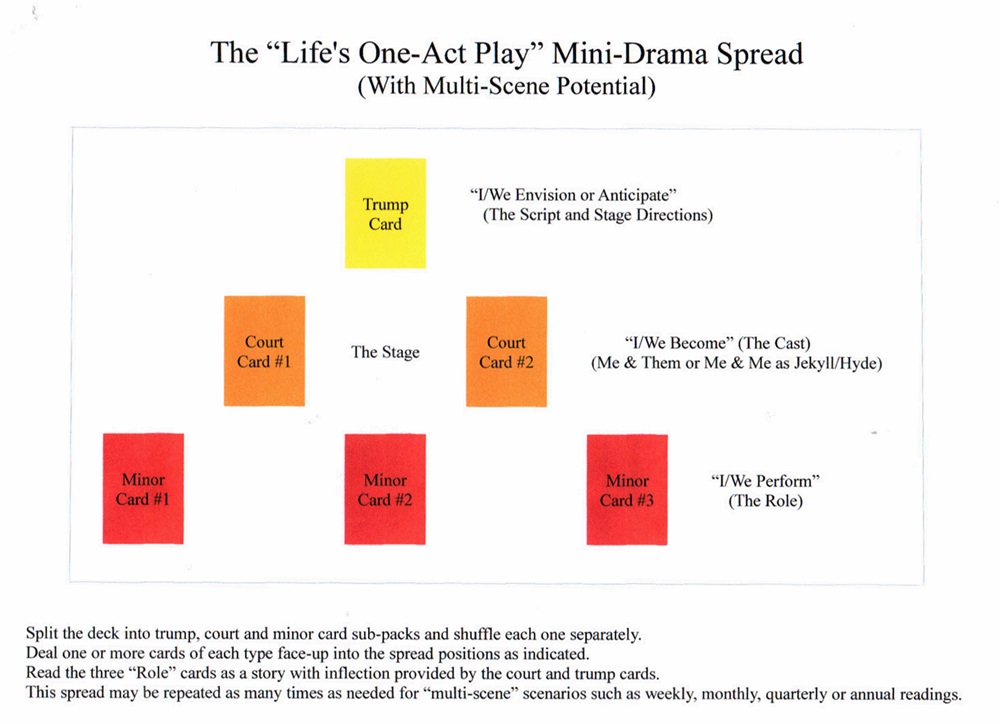
Here is a “theater-themed” spread built around my assumptions that the trump cards (and in this case the court cards as well) function more as sotto-voce observations on the developing drama, often providing off-stage inflection rather than signifying major plot devices. In a metaphorical sense, I find the trumps to depict the “stage-manager,” the courts to represent any supporting “actors” and the minors to show how it all plays out “on the boards.” This approach works best by presenting the different elements in descending “tiers of significance,” from the most general to the most specific.
This is one of my “split-deck” spreads; it can be used in a “multi-scene” narrative by running it as many times as necessary to explore sequential segments in a long-running story (for example, a 12-month “look-ahead” series). This is effectively an amplified 3-card “situational awareness and development” spread that considers a minimal number of direct inputs; it isn’t intended for “past/present/future” readings since it presupposes an advancing timeline from Card #1 (present) to Card #3 (future or outcome), with a mid-course “plot check” at Card #2. It is flexible enough to use for both individual and multi-party readings.
 Parsifal's Wheel Tarot & Astrology