“How does your light shine
In the halls of Shambala”
Danny Moore, songwriter
At its most basic, the tarot is a metaphysical tool (and art) of self-discovery and advancement in both a psychological and situational/motivational sense. I just picked up a quote from The Tao of Thoth that sums up this objective quite neatly: “You have to practice development to be you, or otherwise you will be whatever else it is you do.” I interpret this as advocating the supremacy of focus and concentration over mere “busy-ness.”
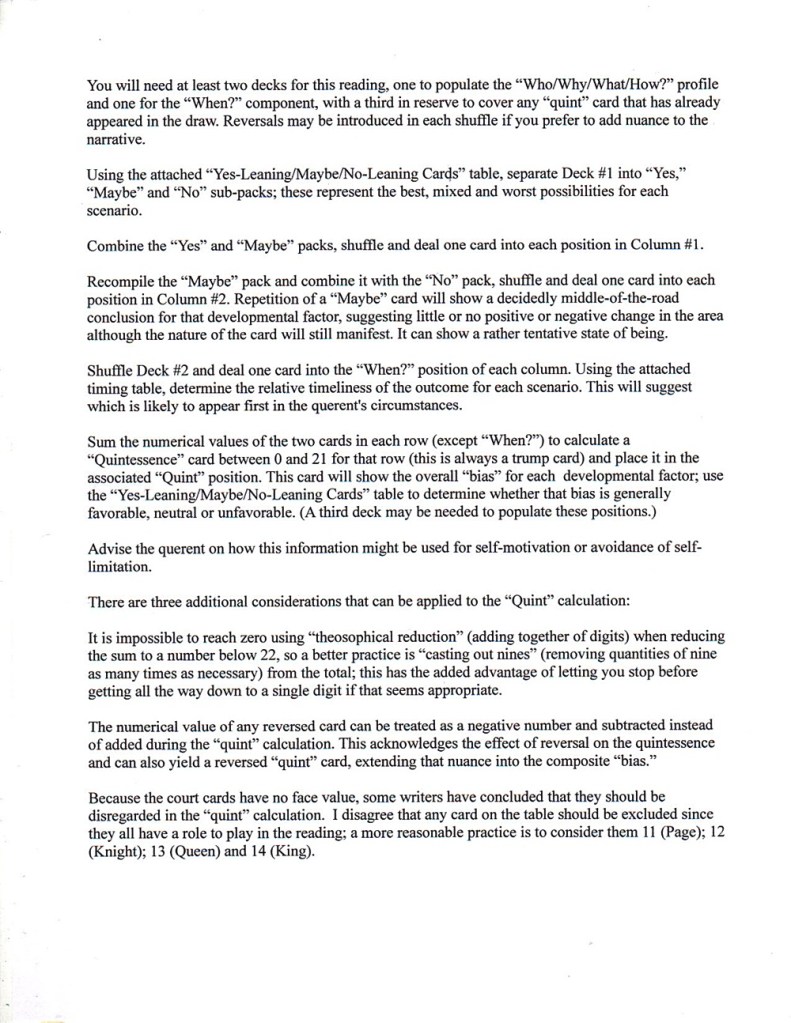
I set myself the task of creating a comprehensive self-development spread that can be used for any adult (although I can envision its usefulness in a business setting as well), with the goal of advising the querent how the results might be employed for the purposes of self-motivation or avoidance of self-limitation. It applies a split-deck/multi-deck approach that builds four of the five elements of effective expository writing (“Who/Why/What/When?”) plus “How?” into a “Best Scenario/Worst Scenario” matrix, along with a “Middle Way” (or “Bias”) viewpoint derived from the quintessence calculation.
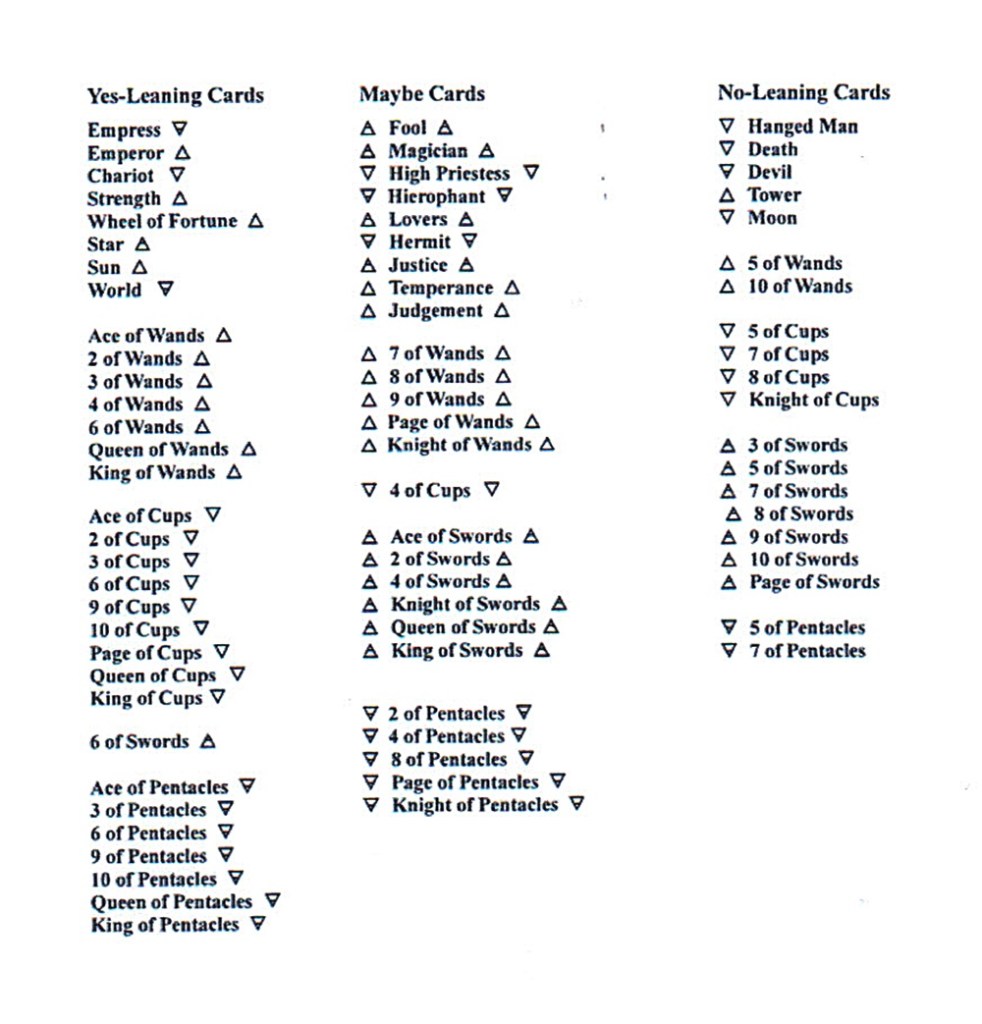
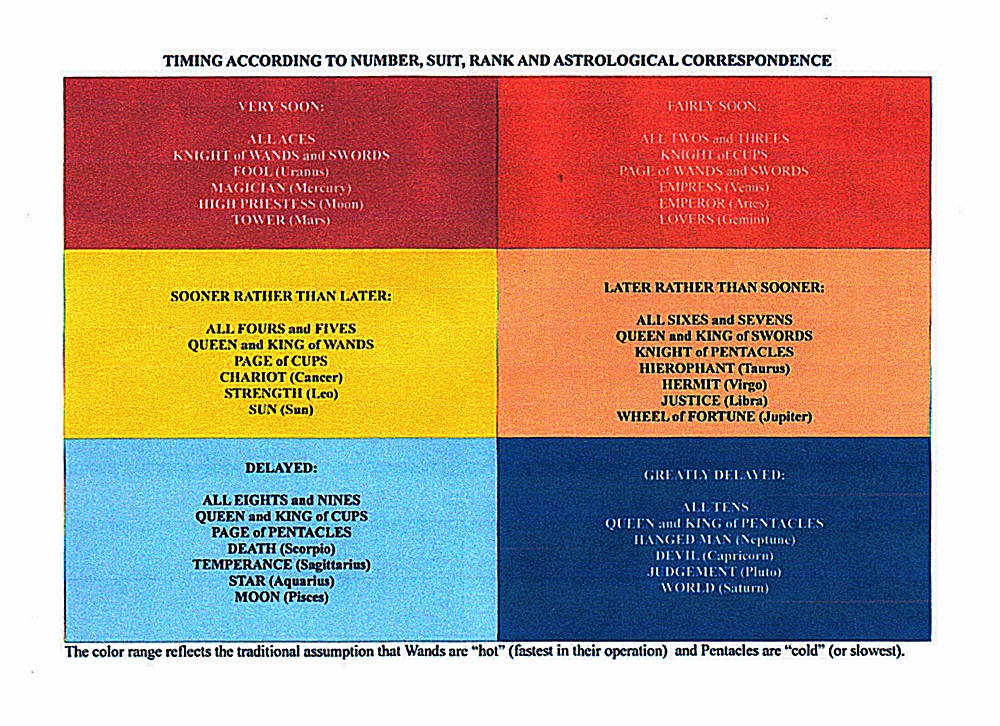
It brings to bear two of my experimental tables: “Yes-Leaning/Maybe/No-Leaning” cards and the recent “Timing Table,” in a “mix-and-match” design that combines “Yes-and-Maybe” cards for the “Best Scenario” and “No-and-Maybe” cards for the “Worst Scenario” (with “Maybe” being something of a noncommittal chameleon). This avoids the “good card in a bad position” (and vice versa) conundrum. There will never be a fully-negative card in the “Best Scenario” column nor a fully-positive card in the “Worst Scenario” column.

 Parsifal's Wheel Tarot & Astrology