As I continue to explore the Taijii (“Yin/Yang”) symbol in combination with the Major Arcana of the tarot, I downloaded an image and inserted the semi-annual solstices and equinoxes to create a four-season cyclical pattern showing the interplay between the dark of Yin and the light of Yang over the course of a year. I reviewed all of the trump cards with an eye toward which four are the purest expression of the primary energies of Yin and Yang, and which four best fit the blended intermediary qualities (Yin within Yin; Yin within Yang; Yang within Yang; and Yang within Yin). I paid no attention to the zodiacal positions of these cards in the calendar year and just used their Golden Dawn planetary and elemental associations in a freely associative way. Because the seasons are a balanced equation, there are no truly discordant pairs here; any less fortunate implications will come from the cards of a reading that are drawn for the “template” positions.
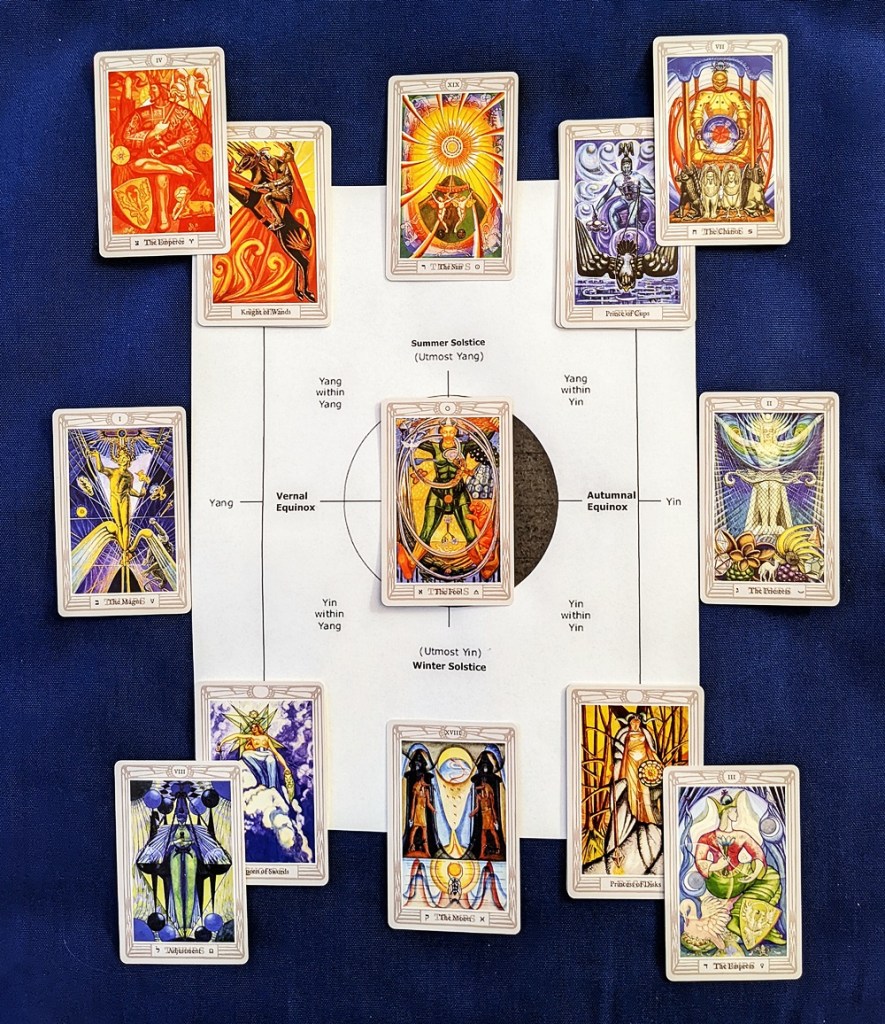
I brought the element of Air clockwise up the “springtime” side from the Winter Solstice to the Vernal Equinox, and transitioned to Fire from there to the Summer Solstice. The element of Water picked up after the Solstice and carried through to the Autumnal Equinox, after which Earth brought the series back to the Winter Solstice. The basic Yin energy at the Autumnal Equinox I correlated with the Moon as the Priestess, and the complementary Yang energy at the Vernal Equinox with Mercury as the Magician. I placed the Fool (Primary Air) at the center of the array to suggest “limitless potential.”
The “Utmost Yin” at the Winter Solstice I gave to the Moon as the quintessential passive card, and the “Utmost Yang” at the Summer Solstice went to the preeminent active card, the Sun. I then juxtaposed the Empress as Venus and “Yin within Yin” of the Earth quarter with the Emperor as Mars and “Yang within Yang” of the Fire quarter. The male Charioteer and its association with the Moon (through its Cancer correspondence) I positioned as “Yang within Yin” of the Water quarter, counterbalancing it with the female Adjustment as Venus ruling Libra and “Yin within Yang” of the Air quarter. Although I tried to select visibly female cards as the “Yin” of Water and Earth and male cards as the “Yang” of Air and Fire, I used a little “metaphysical license” where I thought it appropriate, such that the constituent Yin or Yang quality is sometimes represented by the sign connected to the card rather than by the image itself.
There are several other less obvious but still noteworthy correspondences here. The Sun and the Magus are “numerological counterparts” in that the Sun reduces to “1,” the number of the Magus, by adding together its digits (1+9 = 10, 1+0 = 1). This gives them a common theme (beyond their elemental “friendliness”) as the main Yang cards. The Priestess and Moon cards share the passive nature of the Moon as the essence of Yin in addition to being elementally attuned. Then there is the matter of planetary exaltation to consider. The Moon and Venus share a connection as the “Yin within Yin” due to the former’s exaltation in Taurus, and the Sun joins Mars as the “Yang within Yang” since it is exalted in Aries. Although most of the interplay in this array is between the “personal planets” Sun, Moon, Mercury, Venus and Mars, we can complete the planetary pattern of opposing forces by adding Jupiter and Saturn according to their exaltation: Jupiter is exalted in Cancer, bringing another Yang emphasis to the “Yang within Yin” of the Chariot and Saturn is exalted in Libra, amplifying the “Yin within Yang” of Adjustment due to its association with the judgmental “Dark Mother.”
Next I split the court cards into their elemental sub-sets and put them at the four quarters of the year, Fire courts in the “Spring-to-Summer” months; Water courts in the “Summer-to-Fall” period; Earth courts in the “Fall-to-Winter” interval and “Air” cards in the “Winter-to-Spring” range. In each case I placed the court card at the top of the pile that aligned best with the nature of the intermediary trump card, both elementally and visually. (In a reading I would shuffle all of the courts and let one appear randomly in each of the four quarters to see how well it partakes of the nature of the “base” card.) With the Empress (“Yin within Yin”) I paired the Princess of Disks (“Earth of Earth”); with Adjustment (Yin within Yang) I mated the Queen of Swords (“Water of Air”); with the Emperor (Yang within Yang) I connected the Knight of Wands (“Fire of Fire”); and with the Chariot (“Yang within Yin”) I equated the Prince of Cups (“Air of Water”). I think they are all well-matched in both appearance and character.
To use this as the basis for an annual look-ahead reading, keep the template handy to identify the “archetypal energies” for each position, then separate the court cards from the deck and set them aside. Shuffle the rest of the pack and deal eight cards in a circle (if you choose you can use only the trump cards for this step). Similar to the Celtic “Wheel of the Year” spread, start at the Winter Solstice if possible and move clockwise; but if you’re already in the middle of the year just begin at the next mid-cycle phase (there are approximately 45 days from a seasonal midpoint to the next Solstice or Equinox). Cards that share “dignity” with the archetypal “base” cards by element, number or divinatory character will have their potency enhanced “for good or ill, according to their nature” since that nature will be exaggerated by the reinforcement, giving it more traction in the affairs of that season. “Good” cards could very well give greater joy, and the unfavorable action of “bad” ones could become more pronounced.
Next, shuffle the sixteen court cards and place one at each of the four quarters, beginning at the same point in time as the first operation. This card will show the type of personality and its behaviors and attitudes that will be most apparent during the quarter of its influence. Once again, cards that are either enhanced or impeded by elemental dignity or rank with the “base” court card will act according to their “best” or “worst” qualities.
Read all of the cards to see how well they align with the seasonal model and draw conclusions about what kind of a year you’re likely to have if you don’t consciously intervene to change things. Then contemplate how you’re going to optimize your opportunities and minimize your exposures if and when the need arises.
 Parsifal's Wheel Tarot & Astrology