I’m always seeking ethically sound (not to mention legal) ways to approach health questions, and lean toward a holistic – or “whole-health” – model rather than trying to literally “play doctor” in a narrow diagnostic way. I know next to nothing about Chinese medicine, but thought I would apply my recent contemplation of the Tajii (“Yin/Yang” symbol) to the Western concept of “Spirit/Mind/Body” wellness with the goal of achieving a healthful balance. The focus of this spread is on using the tarot to expose and consciously respond to helpful and harmful influences rather than trying to identify biological causes, symptoms and remedies (all of which have no place in tarot reading). It is based partly on the premise that many health problems are psychosomatic in origin (i.e. “a physical illness or other condition caused or aggravated by a mental factor such as internal conflict or stress”), and can be prevented or mitigated through non-medical intervention. Many kinds of stressful imbalance might be encountered in daily life; several that the tarot excels at identifying are poor personal habits, behaviors and attitudes; unhealthy environments; and toxic relationships, both private and public.
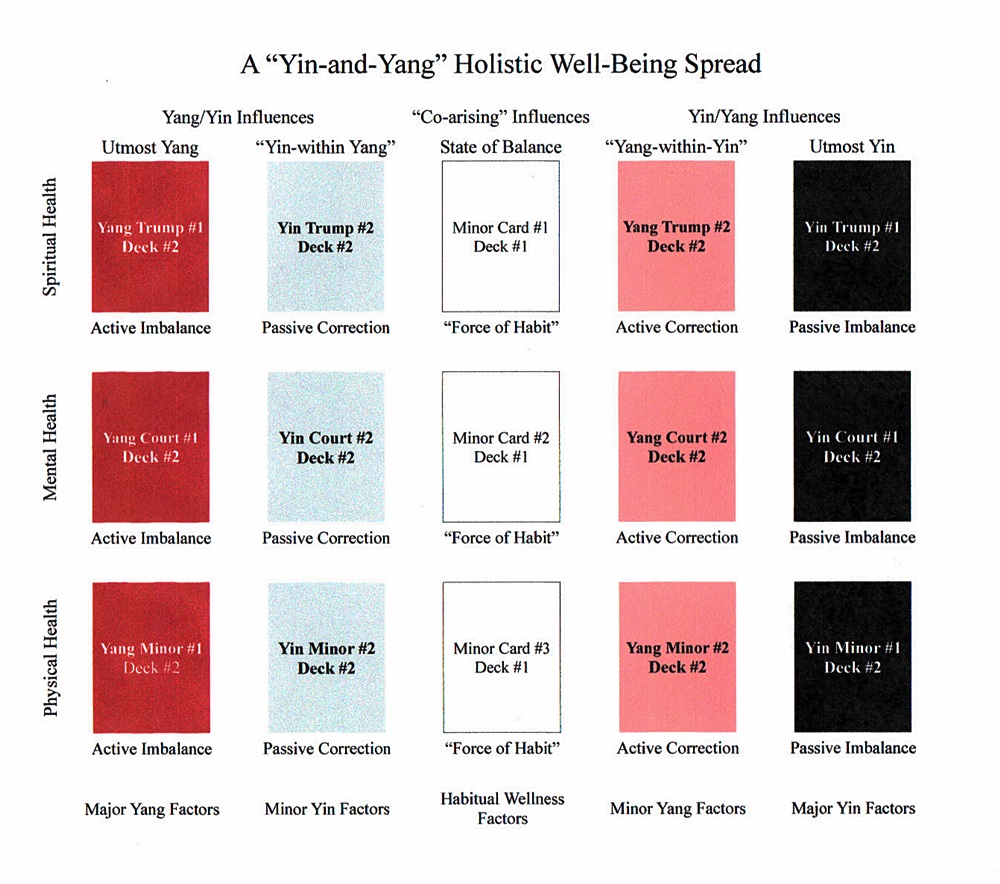
What you see in the layout is a redrawing of the two spiral halves of the Tajii as rectangle card positions showing the “Great Yang” (I used red for artistic purpose) and “Great Yin” as the primary influences that can actively or passively bias the well-being agenda, with their contrasting dots (the “within” positions) as counterbalancing emphases that come from deeper inside the matter. The middle column represents the curved line that divides the two, suggesting their complementary “co-arising” nature (which I’m using to describe how we habitually and routinely manage (or mismanage) our personal well-being “postures and practices” across the spiritual, mental and physical spectrum.
I anticipate some well-reasoned rebuttal to this initiative from Tao traditionalists since I went through the same internal dialogue before attempting it; it’s one of the more challenging syncretic exercises I’ve undertaken. I just gleaned a few more insights from The Tao of Thoth that bear inclusion here:
The book mentions the four “attainments” of Individuation; Absorption; Distinction; and Equanimity View. Relating these to the spread design, I can envision applying them to the principles of Ultimate Yang and Ultimate Yin as “Active and Passive Individuation,” respectively, expanding toward the frontiers of each in a linear way that can foster imbalance if overdone; to the “Yin-within-Yang” as “Absorption,” or drawing inward from the periphery in a centripetal way that seeks to mitigate headlong individuation and restore the calm, “centered” symmetry of balance; to the “Yang-within-Yin” as “Distinction,” or driving outward toward the periphery in a centrifugal way that strives to establish dynamic, “centered” movement as the foundation of balance; and to the “co-arising” state of balance ideally suggested by the middle column (depending on the nature of the cards drawn) as the “Equanimity View.” Taken in total, I believe this provides a “blueprint” for personal wellness that can be implemented though creative application of the tarot.
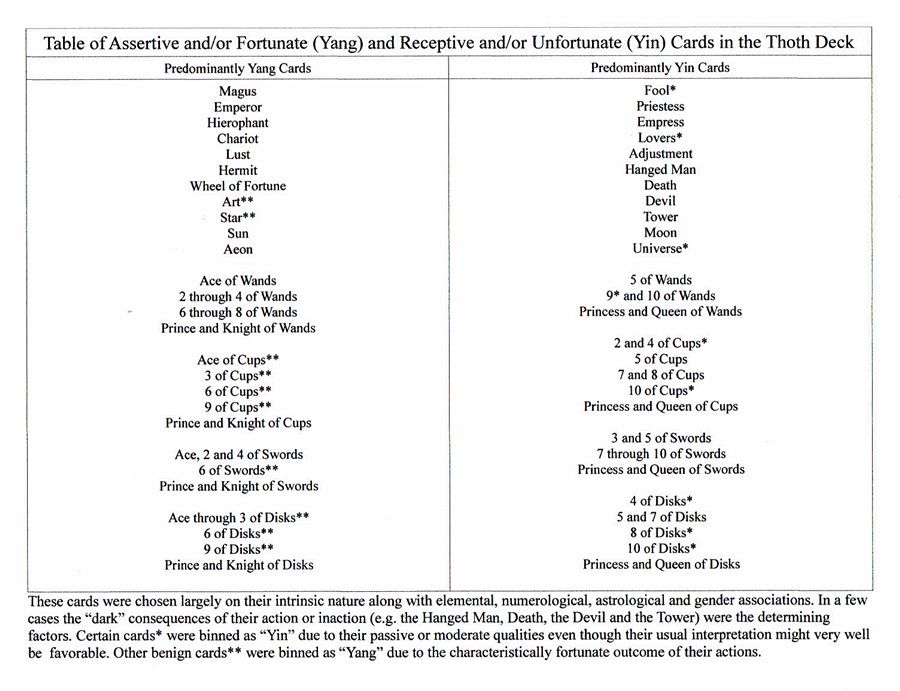
The guidance for using this spread is on the second page, and my table of “Yang-and-Yin Cards” for use with the layout is on the third page. You will need two decks that require a fair amount of preparatory work to subdivide them into “working” packs. Although it isn’t built into the spread, you can use the “quintessence” method to obtain a symbolic “roll-up” of the meaning of the five cards in each line; this can be helpful when the overall wellness impression provided by the individual cards is inconclusive.

 Parsifal's Wheel Tarot & Astrology
Pingback: “Wellness” Readings vs. “Illness” Readings: Innocent Until Proven Guilty | Parsifal's Wheel Tarot & Astrology