While reading an Amazon review of the gold-enhanced, 78-card Oswald Wirth deck (which I had been thinking of buying but now I’m not so sure), I happened upon the phrase “the initial sweep of the divinatory eye” in a criticism of the uninspired non-Wirth pip cards that drag this deck down. The author noted that the “long suits” of Batons and Swords are too delicate, even sketchy, to enable a quick, meaningful visual capture of the entire layout. This “first impression” scan is what I call the “gestalt” overview that enables me to quickly assess broad themes in the reading and focus attention on any “heavy hitters” that jump right out at me as I start the detailed analysis.
I’m always on the lookout for an inspired turn of phrase when reading about the tarot, and some of them make it into my own lexicon of divinatory terms (although it’s hard to beat the one-word German expression “gestalt” in this case). But it does raise the question “What is it about a deck that makes it ideally suited for that “initial sweep?” Is it bold images and colors? Is it simplicity of execution? Is it potent storytelling content? In my own experience, the Albano-Waite recoloring of the classic Waite-Smith Tarot is a great example of a deck that works splendidly for this purpose. Admittedly, though, familiarity breeds instant recognition and decks that depart from the more common pictorial presentation don’t fare as well.
One recent acquisition in the “RWS clone” category that I really appreciate for public readings is the Golden Art Nouveau Tarot. Its immediate visual appeal makes it highly approachable for the average sitter and extremely expressive for the reader.
A number of vividly-colored (and in some cases redrawn) versions of the traditional Tarot de Marseille deck also stand out in this regard, but imagination, inspiration and ingenuity must supply the narrative details. One exceptional example that I’ve reviewed in the past is the “Conver Ben-Dov” (CBD) deck, Yoav Ben-Dov’s reworking of the Conver TdM.
Here is sample reading using two particularly bright Fournier TdM decks showing how it might be done:
Those readers who know me as a Thoth fan might wonder why it doesn’t top my list. The answer to that, at least in part, is that after working with it for fifty years my responses to its imagery are so automatic it seldom makes me jump up and shout “Eureka! I’ve found the key!” If it weren’t for the evocative color palette and mood of the Frieda Harris minor arcana cards, I might lump it in with the TdM decks due to what are essentially its “glorifed pip” cards (which is not really that far from Crowley’s intent as stated in the “Bibliographical Note” at the beginning of the Book of Thoth). Some might also question why over-the-top “bling” decks like the Illuminati Tarot don’t do it for me, to which I reply that they are just too “busy and shiny” for me to take seriously; their sheer ornamental overload makes them opaque from a free-association standpoint.
All things considered, there are also a few non-traditional decks that give me the prompt revelatory experience I’m talking about. One that comes to mind is the Chrysalis Tarot, previously reviewed here (and I highly recommend it to those who want to step away from the usual):
Another interesting option (although in a dramatically different way) is Brian Williams’ Post-Modern (aka “PoMo”) Tarot, an imaginative and delightfully skewed take on 19th Century and early 20th Century art that manages to be both conventionally readable and refreshingly sarcastic. I love it for sociopolitical readings.
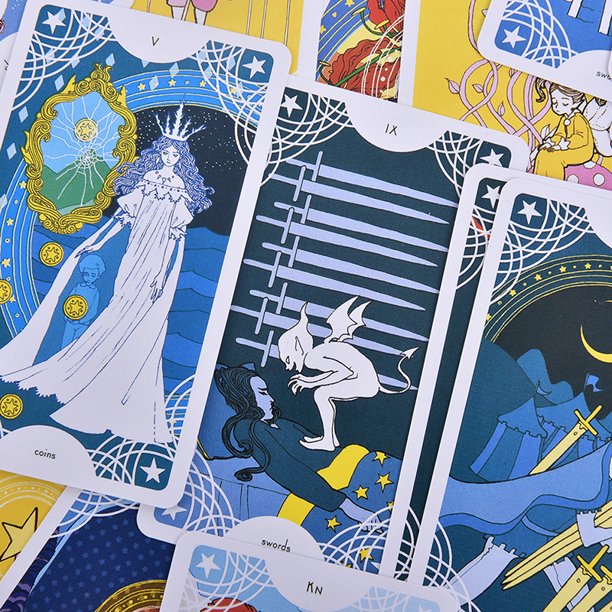
Finally, although I don’t usually warm up to “comic-book-style” decks as being entirely too trendy, one I just encountered in an r/tarot post that makes me sit up and take notice is the Star Spinner Tarot. The images have a little more artistic flair to them than the typically pedestrian, “pulp-y” style of most examples of the type. This is one I could work with due to its sprightly illustrative brio. That 9 of Swords, with its nod to Henry Fuseli’s painting “The Nightmare,” is a keeper! Also, although as something of a traditionalist I don’t obsess over sociological “inclusiveness” in my decks, this one has it front-and-center (but one unimpressed LBGTQ reviewer did carp that it is still largely “white and homonormative”). Who knows, although I’m too old for a complete ideological and attitudinal makeover, if I buy this it may even expand my consciousness in a small way (not that I don’t already have similarly-inclusive decks like the World Spirit, but this is one I might actually use since it reminds me of late-60s psychedelic poster art).
 Parsifal's Wheel Tarot & Astrology