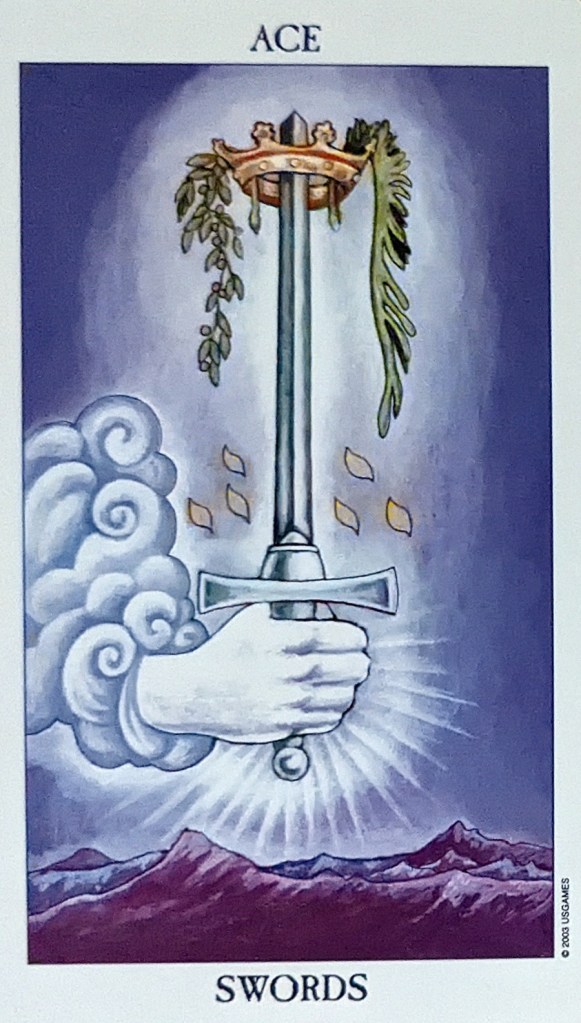
I recently realized that I never completed my discussion of the Swords minor cards as conveying “opportunity” rather than always showing us their unpleasant side. My goal was to explore how we might handle these cards in a constructive way and not merely wind up suffering their “slings and arrows,” whether outrageous or only irritating. In my essay on the 6 of Swords I noted that the Ace, Two and Four are basically neutral when it comes to actively pursuing this agenda, which is apparently why I never wrote anything more about them. Here I will briefly correct that oversight. (All images are from the Radiant RWS Tarot, copyright 2003, U.S. Games Systems, Stamford, CT.)
I usually consider the Ace of Swords the “bright idea” card, but in the realm of opportunity it is more about idly contemplating the notion of maybe entertaining some kind of incipient idea that might encourage pursuing an initiative without actually coming up with a proposed course of action that could conceivably lead to taking the first step. (Do you get the relentless theme of mentally working really, really hard to avoid the appearance of taking a stance or making a firm decision, or doing much of anything beyond thinking about it?) There’s a ton of untapped mental horsepower on-board but no incentive to twist the throttle and take it for a spin. It’s the acme of “ivory-tower” thinking: the “Grand Idea” purely for its owns sake, the ephemeral concept behind the abstract principle behind the experimental premise behind the practical application. Like all the Aces, it needs a “triggering” push to get it going. I’m reminded of Al Pacino’s line as Alphonse “Big Boy” Caprice in the Dick Tracy film: “‘I’m having a thought . . . It’s coming . . . It’s coming . . . It’s gone!” In short, I wouldn’t look here for inspiration if I were intent on “seizing the moment” in pragmatic terms. It has its uses in the “thesis” phase of the “Hegelian dialectic” but not much else. This can be the hedging card of rationalization as easily as the “Aha!” card of enlightenment.
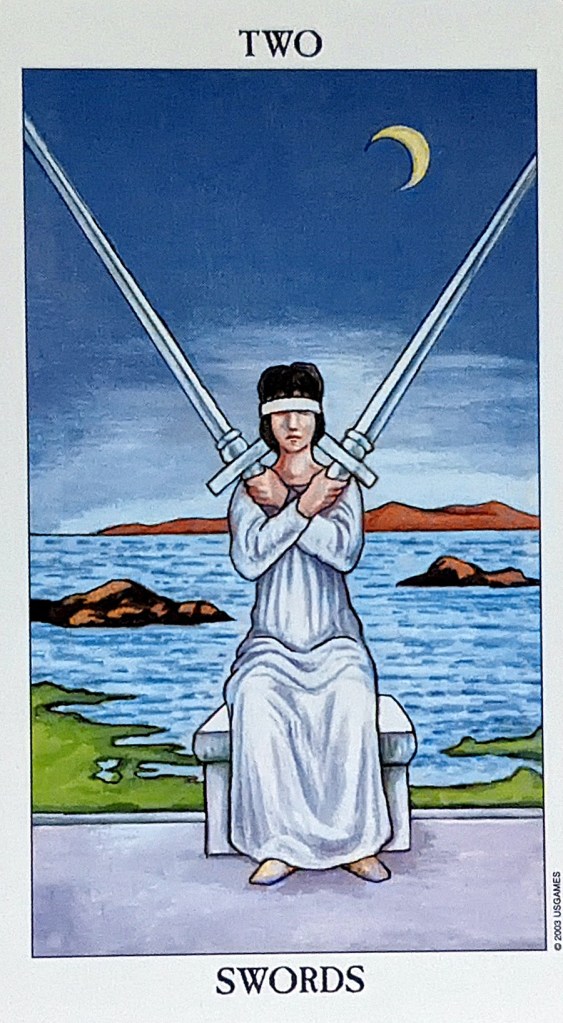
The 2 of Swords suffers from the same malaise exhibited by all of the other Twos: it’s neither here nor there but somewhere in-between. It can be inert to the point of invisibility; it suggests “vacillation” writ large. It may take a step in one direction and then immediately retrace that step going the other way. There is little opportunity to be found when the seeker is of two minds, neither of them particularly focused on results. It might be of use if one’s goal is to squirm out of being “pinned down” prematurely to an opinion or position (that risk looms larger in the 3 of Swords). I liken the Twos to a swinging pendulum; until they come to rest they are essentially a moving target, and once at rest they no longer partake of much cyclical “Two-ness.” This card reminds me of an argument or initiative being “mooted” or neutralized by other competing factors. Another useful analogy is mentally “tap-dancing” all around an issue and never quite coming to grips with it.
The 4 of Swords shows the height of mental immobility. It’s “not going anywhere, fast” and wouldn’t recognize an opportunity if the occasion were to stomp on it with both feet. The inertia of the image tamps down the already limited imagination of the number Four. Consider it the Ace of Swords on a “lower arc;” it has had a taste of conflict and has quickly ducked back into its foxhole to lick its wounds. “Mental paralysis” comes to mind; there may be a fortuitous thought buried inside but it needs to be pried out (which is the role of the 5 of Swords). Think of a legislative motion being “tabled” as a way to effectively kill it. This is the domain of the “Monday morning quarterback:” “I told you so but you wouldn’t listen!” So where lies the opportunity here? Perhaps only from a rueful “lessons learned” perspective, something that can be said of all the minor Swords (although the Swords court might ruthlessly “rub our nose in it”).

 Parsifal's Wheel Tarot & Astrology