I’ve just rediscovered Alejandro Jodorowsky’s unorthodox sequencing of the court cards and, although I still don’t fully agree with him, I now find more sense in his thinking. I decided to compare his vision side-by-side with Waite’s historical hierarchy and the Qabalistic premise of the Golden Dawn/Thoth model.
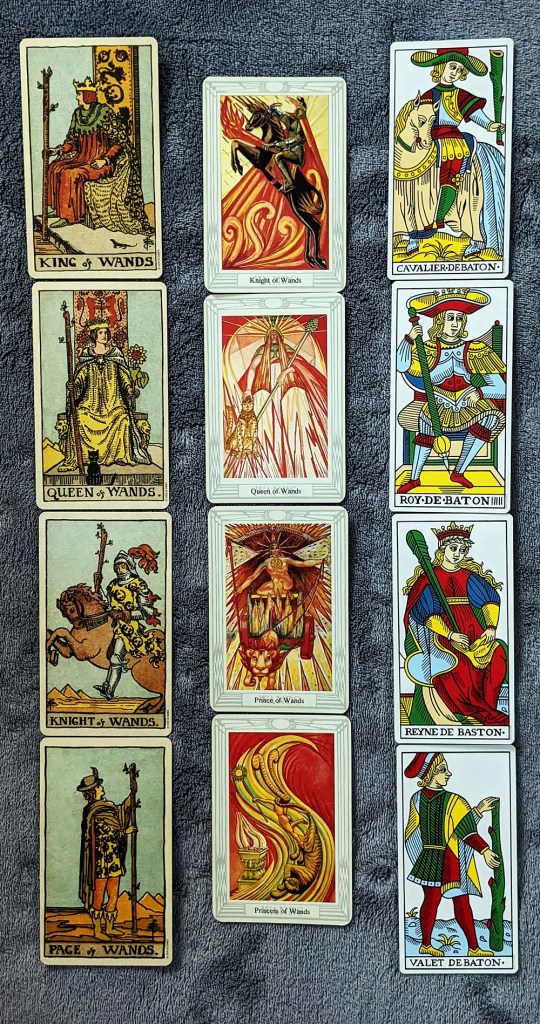
All images are copyright of U.S. Games Systems, Stamford, CT.
In the Waite-Smith universe, the King sits at the top of the heap as reigning monarch; the Queen is his consort, foil and helpmate; the Knight is his “right-hand man,” field general and enforcer; and the Page is the royal herald or perhaps a squire to the Knight. Waite didn’t get too imaginative with his commonplace definitions.
The Golden Dawn envisioned the mounted Knights, the most dynamic and therefore the most formidable members of the court, as the virile “new Kings,” supplanting the tired and toothless regimes of the “old Kings;” the Queens remain in place as consorts and perhaps “surrogate mothers” to the insurgent Knights (a whiff of Oedipal impropriety or maybe just Lancelot and Guinevere?); the Princes represent the “sons” and the Princesses the “daughters,” although it’s debatable whether they are the progeny of the “new” King or the “old” one. What is certain is that the Golden Dawn demoted the “old” Kings to the rank of the traditional Knights and redeployed them in less-mobile chariots, at first keeping the name “King” but eventually deciding on “Prince” (who could also be an “Emperor,” causing no end to confusion).
Jodorowsky considers the Pages to be “just dipping their toes” in their suit and not yet fully engaged in court activities (Jodo’s phrase is “standing outside the door” of the palace); the Queens on the inside fully inhabit their suit and are quite comfortable in it; the Kings gaze down from the parapet as masters of all they survey but all they do is look, they don’t venture outside of the castle to explore beyond the grounds; the Knights are the “movers-and-shakers” and sally forth as conquerors or at least as exemplars and ministers of their suit, which they soon surpass in the process, leaving the idle Kings in the dust as they move on to the next chapter in the imperial saga.
Jodorowsky agrees with the Golden Dawn on the energetic purview of the Knights as “alpha-male” territory but slides the Queens down the totem-pole to become de facto `”gatekeepers” of the palace that the Pages are about to enter and thus become “crowned” as Queens themselves. It’s not clear how two Queens at court will work out in his pecking order since it doesn’t appear that the current one is going anywhere; perhaps that is the central conflict between Jodorowsky’s Pages and Queens in that one wants to usurp the place of the other. The Pages are youthfully rambunctious and ambitious while the Queens are settled and therefore complacent. Maybe the Knights need to defuse the situation by enlisting the Pages as their squires and taking them on campaign. While this drama is going on, the ineffectual Kings are sunk in reveries of past glory and stay out of the spotlight.
In summary, while all three viewpoints are patriarchal, Waite is the most traditional, the Golden Dawn stirs the pot a little, and Jodorowsky takes it a step or two further. I’m a Thoth guy and prefer Crowley’s proto–psychological “moral characteristics” to any of this hierarchical stuff but if offered a (non-binding) choice I would select the Golden Dawn paradigm that Crowley adopted, as strained through the Thoth filter. It can be difficult to assign modern behaviors and attitudes to the rest for any practical purpose.
 Parsifal's Wheel Tarot & Astrology