AUTHOR’S NOTE – Question: What tarot concept involves zodiacal elements, English proverb, folklore, Shakespeare, Dickens, the Archangel Gabriel, yard maintenance and meteorological metaphor? Answer: This spread, obviously.
English idiom: “It’s an ill wind that blows nobody good.”
I’ve always felt that this proverb can be easily misconstrued as an ironclad guarantee of misfortune (e.g. “no good whatsoever can come of it”) when it is actually an equivocal statement meaning that even a very bad situation must have some good results (for somebody). As might be expected, Shakespeare delivered it from obfuscation by restating it in Henry VI as “Ill blows the wind that profits nobody.” It could be clarified further to read: “A foul wind will always blow fair for someone.” (I recall the time years ago when I saw a man raking autumn leaves in his small yard while a stiff wind was blowing toward his neighbor’s plot; he was flipping them up in the air and letting the wind carry them over the property line so he wouldn’t have to bag them.)
In the Charles Dickens serial novel Bleak House, one of the main characters – John Jarndyce – is fond of declaring “The wind is in the East” every time he smells trouble brewing, real or imagined. (It is a folkloric tradition that a wind blowing from the East is unfortunate.) In my own case, a Northwest wind is often my friend because it blows most of the dead leaves off the lawn and into the woods (think of it as “Gabriel’s leaf-blower”), even though it almost invariably brings unsettled weather followed by clear skies and much colder temperatures.
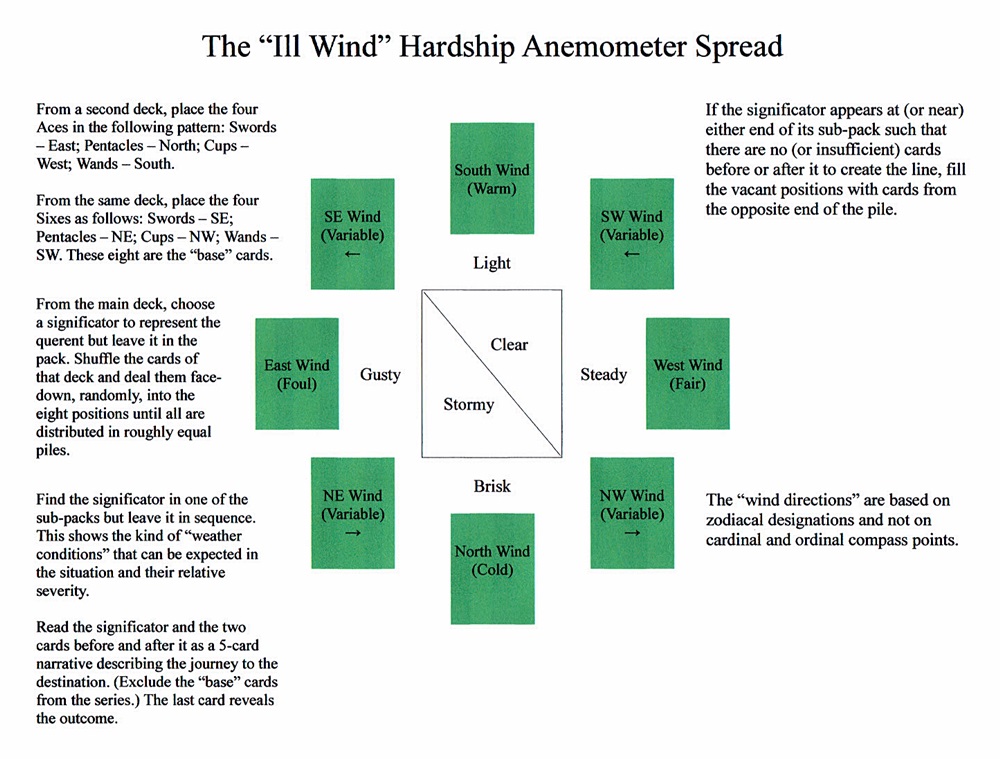
I used this premise to create a spread based on the zodiacal quadrants and the assignment of the elements Air, Earth, Water and Fire (represented by their customary tarot suits of Swords, Pentacles, Cups and Wands) to the four cardinal directions of East, North, West and South and their four ordinal subdivisions. I can see two potential uses for this spread. When some kind of difficulty is known or suspected to be imminent, a reading can be done to see how challenging it might become. On the other hand, for people who currently enjoy stable circumstances but are always “sniffing the air” for any hint of upset, a general “life-reading” can be performed to look at future considerations in a “climatic” way.
The idea is to select a significator in advance to represent the querent, then shuffle and deal the deck to see which of eight “weather systems” the significator appears in; the three easternmost zones could be unpleasant for the querent, while the three to the far West should be much more agreeable, and the North and South extremes suggest either bracing or balmy “stationary fronts.” This leads to a five-card reading that shows how uneventful or, alternately, how uncomfortable the querent’s travels through the exigencies of the matter will be and the outcome that is likely to emerge.

Images are copyright of U.S. Games Systems, Stamford, CT; used with permission under the provisions of Fair Use.
 Parsifal's Wheel Tarot & Astrology