I recently reconnected with an idea I had forgotten about from my previous studies: adding together the integers of certain sets of three consecutive numbers from One to Nine (and, if necessary, refining the sum through “Theosophical reduction”) will always yield the number Six. The same is true of the double-digit trump cards, and actually of all higher numbers taken in discrete triplets. (The key is to maintain the internal integrity of the sets; for example, 3+4+5 does not reduce to 6. Significantly, double-digit totals prior to reduction are always separated by a value of nine: 15, 24, 33, 42, etc.) The pattern look like this:
1+2+3 = 6
4+5+6 = 15; 1+5 = 6
7+8+9 = 24; 2+4 = 6
Wheel of Fortune (10) + Strength/Justice (11) + Hanged Man (12) = 33; 3+3 = 6
Death (13) + Temperance (14) + Devil (15) = 42; 4+2 = 6
Tower (16) + Star (17) + Moon (18) = 51; 1+5 = 6
Sun (19) + Judgement (20) + World (21) = 60; 6+0 = 6
22+23+24 = 69; 6+9 = 15; 1+5 = 6
25+26+27 = 78; 7+8 = 15; 1+5 = 6
. . . and so forth, ad infinitum
This paradigm places the Six (and by extension its association with the Sun) at the conceptual center of each of these mini-series as a source of “inner illumination.” The theory aligns perfectly with the numerological model of the Qabalistic Tree of Life, in which the sixth (Solar) sphere – Tiphareth – sits at the interior nexus of the eight contiguous emanations (“sephiroth”) as a kind of “gatekeeper,” communicating directly with all of them and correlating their energies. Its title is “Beauty” and it expresses idealized harmony and equilibrium. We could say that, in a general sense, the underlying “theme” of each number series described above is informed by this integrative synthesis of forces through union. Six is above all an expression of perfection and completion followed by repose, and also of generation. In the devolving esoteric hierarchy of the tarot “pip” cards, the Six represents a brief, restorative “rest stop” on the path to self-realization in the Ten that can degrade into inertia and complacency if allowed to become entrenched.
Although it is pretty much lost in the prosaic images of the Waite-Smith deck with its “narrative vignettes,” this concentration of generative power is captured with reasonable authenticity in the Sixes of the Thoth deck, in which Crowley and Harris stayed true to his original intent to “execute a pack after the tradition of the Mediaeval Editors” (by which the evidence suggests he meant the Tarot de Marseille). Even in the suit of Wands, which is more “projective” than “collective,” they managed to convey the potency of the central fire that emanates from the “heart of the Sun.” (He used it in a different context, but Alejandro Jodorowsky’s mention of the “Christlike ideal of the flaming heart” seems applicable since Tiphareth is the “Christ-center” on the Tree of Life; but here the flames are more banked than intense). While the Sixes in Qabalistic terms embody the idea of “Harmony Restored,” their fertility also provides the “convenient soil” (Crowley’s evocative phrase) for further growth.
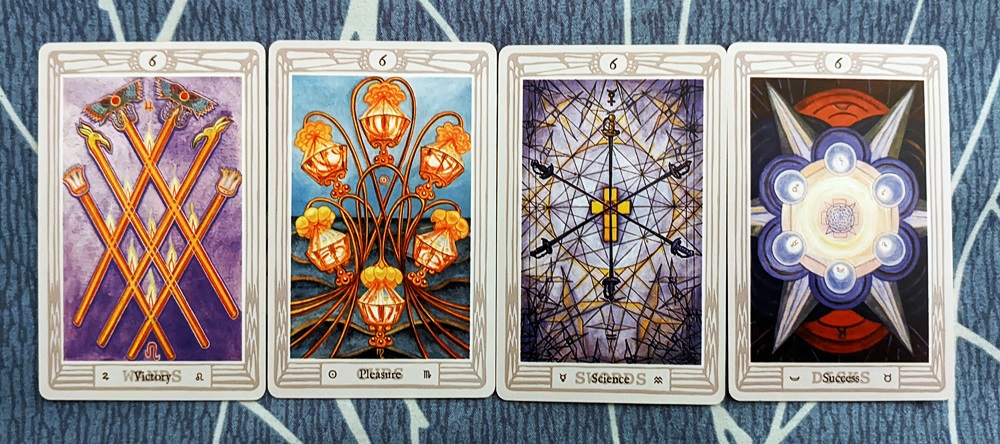
This pervasive, harmonious accord makes it understandable that cultural anthropologists would suppose that all modern religions in temperate zones find their roots in primeval Sun worship. The Sun is the source of all life and comfort (especially in colder climates) and, when it gradually receded in the heavens during the winter months, existential malaise descended upon the irrational human mind as the darkness triumphed. Its miraculous resurrection after the solstice was thought to be the result of devout supplication. The opposite of this premise also explains why tropical peoples – for whom the Sun is a constant presence – have more polytheistic animal, forest and volcano gods than the austere, monotheistic solar kind that periodically deserts the faithful and must be lured back (in fairness, primitive tropical cults retained their own forms of appeasement and atonement – e.g. ritual sacrifice – long after more advanced civilizations had moved on to symbolic pageants and prayer).
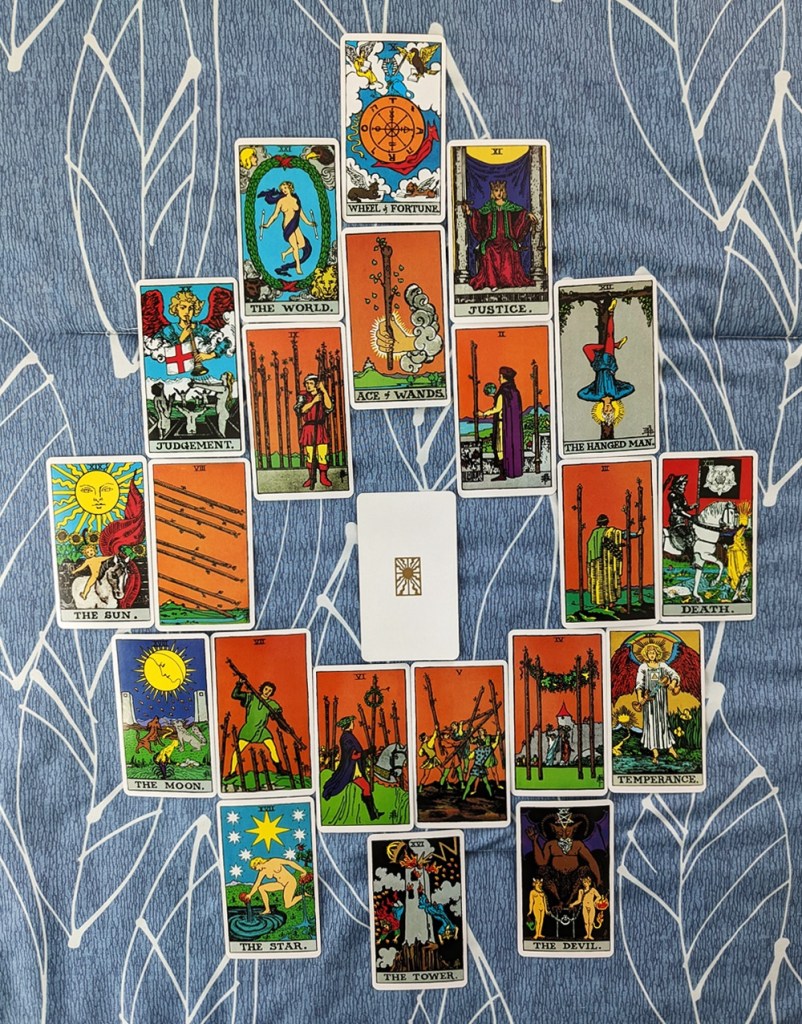
We can make an intriguing tear-drop-shaped mandala out of this array (in this case for the Wands), with the “solar emblem” on the Albano-Waite card-back serving as the “centerpiece.” With a little imagination we can even bring Jodorowsky’s “decimal equivalents” into the picture. For example, “10” (Wheel of Fortune) is a numerological counterpart of “1” (the Aces) through Theosophical reduction; “11” (Justice”) is a counterpart of the Twos through the same reductive process; similarly, “12” (the Hanged Man) is a numerical counterpart of the Threes; “13” (Death) matches up with the Fours as “1+3.” Using a different decimal premise, the “3” in the “13” of Death can also be correlated to the Threes; the “4” in the “14” of Temperance can be associated with the Fours; the “5” in the “15” of the Devil can be linked to the Fives, and so forth. The visual continuity holds true until we get to the trumps beginning with “2,” in which case Judgement relates to the Twos and the World to the Threes through reduction; however, the “1” in the World might be considered to correspond with the Aces, leaving only one “orphan” that finds its correlative in the Fool.
I’m not sure all of this has any practical usefulness, but it makes for a fascinating exercise. One way I might apply it is to fashion an allegorical “story” out of each mini-series with the “moral” being the pursuit of enlightenment and satisfaction via the three-fold evolution infused with solar inspiration, which could be viewed as “action/reaction/resolution” or in Hegelian terms as “thesis/antithesis/synthesis” that pivots on the fulcrum of the Six.
 Parsifal's Wheel Tarot & Astrology