AUTHOR’S NOTE: An interesting discussion on one of the Lenormand Facebook pages led me to a new perspective on the diagonal series of cards in a 3×3 tableau. I will use the example spread from my previous post for this discussion.
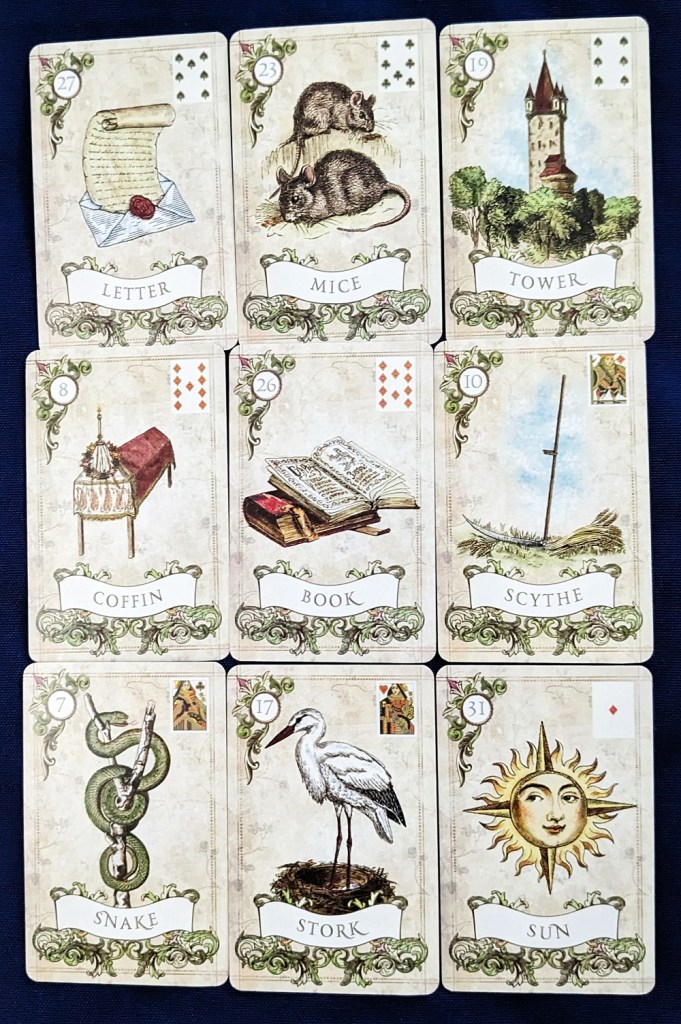
The “central conflict” in this reading involved differing views of “access to education” in the American (meaning US) public university system. The US Supreme Court (represented by the High Tower) was the “arbiter” in this case and the adversarial forces are represented by the Snake at the opposite end of one of the diagonals, with the Book as the “bone of contention.”
The first diagonal, Letter + Book + Sun shows a clear progression, suggesting that the high court’s ruling (Letter) regarding access to education (Book) will stand largely as written (Sun). I typically read Lenormand spreads from left-to-right, so this line is straightforward. However, a question was put to me regarding how I read the second diagonal: does it start at the bottom-left or at the top-right? One or the other would result in a different interpretation.
My answer was that, to be consistent with my normal practice, I would read it as Snake-Book-High Tower, although I know that some readers would approach it as High Tower-Book-Snake, with enemies of the court “holding all the cards” in the matter. It depends on whether you follow a side-to-side or a top-down flow but my belief is that, if the rest of the narrative progresses from left-to-right, changing it up in this one instance kind of goes against the grain (which may not be entirely unjustified if the cards are radically different in import from the other diagonal; however, that’s a topic for another time). There is also Andy Boroveshengra’s idea — lifted from his Grand Tableau guidance — that the card at the top-right corner of the layout is the most significant card in the reading and the dominant conclusion gravitates in that direction, which supports my own assumption that the Supreme Court is indeed “in the driver’s seat” here.
But this is worth discussing further. Perhaps when the cards at opposite ends of a diagonal are adversarial and both are focused on the objective of the central “topic” card, the direction we read them in is less important than their individual stance in the matter. Here the “eldritch force” (aka “established authority”) of the High Tower is pitted against the “contrarianism” of the Snake, and both have different views of what “access to education” (Book) means. In the first diagonal there is a clear progression, in the second the cards are at odds so it’s more of a “tug-of-war.” I think in this instance there is certain to be more legal wrangling on the horizon; the high-powered constitutional lawyers are already seeing dollar signs.
 Parsifal's Wheel Tarot & Astrology