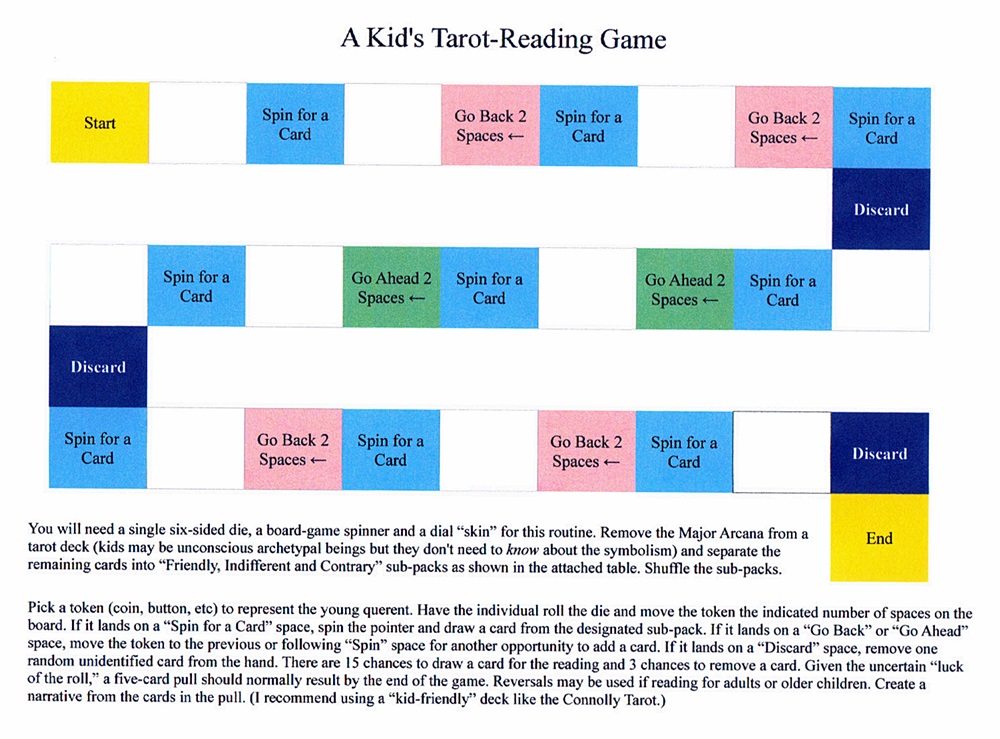
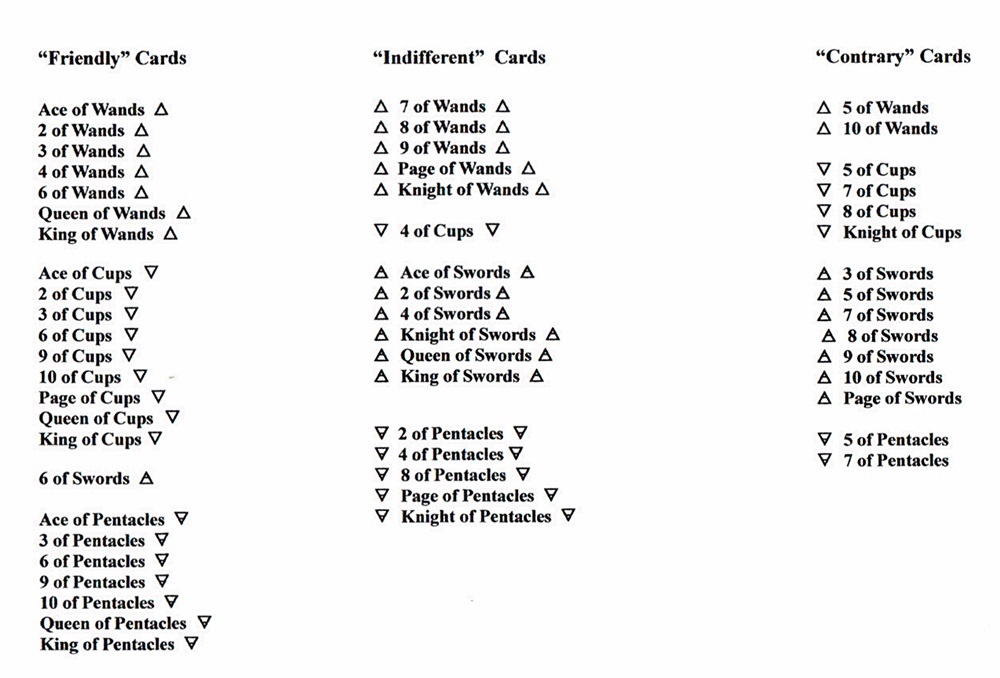
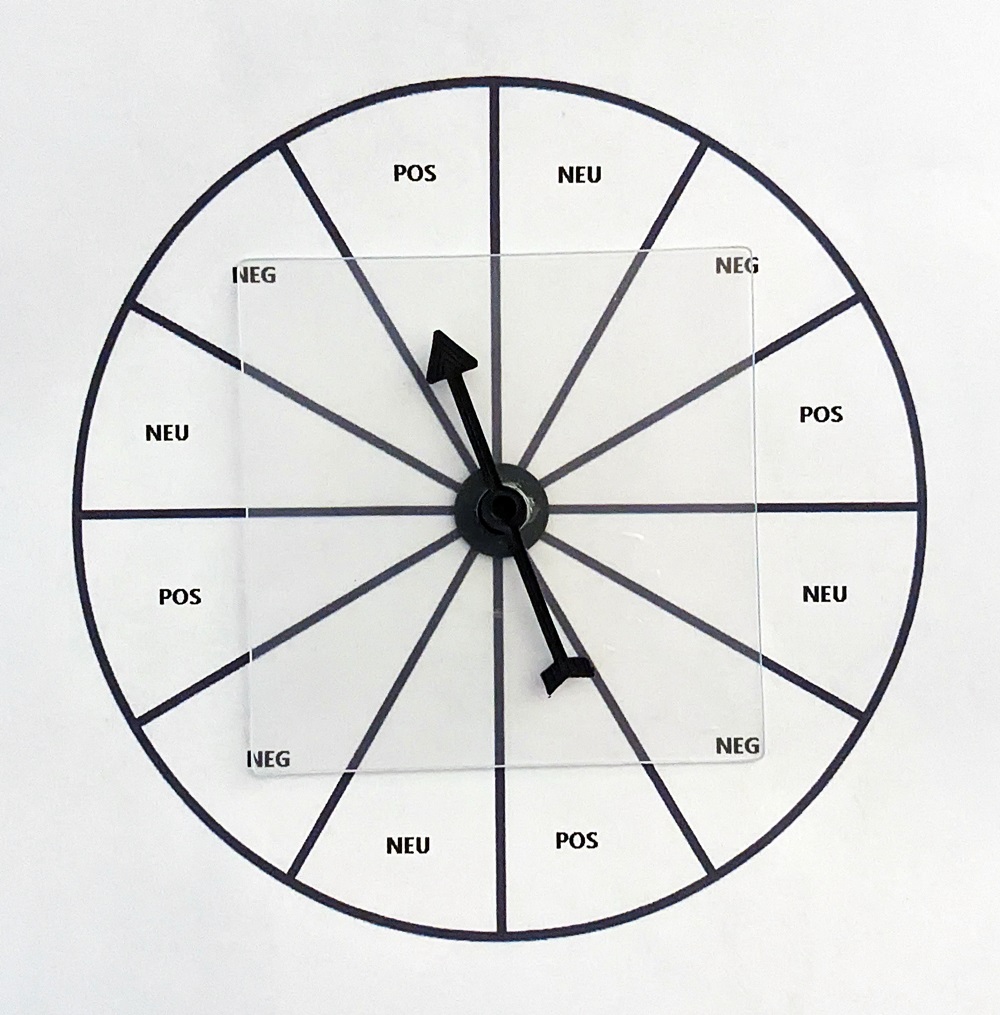
AUTHOR’S NOTE: I’m always looking for novel ways to read the cards for young people that will get them involved in the process and hold their interest. Here is a board-game motif that invites them to roll a die and move a token on the board to select cards for the reading. It requires a single six-sided die and a board-game spinner along with a segmented dial “skin” or pattern similar to the one shown below. I’ve restated the “Positive, Neutral and Negative” card associations from my standard table – which are skewed toward the affirmative – in terms of “Friendly, Indifferent and Contrary” for the purpose of this reading (see the second scan); you can employ any other qualitative model you choose to create discrete populations. (For Lenormand enthusiasts, this technique can also be used with the established positive, neutral and negative qualities of those cards.)
I decided to exclude the Major Arcana because the very young have no intellectual grasp of archetypal symbolism and it would be useless to try explaining it in simple language. On the other hand I left the court cards in because a child’s experiences are largely governed by the adults and older siblings in the immediate vicinity. I would restrict the use of reversals to teenagers and grownups. If you don’t have a board-game spinner (which is mainly an interactive prop), keep the 56 court and minors cards in a single pack and encourage involvement by having the subject pull cards at random when prompted by the roll. Just make sure you’ve thoroughly randomized them.
I suggest using a “kid-friendly” deck like the Connolly Tarot with its non-threatening images, although there are others that are even more innocuous. I’m hoping that the design will yield no more than a five-card pull most of the time, given the uncertain “luck of the roll.” If it doesn’t, I’ll go back to the drawing board since this is a work-in-progress that will most likely change. If you hit a “Discard” space before you have any cards in hand, ignore it; they aren’t retroactive. Similarly, if you arrive at the end with no cards to read due to uncooperative rolls, just start over.
My first trial run gave me three cards – two “direct hits,” one “backtrack” and no “discards” – which is not an unreasonable number for a reading of this type. However, several subsequent trials with one die gave me eight cards on average, and sometimes more, which is too many for a basic narrative. I switched to two dice but repeatedly came up with no cards because every roll “fell between the cracks.” Short of tinkering with the design (which I will probably do anyway), it may be best to use a single die and stop rolling as soon as you hit five cards; any more would be “information overload.”
 Parsifal's Wheel Tarot & Astrology