AUTHOR’S NOTE: Accurately predicting the time of occurrence for unscheduled events or the rise of unplanned circumstances is one of the thorniest challenges in divination. I still think the best way to pose timing questions is simply to ask “What will happen in my <insert situation here> over the next <week/month/year>?” However, it is possible to impose certain rational “filters” on any temporal forecast that isn’t completely open-ended. I call it “passing the giggle test;” if we don’t laugh out loud when we receive a projection of “ten years out” for something that will undoubtedly occur much sooner, we’ve lost touch with the reality of the situation. (Unless, of course, the cards are merely trying to tell us that the event will never happen but they don’t have a way to say that directly.)
If there ever was a justifiable excuse for getting “weasely” with our predictions, event timing is a prime example. I’ve tried every method I could find and have created a few of my own, all with uniformly unreliable results. I’ve concluded that the best we can do is come up with a sensible range that takes into account the nature of the expected incident when that is known or can be deduced. Within the indicated span we can then bring to bear the evidence provided by the placement of certain significant cards. As always, my work here is experimental and leans toward the empirical rather than the mystical.
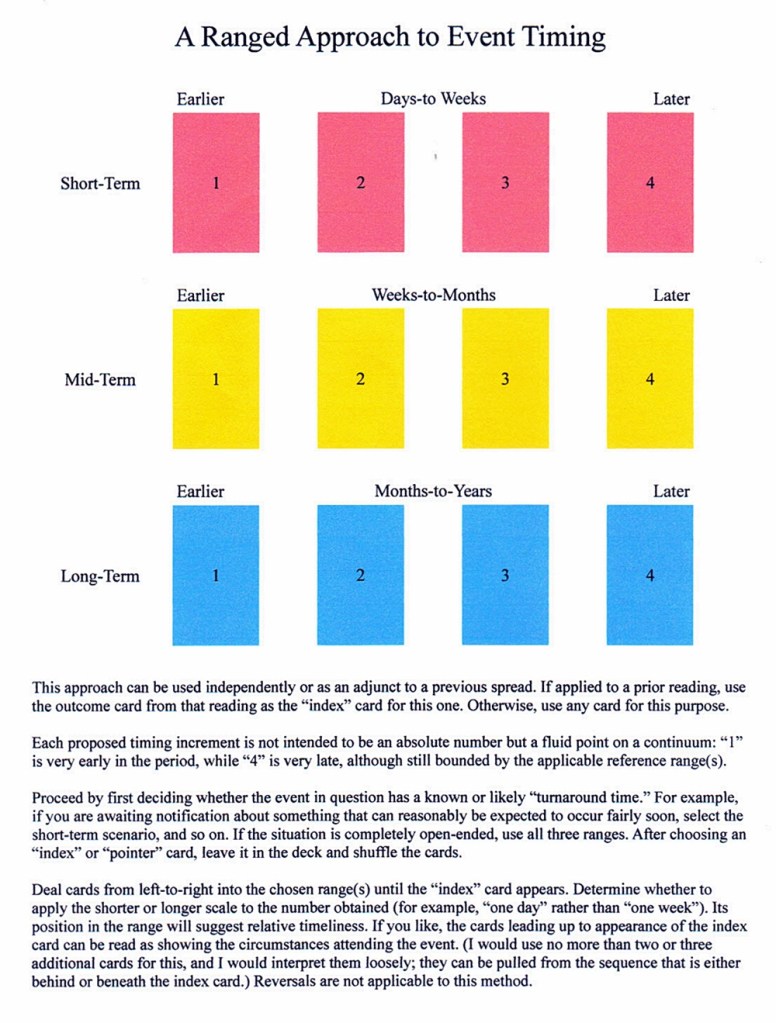
This spread is my latest attempt to inject some reason into the process without trying to make it overly prescriptive. In my experience the timing assumptions connected with suit or element, zodiacal attribution and rank don’t add much value, and those associated with number are only marginally more useful, so I’ve dispensed with all of them and have gone with the concept of a “pointer” card that lands within a range of timing increments. The reader must then decide which scale makes the most sense under the circumstances (days-to-weeks; weeks-to-months; months-to-years) before attempting to speculate. These are the same distinctions one confronts when dealing with the timing aspects of the Celtic Cross spread. As long as the querent has a hand in the prophecy (typically by shuffling the cards – the “subconscious induction” premise – and assisting with the judgment call), this outlook is no more prone to error than any other random prediction made with the tarot cards, it just has less narrative padding to support it (unless we opt to use the adjacent cards to tell a background story as described in the spread guidance).
 Parsifal's Wheel Tarot & Astrology