AUTHOR’S NOTE: I’ve been reading about the origins of the esoteric alignment between the 12-year Chinese zodiac/calendar and the eight trigrams of the I Ching, and I was struck by the notion that – with twelve “branches” and only eight trigrams resulting in an apparent ideological disconnect – there may be a more symmetrical formulation.
At one point in the development of ancient Greek astrology, an eight-segment “octile” house system was created. The system was based on 45-degree subdivisions of the 360-degree circle that were intended – as with all house systems – to describe mundane circumstances. I was unable to find anything conclusive about how it was used (for example, how was the twelve-sign and eight-house disparity reconciled?) so I created my own model inspired by German Cosmobiology. (Excuse the poor image quality; it was hand-drawn many years ago on the back of a blank horoscope form, but it did “clean up” a little better in the second example.) The labeling of the various features was based partly on “New Age” appropriation of Jung’s psychology and partly on my own experience with Marc Robertson’s Cosmopsychology: The Engine of Destiny and Dane Rudhyar’s eight-phase Lunation Cycle that motivated Robertson.
If we were to superimpose the “natural” (Aries-rising) astrological signs on this wheel, Houses 1, 3, 5 and 7 would begin at zero degrees of a Cardinal sign and end half-way through the succeeding Fixed sign, while Houses 2, 4, 6 and 8 would begin at 15 degrees of Fixity and end at 30 degrees of Mutability. The planets would be entered according to the degree of their sign placement at the time of the inquiry and would take on the qualities of the resulting house. This agrees with the Cosmobiologists’ assumption that 45 degrees is a critical, action-oriented angle for showing any kind of concrete (as opposed to purely theoretical) testimony in a horoscope; it was called a “hard” angle for that reason.
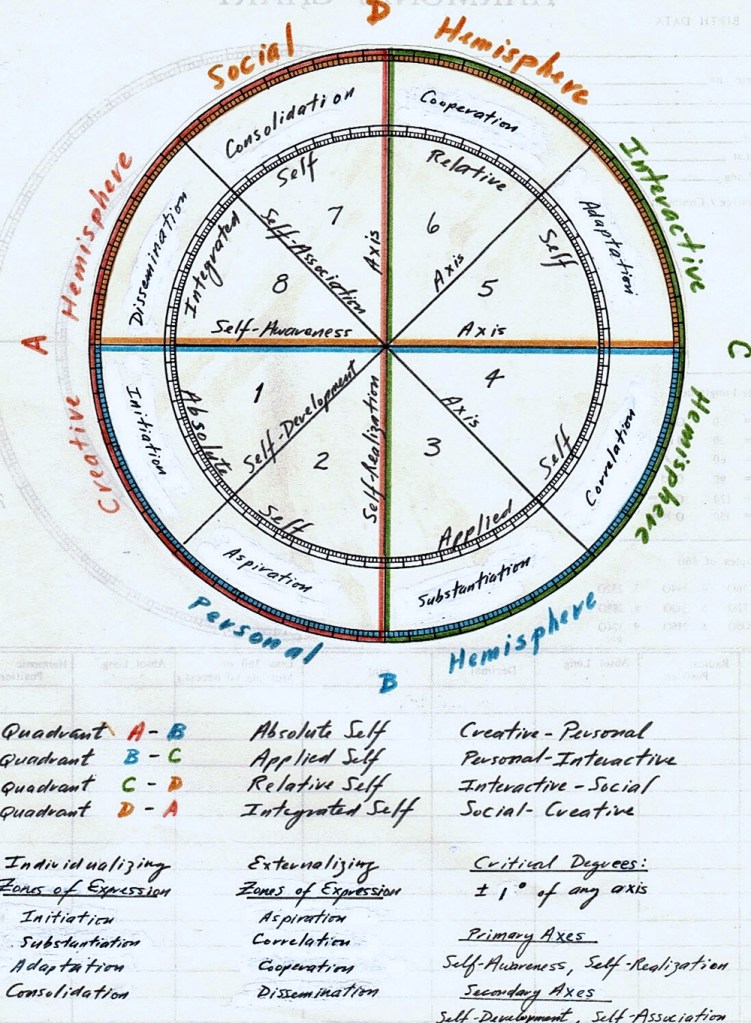
But my purpose here is not to explain this unique horoscope, but rather to map the eight trigrams onto it in the form of derived hexagrams and see what happens. Because I intended to bring in the “triplicity” (Cardinal, Fixed and Mutable) of the signs that jointly occupy each “octile” house, I had to become creative in figuring out which trigram to assign to each one, and some had to do “double duty” (or even “triple duty”) as either dominant (upper) or subordinate (lower) components in order to devise eight representative hexagrams. In doing so I applied a large helping of inspiration, imagination and ingenuity that draws on the four fundamental elements of Empedocles and has little to do with classical I Ching scholarship, in which case I’m afraid my inexperience with the latter is on full display. For example, I’m playing a bit “fast-and-loose” with the dual attribution of “Wind” and “Wood” as it suits my design. (This is where the informal “syncretism” emerges). The I Ching content herein is from the Wilhelm-Baynes translation, copyright of Princeton University Press, Princeton, New Jersey.
The Cardinal signs were easiest: Aries is clearly Li (Fire); Cancer is undoubtedly Water (K’an); Libra is rarefied Air (Ch’ien/Heaven); and Capricorn as intractable Earth can only be Ken (Mountain).
Among the Fixed signs, Taurus is the quintessence of Earth (K’un); Leo is a second iteration of Li, this time as a lower trigram; Scorpio is a Water sign but it has a powerful affiliation with energetic Mars, so Chen/Thunder seems to make sense; Aquarius is the subordinate Air sign in the 7th and 8th octiles and suggests Sun as “Wind.” (Note that the Fixed signs are never dominant, befitting their transitional, equipoised nature.)
The correspondences for the Mutable signs are even trickier. Gemini is an Air sign but I’ve already used all of the the “atmospheric” trigrams, so I’ll get clever and say that, since Gemini is often restless and capricious, Sun as “Wind” deserves to make a second appearance; Virgo is a less obdurate Earth sign than Capricorn, so Sun in its “Wood” mode looks like a reasonable choice (although, given the facile nature of Mutability, we might concede that Virgo has “Wind in the back-seat”); Sagittarius is a Fire sign, so Li is the only possible candidate; and placid Pisces takes the last trigram, Tui (Lake). These are far from perfect, but we’ll see how they work out.
The First House is both angular in function and predominantly Cardinal Fire with a secondary emphasis of Fixed Earth, so two trigrams would be assigned to it, creating a hexagram. I believe it would be best to place the trigram for the dominant element in the “above” position of the hexagram and the one for the subordinate element in the “below” position. Thus, we would have Hexagram 35 (Chin; Progress), Fire over Earth as the first “octile” figure.
The Second House is collateral in function and predominantly Mutable Air with a secondary emphasis of Fixed Earth. With Sun as “Wind” in the upper position and K’un as “Earth” in the lower position, we have Hexagram 20 (Kuan; Contemplation), Wind over Earth.
The Third House is angular in function and predominantly Cardinal Water with a secondary emphasis of Fixed Fire. The resulting figure is Hexagram 63, (Chi Chi; After Completion), Water over Fire.
The Fourth House is collateral in function and predominantly Mutable Earth with a secondary emphasis of Fixed Fire, producing Hexagram 37 (Chia Jen; the Family); Wood over Fire.
The Fifth House is angular in function and predominantly Cardinal Air with Fixed Water as a secondary emphasis. Joining them produces Hexagram 25 (Wu Wang; Innocence; The Unexpected), Heaven over Thunder.
The Sixth House is collateral in function and predominantly Mutable Fire with a secondary emphasis of Fixed Water, yielding Hexagram 21 (Shih Ho; Biting Through), Fire over Thunder. (This suggests the tenacity of Scorpio.)
The Seventh House is angular in function and predominantly Cardinal Earth with a secondary emphasis of Fixed Air. This pair creates Hexagram 18 (Ku; Decay, subtitled Work on What Has Been Spoiled), Mountain over Wind. (I’m reminded of the alchemical principle of “putrefaction.”)
The Eight House is collateral in function and predominantly Mutable Water with a secondary emphasis of Fixed Air, generating Hexagram 28 (Ta Kuo; Preponderance of the Great), Lake over Wind. (Alchemically, this might be construed as “Completion of the Great Work” by metaphorically refining and transmuting prosaic tenets into philosophical gold. See my series of essays on the tarot and the seven stages of alchemy.)
Here is what it looks like cleaned up with the hexagram numbers and titles inserted into the octile pattern. (I Ching correspondences are in red.) Now all I have to do is figure out what it all means in pragmatic terms (if anything, but at least it’s an intriguing exercise).
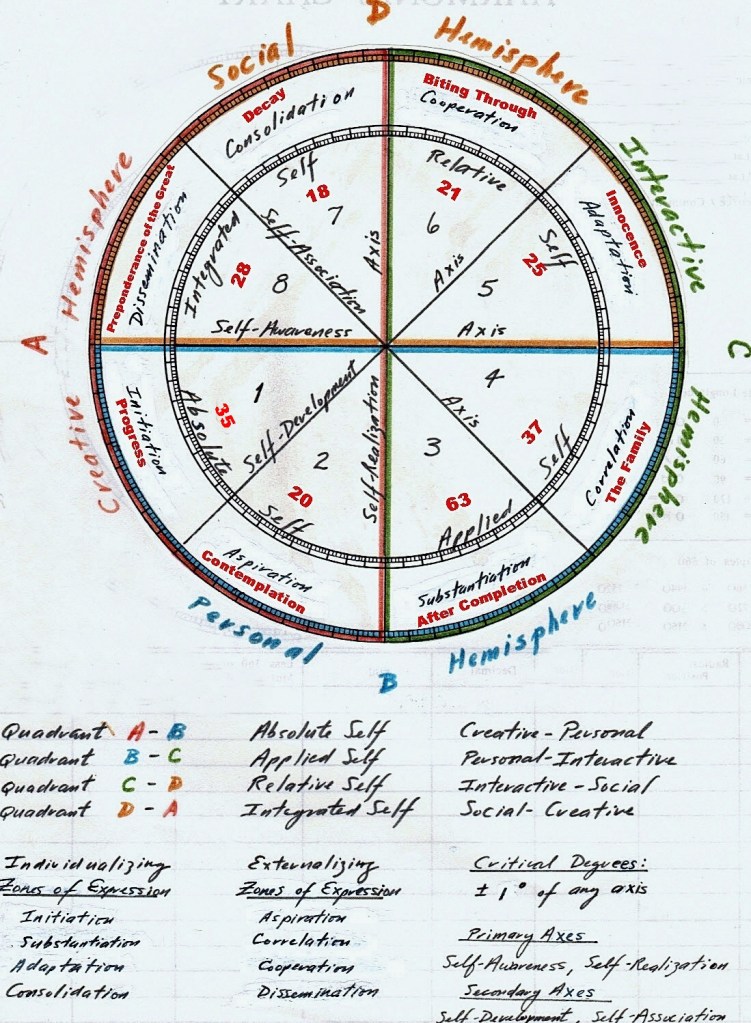
To use this model in practice, I would cast the Ascendant and Midheaven points for a typical horoscope, place them on the primary axes of the octile map and move clockwise and counterclockwise from each one to find the midpoint between them (which in most cases will not be exactly 45 degrees). I would place these degrees on the secondary axes, situate the planets in the chart and then derive the trigrams and hexagrams for each octile according to the above reasoning. This will link I Ching concepts to the astrological factors in a novel way that can be treated as supplemental information for character analysis or situational discovery. The result may not be as symmetrical as the baseline layout but there should be a distinction between dominant and subordinate signs that will make it workable. Only time will tell.
As a footnote, there may also be some insight to be gained by looking at polar opposites on the wheel. If there are planets at both ends, their interaction could very well follow this script (or something like it depending on the hexagrams present in the “octiles” of an actual horoscope). For example, House 1 (Progress) leads to House 5 (Innocence). Hmm, it suggests “growing into the Fool’s shoes.” House 2 is paired with House 6 such that “Contemplation” kicks off a firm and vigorous response via “Biting Through” any obstacles (aka “think first, act later”). House 3 is balanced by House 7: After Completion comes Decay. House 4 aligns with House 8, reminding me of our annual family Christmas party (the “great in girth” assemble).
 Parsifal's Wheel Tarot & Astrology
Pingback: Trumps and Trigrams: A Syncretic Exercise | Parsifal's Wheel Tarot & Astrology
This was a great post on astrology! I’ve learned a lot from you, so I just wanted to thank you, really.
Btw you should check out this astrology reading. It’s super accurate and tells you about your personality, relationships, and your purpose in life: https://bit.ly/3K4Li7o
LikeLiked by 1 person