AUTHOR’S NOTE: When I was employed as a Purchasing Manager for a utility power-plant, the Maintenance team used to say that there was no wizardry involved in keeping the facility’s operating equipment running smoothly as long as they had the right parts and the right skills. This attitude led to the adage “Parts is parts” (cribbed from the old Wendy’s commercial), meaning that in this context there was nothing unique about their procurement, it was just one facet of “business as usual.” The “parts” I’m talking about here are character traits as defined by astrology, tarot and the I Ching.
As you’re aware, I’ve been reading Benebell Wen’s I Ching, The Oracle: A Practical Guide to the Book of Changes, and I just encountered her discussion of the “Personality Profile” system of therapeutic counseling credited to Dr. Michael McDonald, who used the I Ching in connection with his work in transpersonal psychology. Here I’m employing astrological principles and tarot cards in lieu of hexagrams, but I will “back-door” a little I Ching into the mix as an option at the end. (Interestingly, “personality profiling” is the practice used by police detectives that I find natal astrology to be pretty good for, but tarot by itself is more like “mind reading with props.”)
The quote from Wen’s book that inspired me has as much applicability to natal astrology as it does to the interpretation of hexagrams, and I’ve stretched the concept to include tarot cards:
“What important mission did the Divine task you with, and thus, what attributes have you been endowed with so you can complete that mission? We’re not always born with the attributes necessary; perhaps the Divine has set out a path of life so you can acquire those attributes along the way. If there are hardships for the learning of life lessons to cultivate the necessary attributes, those hardships are reflected in the (horoscopic) results.”
To prepare the profile, I created a map of the ten planetary “spheres of influence” to use as a template on which to lay tarot cards that suggest ways to access and exercise those functions to best effect. Rather than sticking with the Golden Dawn’s seven classical planets, I expanded the scope to include Uranus as “Utopian Tendencies;” Neptune as “Mystical Tendencies” and Pluto as “Transformative Tendencies.” I also tied together the planets that are co-rulers of signs; that share a common theme (often shown by the exaltation of one planet in the other’s sign of rulership); that are higher and lower octaves of the same energy in esoteric astrology; or that are otherwise jointly dignified (the Benefics) or debilitated (the Malefics). Ignore the reversed card backs; I wasn’t paying attention. (Card backs are from the Retro-Thoth tarot [no longer available]; card faces are copyright of US Games Systems Inc, Stamford, CT.)
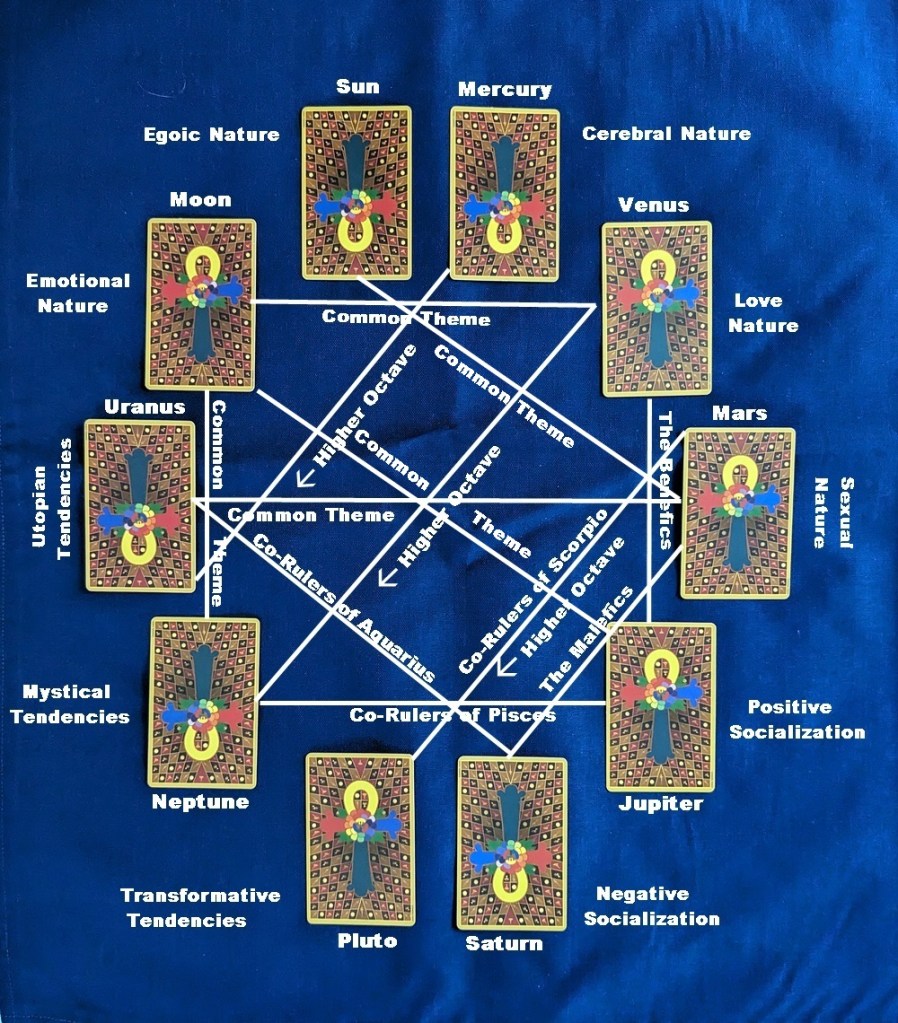
The idea is to shuffle a tarot deck and deal cards face-up into the ten positions in any order you choose. Then using the Golden Dawn’s system of correspondences, determine whether the nature of the card that lands in each planetary position is harmonious or discordant with the inherent qualities of that planet. If the pair is well-favored in combination (typically by element or implicit energy), that aspect of the personality needs little or no attention. However, if they are poorly matched, an effort should be made to determine what the card is trying to say about the condition of the planetary force in one’s psychological makeup at the time of the reading. Once that is sorted out, an action plan can be developed as necessary to address any apparent weaknesses.
A couple of additional steps can increase the depth of this analysis. If you have your astrological birth chart, find the ten-degree decan for the location of each natal planet in its sign using the Golden Dawn’s “Chaldean” zodiac (linked below). Place the cards for the decans on the template positions as “earmarks” for those planets. (Note that the planetary attribution on the card itself won’t always be the one for the planet in question but the sign will be identical.) You will need more than one deck if you have two or more planets in conjunction. (See my personal template below for an example; although they’re not part of the planetary layout, I included my Ascendant and Midheaven decans as well. As a “character snapshot” my pattern is a mixed bag bordering on “horrible.”) When you deal the random cards, place them on top of these decan cards and read the two in each position as a pair centered on the astrological meaning for the planet.
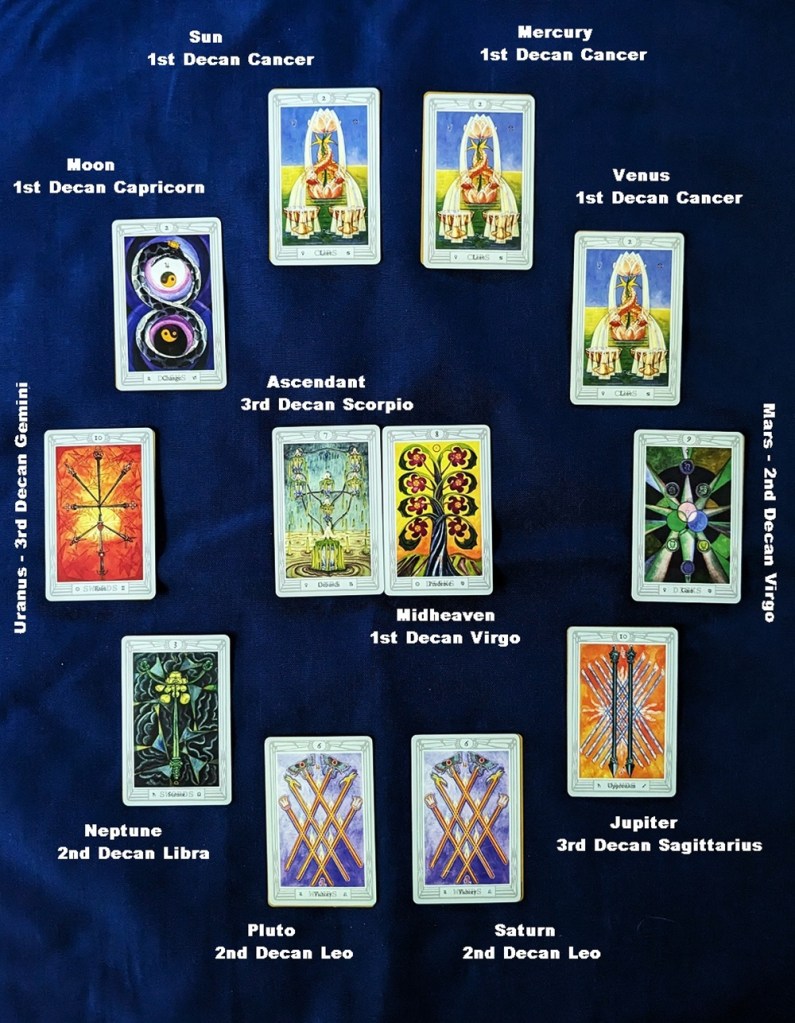
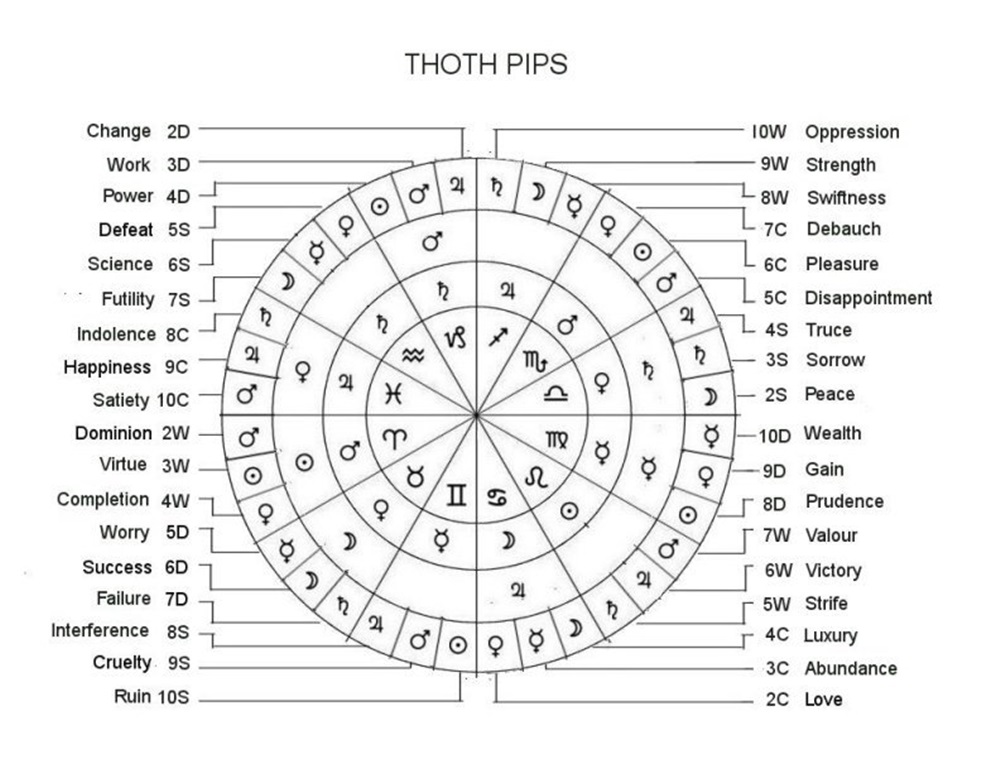
As a final step, identify the hexagram associated with each decan card using the table in my previous post (linked below) and read the advice of the I Ching as part of the analysis.
https://parsifalswheeldivination.wordpress.com/2024/05/21/connecting-the-dots-an-i-ching-oracle-card-tarot-card-triplet/
 Parsifal's Wheel Tarot & Astrology