AUTHOR’S NOTE: Here is an elegant spread that offers three possible paths to resolution: the left-hand path of intuitive insight, the right-hand path of rational judgment, and the central or “ideal” path that blends the two into a perfectly coordinated “middle way” between them. All three pass through a central “lens” (Key #2) that represents either a “window of opportunity” (if the context of the reading involves seeking an advantage), or a “choke-point” (if it is more about overcoming an obstacle).
To begin, shuffle a tarot deck while concentrating on the question and deal eleven cards face-up in the order shown by the black numbers on the card backs in the illustration below. Reversals may be used to add further nuance to the narrative.
There are a number of options for reading this spread. One is to treat it as three separate developmental arcs, flowing from bottom to top, in which the path that holds the most dynamic and cohesive set of cards can be viewed as guidance for the querent, with the others showing less-promising alternatives. The Ideal Path or “Middle Way”(which is also the most direct route to the top) totals seven cards and includes all four of the “Clarifying” and “Conditional” cards, two of which (#4 and #7) draw on the intuitive perspective (“left-hand arc”) while the other two (#5 and #8) partake of the rational viewpoint (“right-hand arc”). The two alternate paths both contain five cards that include the midpoint card (“Key #2”) and one each of the “Clarifying” and “Conditional” cards. The idea in reading the three series of cards is to find the path that brings the most consistent energy to bear on the matter, with no stutters or stumbles along the way.
If a great deal of information is desired , the pattern can be read as eight sets of triplets, four pointing upward toward progress (1-3-4; 2-3-5; 4-5-6; and 7-8-9) and four oriented downward, emphasizing dispersion (4-5-3); 7-8-6; 10-9-7; and 9-11-8). The card at the apex of each triplet, whether pointing up or down, should be considered the “keynote” of the triplet, and the cards that appear in multiple triplets (specifically the “Clarifying” cards #4 and #5 and the “Conditional” cards #7 and #8) should be accorded special significance second only to their role as “apex” cards. Those triplets containing the most compatible group of cards are the ones to watch.
It’s possible to approach it as two six-card triangles focusing on the center card (#6) as the “crux of the matter,” with the upward-pointing triangle suggesting how the “crux” card might be leveraged to the querent’s benefit, while the downward-pointing triangle implies all of the weight that card will have to bear in the situation. Cards #3 and #9 could be regarded as describing stalwart proponents or opponents of Card #6 in surviving this “pressure-cooker” environment, the premise being that even the toughest challenge usually presents an opportunity.
Still further, the spread can be read as five horizontal layers, two of which give the detailed situational “baseline” and the range of “outcomes,” two that provide adjustments to the scenario and one that portrays the “point of greatest friction,” making it the most sensitive feature of the reading. In this approach, the three cards of the “Middle Way” (#3, #6 and #9) can be interpreted as a consolidating force (the symbolic “backbone” of the reading) that gathers all eleven cards together at the critical juncture. Although we might like to stay on the “straight-and-narrow,” the nature of the cards pulled can and often will shift this dynamic toward one side or the other. (I chose this structure because Three, Six and Nine represent the “Three Perfections” of ancient Greek philosophy.)

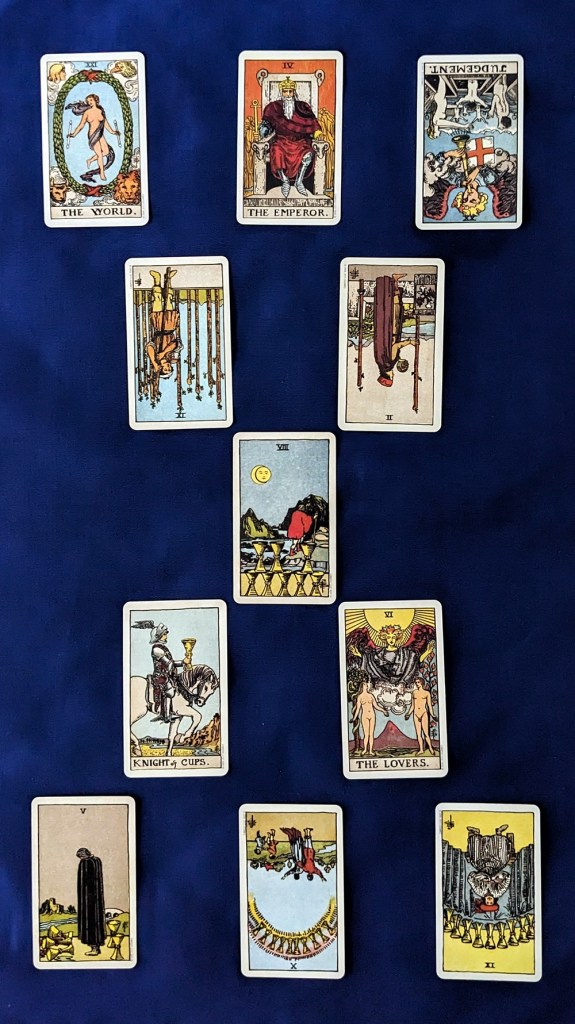
The following example reading offers an abbreviated overview of one way to read this spread. The question I asked was “What is the best path to take to accomplish my goal in a challenging situation?”
The “Situational Baseline” layer is weak, with the upright 5 of Cups and the reversed 9 and 10 of Cups suggesting halfhearted enthusiasm. The two triangles pointing upward from the baseline are topped by the Knight of Cups and the Lovers, respectively, which – if this had been a romantic reading – could almost make a go of it together as hopeful “Clarifying Factors” for the murky bottom row. But the 8 of Cups as the “Choke-point” card throws a bucket of cold water on the pair, bringing any progress to a dead stop.
The two “Conditional Factors” are both reversed Fire cards that are trying vainly to ignite a little optimism in the matter but failing to dislodge the gloomy 8 of Cups, which is deeply entrenched. The downward-pointing triplets in the top half of the layout are fascinating since four of the five cards are expressions of Fire that lean heavily on the 8 of Cups. The implication is “If you can’t stand the heat, get out of the kitchen!”
Of the three “Situational Outcome” cards at the top, the World represents the most satisfactory result; the Emperor implies egotistical “strong-arm tactics” that wouldn’t be appropriate and Judgement reversed indicates an inability to make much headway in the face of major deflection.
Examining the three paths, I believe the Intuitive Path (the “Left-Hand Arc”) provides the greatest opportunity for progress, with the World signifying an agreeable conclusion. The three Water cards and one Earth card are elementally cooperative, easily overpowering the single anemic Fire card that, being reversed, can muster little more than a token protest since there is no Air in this arc to fan the flames. This developmental curve takes only a glancing blow from the 8 of Cups, in which the despondent figure is looking in the other direction as the action veers away. As “Lords of the Middle Way,” the Emperor and his two Fire henchmen want everything on their own terms but they won’t gain much traction in all of the Water under their feet. The Rational Path (the “Right-Hand Arc”) is encumbered by three reversals and capped by another domineering Fire card; other than the Lovers (representing equivocal Gemini), there is not much logical stimulus to be found there. None of the paths is ideal (at least there are no divisive Swords in any of them), but I think I will go with my instincts on this one and not try to push too hard.
 Parsifal's Wheel Tarot & Astrology
Excellently done
LikeLiked by 1 person