AUTHOR’S NOTE: In my estimation, Edward Fitzgerald’s vibrant and evocative translation of The Rubaiyat of Omar Khayyam is a masterpieces of English mystical poetry. Relative to the subject of this essay, here is one magnificent quatrain:
Into this Universe, and Why not knowing,
Nor Whence, like Water willy-nilly flowing:
And out of it, as Wind along the Waste,
I know not Whither, willy-nilly blowing.
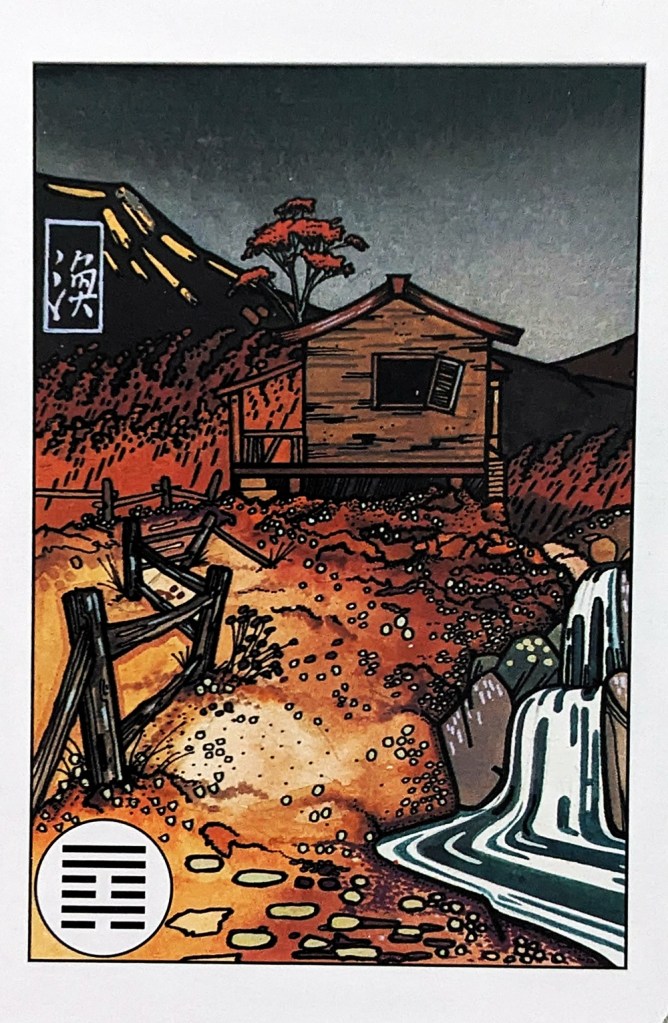
In the I Ching, there is a hexagram that relates, at least conceptually, to this vision. Reading from bottom-to-top of the six lines, its trigrams are Water and Wind, creating Hexagram 59, Huan (Dispersion/Dissolution; Wind over Water). The very first line of the Wilhelm-Baynes translation perfectly echoes Khayyam’s mood:
“Wind blowing over water disperses it, dissolving it into foam and mist.”
“Dispersal” is an intrinsic quality of Wind in its role of disseminating plant seeds so they can alight far away and ideally germinate in more hospitable soil. Because this quatrain appeared fairly early in the Rubaiyat, I get the impression that Khayyam gained considerable wisdom as he became more broadly and deeply immersed in life, even if he did arrive there by drinking wine! On the other hand, stepping back from the result, it can be readily equated with egoistic “dissolution,” or at least “dissipation.”
But Khayyam’s nihilistic self-assessment conveys the idea that he had learned nothing about the Universe at this point in his journey; he just poured in one end and blew right out the other. One of the key points in this regard from the Commentary to Hexagram 59 is “He dissolves his self” (His will is directed outward.) The main text opens this discussion by stating that the subject of the hexagram is “the dispersing and dissolving of divisive egotism” in which “gentleness serves to break up and dissolve the blockage.” Furthermore, “. . . only a man who is himself free of all selfish ulterior considerations, and who perseveres in justice and steadfastness, is capable of so dissolving the hardness of egotism.” This brings me back to the humanity and humility that shine so brightly in Khayyam’s (and by extension, Fitzgerald’s) lyrical verse; these are the qualities that endear it to me so strongly.
 Parsifal's Wheel Tarot & Astrology