AUTHOR’S NOTE: I’m not proposing this as a spread for divination but rather as a tool (a form of mandala) for meditation. It could, however, be used as a “birth-chart” for the moment of the pull and supplemented over time with additional cards that function like astrological transits to a natal horoscope. One possible way to do this is described at the end of the essay. Users can also substitute nodal properties of their own choosing for those I’m suggesting; the critical feature here is the interlocking “nucleus-triangle-and-square” arrangement.
Shuffle a tarot deck and deal eight cards face-up in any order into the nodes of the pattern. Reversals are not used. Contemplate the relationship between the cards according to the confluence of energies at their nodal points of intersection, using the letter combinations as keys to their interaction. Consider the network of connecting lines as showing paths or channels for merger of the spiritual, intellectual, emotional and practical powers of the personality. In this way a single card can serve as a “portal” that opens up access to other cards in the pattern, particularly between those of the “inner” and “outer” natures. For example, we could say that the subconscious (S) acting through the emotions (C) takes advantage of the body’s physical vitality (D) and stability (G) over the paths S-C and C-D-G in line with the testimony of the four cards.
Fortunate cards in all the nodes of any sub-set will strengthen the constitutional properties of that group. A less-favorable card in any node or nodes will weaken the state of well-being for that (or those) node(s). This forms a kind of “blueprint for mind, body and spirit” in the present incarnation, much like an astrological nativity that shows growth potential. Difficult cards can reveal where psychological, practical or spiritual work on one’s character is needed, and linked cards will either aid in the recovery if benevolent or aggravate the problem if malevolent.
After placing cards into the eight positions and evaluating their strengths and weaknesses, it may be instructive to shuffle a second deck and deal eight more cards onto the original layout. (Reversals may be introduced at this point.) Read these cards as “real-life” outlets for the abstract nature of the “blueprint” cards. The degree to which the second card is compatible or incompatible with the first one according to various forms of dignity (suit, element, number, rank, etc) will adjust its contribution to the overall expression of their combined forces in outer reality, “for good or ill.” This could be done periodically to update the outlook for current circumstances.
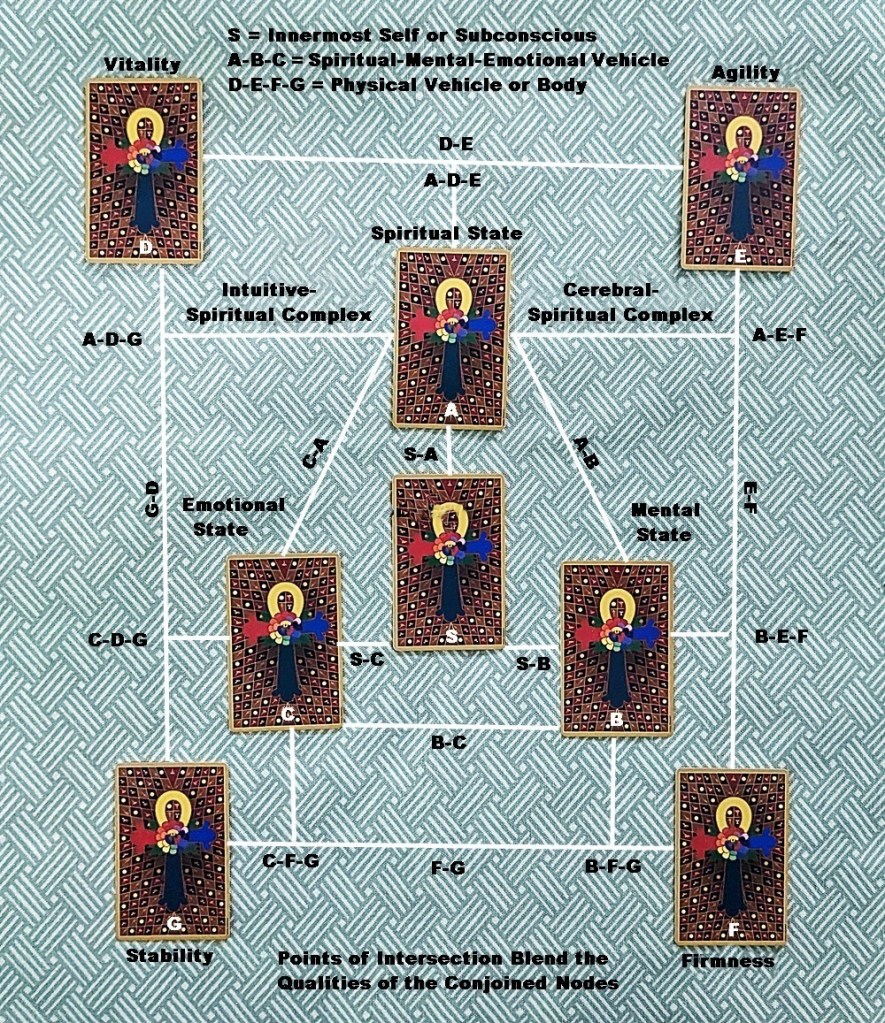
Retro-Thoth Tarot card-backs, privately published
 Parsifal's Wheel Tarot & Astrology