AUTHOR’S NOTE: This is my second post on the subject (the first one is linked below). My original idea was to create a four-card line spread using fixed position meanings based on the four classical elements of Empedocles, going from left-to-right and from Wands to Pentacles. Then I shuffled a deck and dealt random cards into those positions looking for elemental matches and mismatches. In that approach, any card that was elementally hostile to its positional suit was considered to be “moving,” changing into its opposite number and altering the complexion of the reading by potentially taking it in an entirely new direction. (The objective was to show a possible “way out” of any unpleasant conditions.) In this iteration I’m opening it up to any card in any spread by applying the elemental “intent” of the question or topic, this time changing cards that are elementally harmonious with the querent’s stated purpose into their opposites as a way to show “both sides of the story.” (Warning! Esoteric “heavy lifting” ahead; the “tl;dr” option is to cut right to the example reading at the end.)
In several previous posts I’ve broached the theory that every card in the tarot deck has a closely-linked “counterpart.” With the Major Arcana this paired card is usually the numerological equivalent of the first card: for example, the Chariot (7) and the Tower are mathematical twins because 16=1+6=7, and provisional assumptions about their metaphysical convergence can be reached on that basis. It isn’t so straightforward with the rest of the cards, and I’ve used a couple of different models to achieve the partnering. Here I’m once again applying a concept similar to the “moving lines” from an I Ching hexagram as a way to identify these parallels, but not in the same way as before.
The premise I’m using this time is Benebell Wen’s assertion that “moving” (or “changing”) lines in a hexagram are a function of either an Elder Yang or an Elder Yin event produced by a toss of three Chinese coins (three “heads” yield the first outcome and three “tails” the second one). Although I haven’t discussed it with her, the feeling I get is that these lines have reached their fullness or completion and are ripe for transformation. They “morph” into their opposites, a yang line becoming a yin line and vice-versa to create a new hexagram that offers supplemental guidance. I’m thinking that something similar can be done with any tarot spread, in which certain cards would be transmuted into their opposites using the technique of transposition, thus generating a different but related narrative. While I’ve touched on the relevant principles in the past, I’ve never taken it to the extreme of reformulating an unstructured random pull using them as a basis; my last effort was predicated on an underlying “elemental field theory.” What I hope to do here is come up with a rational “triggering” mechanism akin to the “yang-to-yin” conversion that dictates when to make the swap with specific cards.
As a working hypothesis I’m proposing that any cards that directly reflect the elemental nature of the question or topic area as shown in the graphic below will be changed to their opposite expression under the provision that, if well-aligned cards reinforce the querent’s intentions, those that display an inverse alignment reveal a potentially less-supportive climate; the first scenario may show the outcome we subconsciously expected to experience when we approached the reading and the second might well pose a much-less-agreeable solution that could in fact expose a “hidden agenda” at work in the matter. Together they offer a comprehensive picture showing “both sides” of the situation, and the actual conclusion may come down somewhere in the middle depending on what the neutral cards have to say.

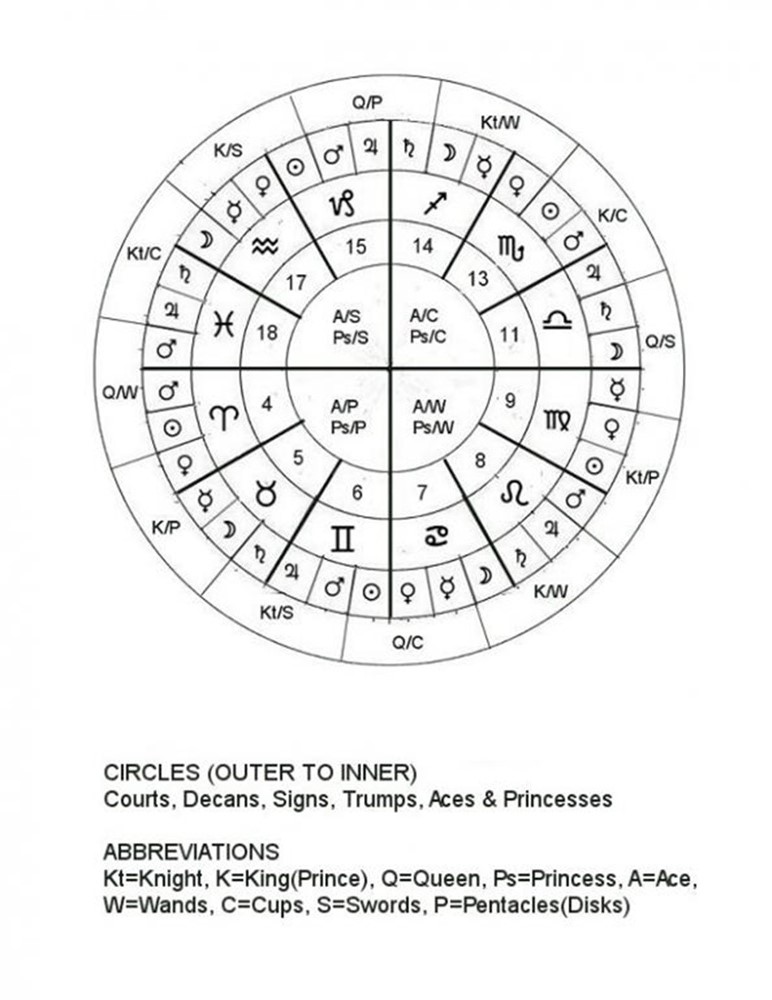
My primary method for deducing non-trump counterparts has always been the Golden Dawn’s set of correspondences that was developed using the 36 decanates (or “decans”) of the “Chaldean” zodiac. The 36 minor and 12 court cards on the outer rim of the wheel all have a diametrically-opposite companion occupying a compatible element on the other side of the circle, while the Aces and Princesses/Pages at the center have a cross-quadrant affiliation in sympathetic elements. To illustrate this, I’ll point out that the 2 of Wands covering the first ten degrees of Aries is counterbalanced by the 2 of Swords in the first ten degrees of Libra. (With the similarly-situated Queen of Wands and Queen of Swords there are four elements involved in a two-thirds to one-third ratio.) The notion I’m toying with is that, when appropriately “triggered,” the appearance of any of these cards in a spread can be replaced with its counterpart to create a secondary interpretation. So if the question was of the nature of Fire and the 2 of Wands came up in the pull, a parallel spread would be initiated that substitutes the 2 of Swords in the same position. If none of the other cards are “moving,” the updated spread would be identical except for that one position. Here are graphic displays that identify the paired cards :

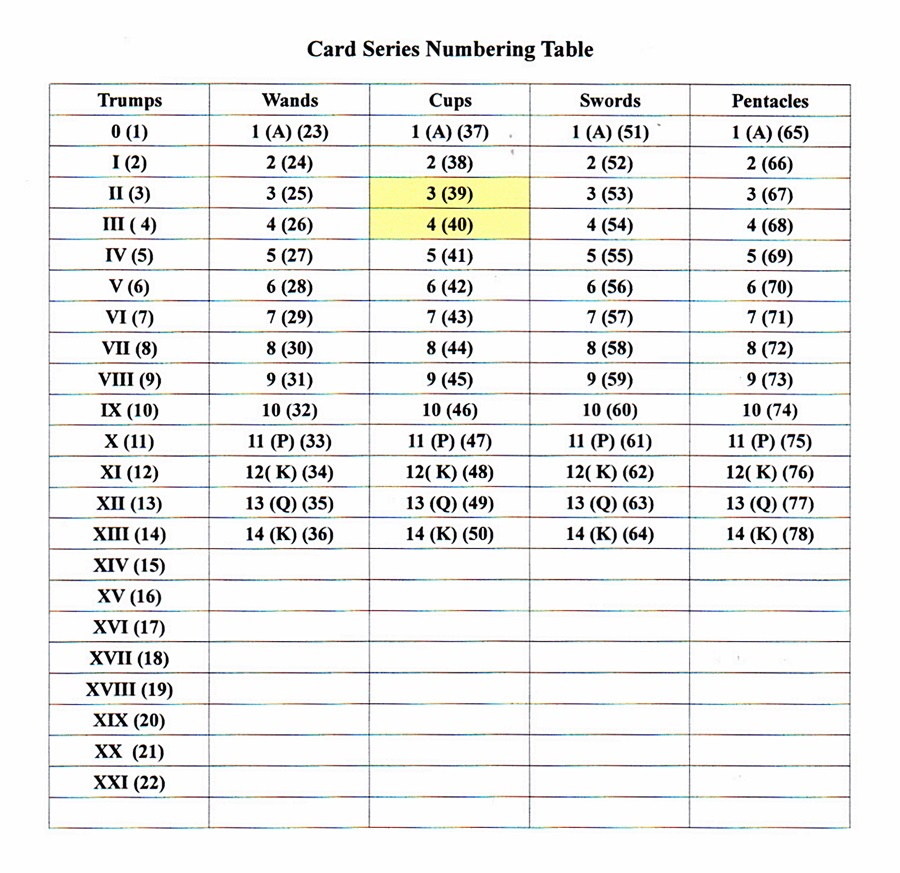
The other technique I’ve used to define counterparts involves a numerical sequence that begins with the Fool at “Position 1” and ends with the King of Pentacles at “Position 78.” Any two cards that are equidistant from the ends of this series are considered to be counterparts. Below is the table that I use for this purpose. One representative pair would be the 2 of Wands coming in from the left and the 5 of Swords when entering from the right; each card is 24 places from its end of the array. Again, in a Fire-related reading for which the 2 of Wands was pulled, I would swap it out for the 5 of Swords in a parallel layout.
Here is a random five-card example reading that has no specific question or topic other than to assume that the subject matter is related to the element of Fire. (For simplicity I chose not to allow reversals.) The Ace of Wands is the only card that directly exhibits a “Fire” focus so I changed it into its “Chaldean” counterpart, the Ace of Swords. In my five-card reading model, it fell in the fourth position that describes a “new direction” following a “turning-point” or crisis in the matter. The first thought that came to mind was the title of the Larry David TV show (which I could never stand to watch), Curb Your Enthusiasm, offering the alternative advice to avoid being too “pushy” (Ace of Wands) and assume a more thoughtful posture (Ace of Swords) in the situation. But considering that three of the other four cards (except the Priestess, which is elementally hostile) are Earth and therefore cooperative with Fire if not fully on-board, there may be counter-arguments against backing down too far. If I use the numbering table instead of the Chaldean model, the “moving card” becomes the 6 of Swords, which conveys a comparable but more fully-realized evolution.

 Parsifal's Wheel Tarot & Astrology