AUTHOR’S NOTE: More inspiration from Benebell Wen’s book, I Ching the Oracle: A Practical Guide to the Book of Changes. I was just reading about Hexagram 23 (Bo; Partition) which has five “dark” yin lines underlying a single “bright” yang line. The commentary is “Dark yin lines ascend upward to overthrow the final line of yang. Darkness defeats the Light.” This started me thinking about how I might convey in a tarot spread how the inner “shadow” side of the character will sometimes vie with the outer “persona” for dominance (an academic way of saying “the Devil made me do it”).
Many readers use the very bottom card of a shuffled deck to show hidden aspects of the matter; they examine this card after dealing the main cards of the reading from the top of the deck. Here I’ve developed a spread that provides a covert “shadow partner” for each card of the overt draw. They can be read either as concealed aspects of the situation or, when doing a psychological reading, as buried perceptions and inclinations that threaten to overwhelm the conscious awareness. If applicable to the question, both can be covered at once as I’ve done in the example reading.
There are a number of ways to derive these counterparts. One is to continue dealing from the top of the deck to populate a second parallel row of cards below the initial set, an approach I find rather counterintuitive. A more compelling technique (which I prefer) is to pull an identical number of cards from the bottom of the deck for this purpose, starting from the base card and working upward in the stack. Other less straightforward approaches are to use the cards that are opposite to those drawn as shown on the Golden Dawn’s “Chaldean” wheel of astrological correspondences, or the cards that are the same distance from the end of the 78-card series as the pulled cards are from their end (a numerical correlation). For the purpose of this essay, I’m recommending the second method.
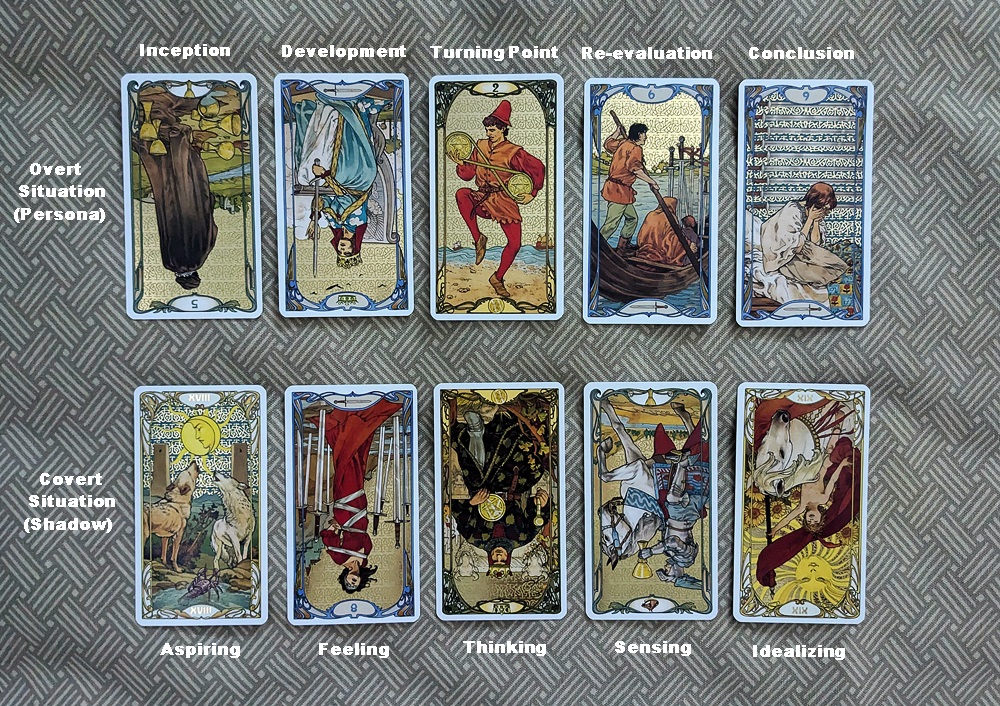
The photo below shows both a suggested positional structure and an example reading. Here is my analysis:
Taking the interpretation from a situational standpoint, the issue is being driven by a deeply entrenched emotional malaise (5 of Cups reversed) that needs decisive remediation but the reversed Queen of Swords can’t quite get her head around the right way to attack it. Consequently, the “turning-point” has the man in to 2 of Pentacles “tap-dancing” around the dilemma, trying to stay out of the line-of-fire; judging by his “facing” or “gaze,” he suspects that something has to change but he’s too intent on his footwork to focus on it. The 6 of Swords implies strategic retreat rather than advance, and the 9 of Swords shows surrendering to despair. This is a very moody forecast in which there appears to be no “silver lining.” It reminds me of the title of the Eugene O’Neill play Long Day’s Journey into Night. It also suggests Edgar Allan Poe’s biblical quote in The Raven: “There is no balm in Gilead.”
Covertly, the Moon fuels the 5 of Cups’ anxiety; the 8 of Swords reversed ties up the Queen of Swords even more tightly in knots; the King of Pentacles reversed has the “dancer” in the 2 of Pentacles gingerly “walking on eggshells” lest he be “swallowed up by the earth” if he takes another careless step; the Knight of Cups reversed, which upright might suggest a sanctuary, is averse to taking in refugees; and the Sun reversed implies feelings of worthlessness or inadequacy that compound the angst of the 9 of Swords.
From a psychological perspective, the querent seems to be in a weakened state dominated by debilitating “agents of shadow” made more insidious by the fact of reversal. The overall implication of this reading is “You can run but you can’t hide.” As the only upright “shadow” card, the Moon comes across as the main culprit in this downturn because it prods the 5 of Cups with its distorted insinuations, which in turn create a disheartening “opening scene” for the rest of the upper line that only gets worse; the reversed cards of the lower line descend into chaos.
 Parsifal's Wheel Tarot & Astrology