AUTHOR’S NOTE: In ground combat, an expeditionary skirmish line exists when a sparse detachment of infantry faces a larger enemy force across contested terrain. This is not a pitched battle, a melee in which all available resources are thrown into the fray by both sides, but rather a “scouting, feinting, harrying or blocking” mission such as the rear-guard action often deployed during a strategic retreat. But there is no immediate resort to orderly withdrawal in this spread, just a head-on confrontation of the “winner-take-all” kind; alternate tactics may enter the picture after the initial clash-of-arms. The reading requires two decks so all cards are available to both parties, and a third deck may be required for the secondary operations.
Begin by shuffling Deck #1 while concentrating on the matter, then deal three cards face-up, from left-to-right, into the top row to signify Opponent #1. Reversals may be used to imply disarray or lack of readiness for combat.
Shuffle Deck #2 and deal three cards in the same manner below the top row to represent Opponent #2. Leave a gap between the upper and lower rows to accommodate an additional series of cards.
Compare the relative potency of the “face-off” cards in the two rows to determine whether one opponent holds the upper hand in terms of strength, stability and flexibility. Beyond this one-to-one comparison, Elemental Dignities and other forms of moderation can be applied to create a power profile for each three-card array that will either confirm or refute the preliminary assessment.
Each row contains three positions, a center command post and two flanks, left and right. A substantially stronger flank card can indicate that the combatant so blessed could perform a successful flanking maneuver on that side to come at the enemy obliquely, creating confusion and potentially causing a rout that can spell victory. With two dominant flank cards surrounding a weaker center, there is less need for finesse because they can adequately protect the middle while advancing on the wings. If the center position is solid and the two flanks exposed, the advice would be to “go for broke” on the initial thrust before the opponent can probe any outlying vulnerabilities. If all three cards overmaster their adversarial counterparts, the outlook for advancement across the board is auspicious, while if all three are significantly inferior to those of the enemy, it may be time to initiate a retreat.
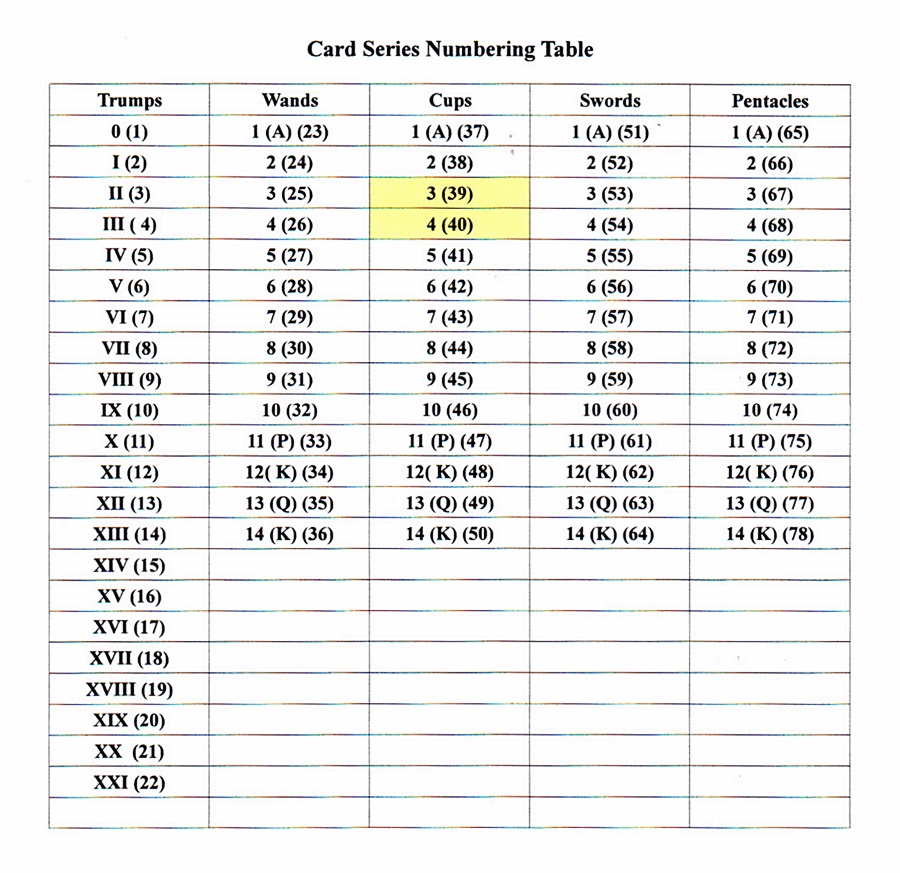
However, before fleeing the scene, it is worthwhile to evaluate whether one of the combatants might take an advantageous forward position in the field, thus gaining a strategic advantage. There are two ways to do this. One is to find the card that sits at the numerical midpoint between the two cards in each column (see the table below) and place it in the contested area between the rows, then decide whether its energy affects one adversary or the other in a way that could either advance or impede its progress. The second way is to perform a “binary synthesis” calculation for the two cards in each column by adding together their face values (and reducing the sum numerologically if necessary) to come up with a trump card to be similarly placed between the rows and examined in the same way for consequences. In either case, one or more of these cards could create an opportunity for a break-out assault or the risk of an unstoppable incursion by the enemy.
Take all of this data into consideration in forming a projection that addresses the relative likelihood of one opponent vanquishing the other, and the circumstances under which that might occur. Then, translating it back into real-world terms, advise the querent whether to assume an offensive or defensive posture in the matter. Below are two example readings to illustrate this deliberation. The first one uses the midpoint theory to identify the Forward Position card while the second applies the binary synthesis approach. (Images are from the Albano-Waite Tarot; the Radiant RWS; and the Waite-Smith Centennial Edition, all copyright of US Games Systems Inc, Stamford, CT.)
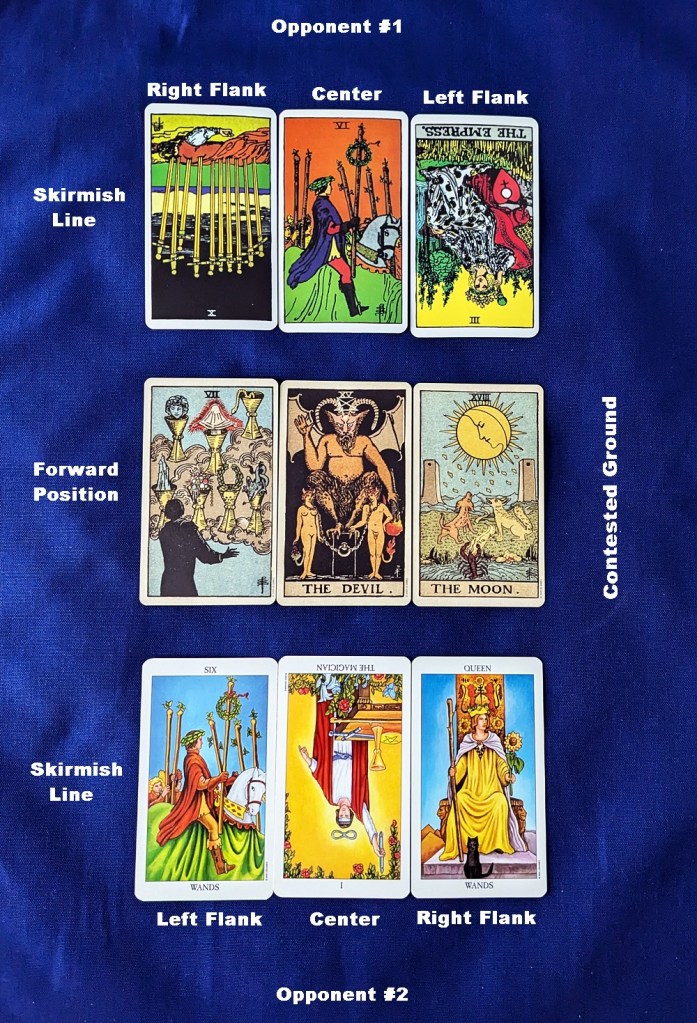
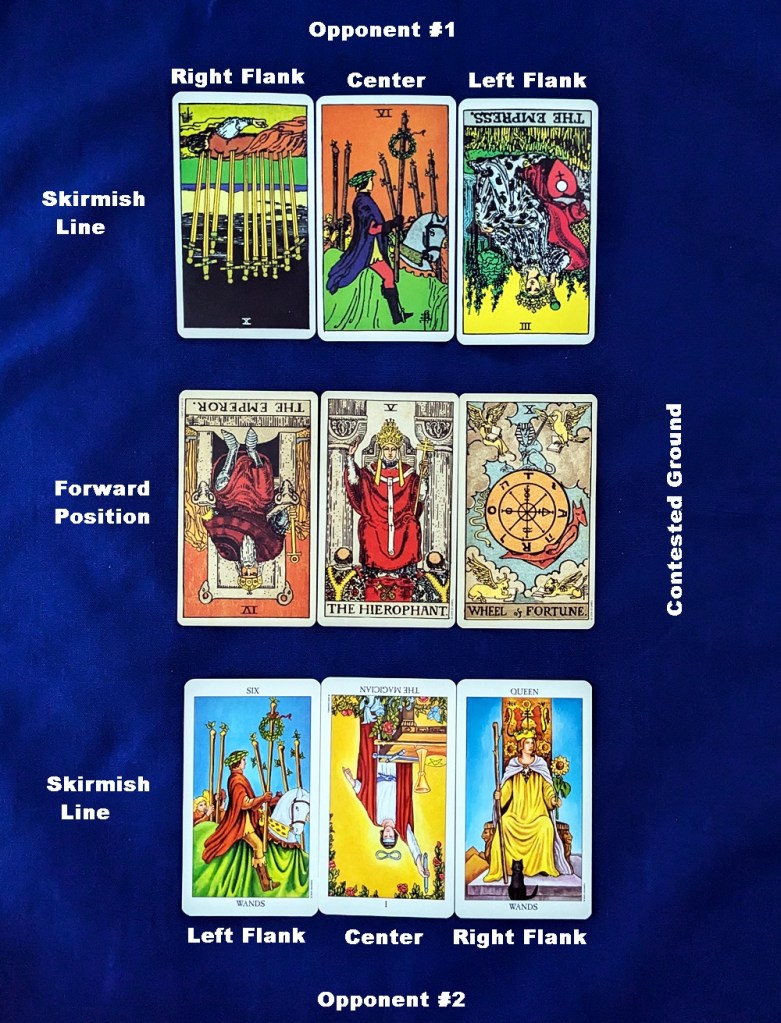
For the sake of these examples, let’s suppose that Donald Trump came to me and asked for a tarot reading to predict his chances of beating Kamala Harris in November. (Yeah, I know, when pigs fly. But Ronald Reagan might have done so if astrology-fan Nancy had told him to.) Therefore, as the querent, Trump becomes Opponent #1.
His three-card skirmish line is strong in the center with the 6 of Wands, suggesting that he will be able to count on his political base to propel him toward victory. However, his left flank (the Progressive Left is a thorn in his side) is extremely weak with the 10 of Swords reversed; it could be overrun by the opposition. The right flank is also compromised, with the Empress reversed implying complacency: he may lose female voters who stay home from the polls, or they may defect to Harris in droves if he doesn’t soon inspire them. Trump needs to put effort into shoring up his center as much as possible, not taking it for granted while guarding his flanks against further attack. The Elemental Dignities are not in his favor since Air (10 of Swords) and Earth (Empress) are mutually hostile; however, the 6 of Wands is friendly with one and cooperative with the other, so he may be OK as long as he can keep his allies from cutting each other’s throats.
The skirmish line for Harris is shaky at the center with the Magician reversed because it could mean she will be undone by deceptive or manipulative practices. The left flank with the 6 of Wands is encouraging for her due to the same activism that is a headache for Trump. The right flank with the Queen of Wands could mean that radicalized female voters will come out in force. Harris needs to protect her center from accusations of impropriety, but she does seem to hold a more promising position overall. The Elemental Dignities are entirely supportive since Air (Magician) is friendly with Fire (the two adjacent Wands); unfortunately, the Magician is untrustworthy and may sandbag her at the worst possible moment.
Regarding the Forward Position analysis, in the first example the 7 of Cups suggests that Harris may lose focus and fail to leverage her left-wing advantage over the reversed 10 of Swords. Thus, Trump may be spared an embarrassing “Emperor’s New Clothes” scenario. The Devil in the center looks like the Liberals’ worst nightmare; as Earth it is supportive of Fire (6 of Wands) and unsympathetic to Air (Magician), so the “Arch-demon” (Trump) seems to be sitting pretty as the Magician struggles with credibility. As elemental Water, The Moon has more in common with the Empress (Earth) than with the Queen of Wands (Fire); the two in cahoots invite collusion, giving the Empress insights that are denied to the Queen of Wands. The Empress is not above getting her hands dirty to further her cause.
In the second, or Binary Synthesis, example the Emperor reversed stands between Harris and her opportunity to outflank Trump on the left; I’m thinking that her running mate may hurt her here. I don’t believe it shows Trump stepping into the breach himself because I’m not sure he’s been sensitized to the risk; he thinks all Progressives are socialist crackpots. The conservative Hierophant, another Earth card, looks kindly on the 6 of Wands (Fire) and disapproves of the glib Magician (Air); it could mean that the Religious Right will rally to Trump’s cause in a big way, bolstering his center. The Wheel of Fortune presents a contest of wills; who can spin it in her favor, the Queen of Wands or the Empress? It looks like the reversed Empress is leaning on the Sphinx to do her bidding while the Queen of Wands must make do with Hermanubis, who appears to be trying to glide out of the line-of-fire.
In summary, Harris looks stronger in principle at this time, but Trump gets more of a boost from the Forward Position advantage that could figure prominently in the late going. I’m wondering if Walz as the Vice Presidential candidate and the Progressive bias of Harris will be her twin Achilles’ Heel.
 Parsifal's Wheel Tarot & Astrology