AUTHOR’S NOTE: Hexagram 61 of the I Ching is composed of two yin (or “broken”) lines sandwiched between a quartet of yang (or “solid”) lines, giving the impression of a hollowed-out center. Benebell Wen’s commentary notes: “One is faced with an equal and opposing adversary. This is a war between equals. There is currently a hollow opening for either to seize upon the chance and get ahead. Notice how the third line is yin and begins to form the shape of a hollow center (the third and fourth yin lines). This hollow center resembles a narrow opening, symbolic of an opportunity for either side to advance or retreat – there is a path to success from here, but it is a precarious one.” This reminds me of the premise that “Nature abhors a vacuum,” meaning that there is an irresistible urge for something to fill it.
I began casting around for a way to use this design syncretically in the form of a tarot spread. I hit upon the notion of a progressive scenario in which the middle becomes uncertain after a confident start; in other words, the bottom falls out and there must be a mid-course correction to recover stability and momentum if one is to carry on. Rather than both ends converging on the center, I looked at it as temporarily stalled progress on an ascending arc (while retaining the concept of a perilous path to success). Each three-card “solid” line suggests wholeness of purpose and the resources to implement it (although it’s likely that not all of the cards will be conducive to resounding success). On the other hand, the two-card “broken” lines reveal an unstable core in which the heart of the matter is lacking in clarity and resolve.
The idea is to populate the pattern from bottom-to-top in any order you choose while leaving the center empty, creating the impression that one side isn’t talking to the other. Then, after reading the narrative including the unfinished chapters in the middle that show “faltering on the road” aggravated by “making a wrong turn,” pull two more cards to flesh them out, giving an idea how to remedy what was found to be deficient in the fulfillment of their mission. This reformulation could also be construed as yielding “moving lines” that produce Hexagram 1 (Ch’ien; The Creative, or Heaven), imparting, according to the Wilhelm/Baynes translation, “sublime success and furthering through perseverance.” (If you like, you can reshuffle the remaining cards before the second pull to refresh the perspective.)
Once the void is filled, revisit the story and incorporate advice for jumping the gap that impeded advancement. These two reconstituted lines thus become the linchpin for facilitating successful arrival at the destination, even though flaws may be apparent in the overall trajectory that tend to steer the initiative away from the goal. (For example the traveler may disembark hale and hearty or a bit rumpled – but hopefully not “DOA” – on reaching the terminus.) If the majority of the cards are conflicted, it may be advisable to retreat or submit to a less-than-optimum solution.
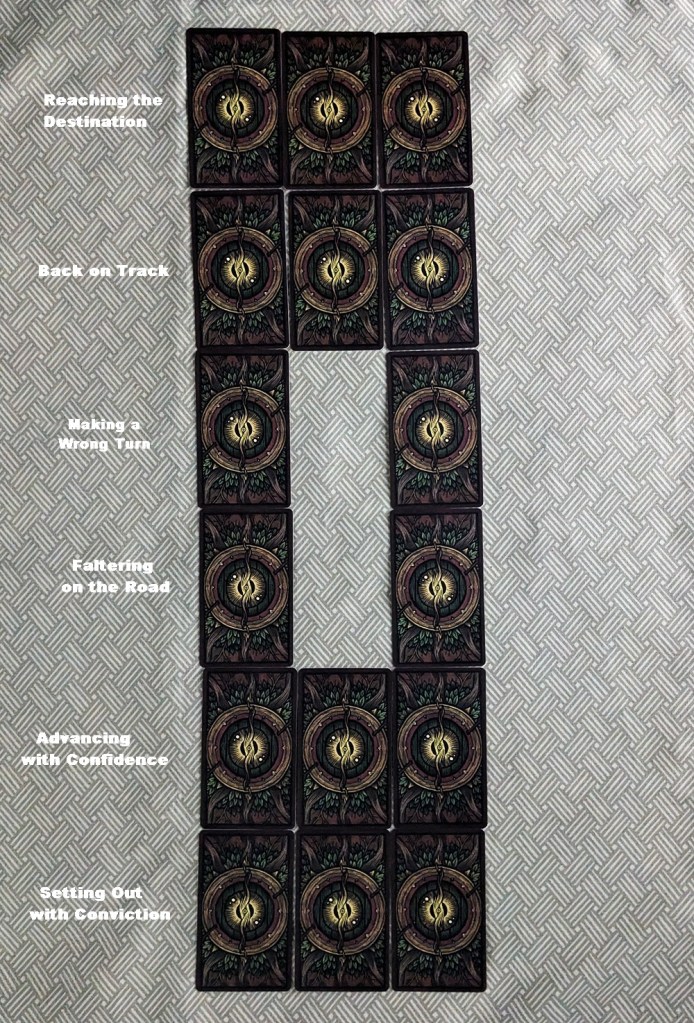
Here is an example reading to illustrate the process. I typically don’t use reversals with this “pip” deck but I certainly could have. The querent is a man I’ve read for previously who has a powerful emotional and physical attraction toward another individual, and I’m telling his story in the first person rather than endlessly repeating “the querent, the sitter, the seeker,” etc in order to streamline the narrative. (All of the cards are from the Lord of the Rings Tarot, copyright of Insight Editions, San Rafael, CA.)
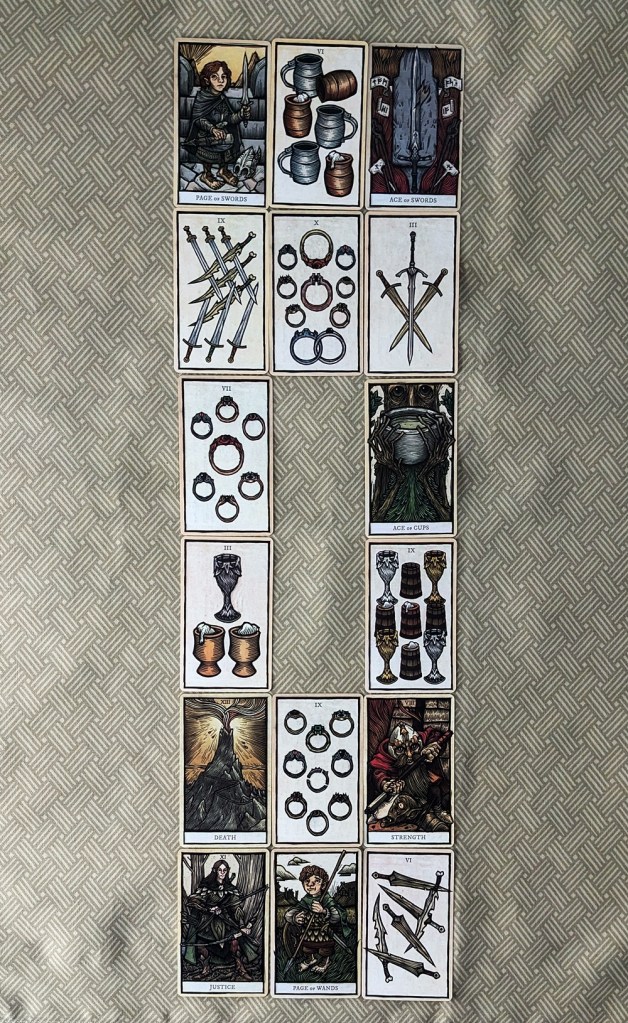
The querent speaks:
The situation begins with relative certainty that my objective is justified, or at least that I will be given a fair chance (Justice); the Page of Wands identifies me as the enthusiastic aspirant, while the 6 of Swords is sometimes seen as a “journey.” So far this hangs together.
However, the prospect for confident advancement in the second line is not quite so certain. I do think that Strength overpowers Death here, and there is not one ring but nine at stake. Perhaps I need to take out the nine Ring-wraiths before I proceed to the mountain (in other words, I must focus on clearing away obstacles to the main thrust). The summary judgment of this line in the hexagram seems to be to “remain in the shade, being heard but not seen;” I’m taking it to mean that, for the best results, I should insinuate my intentions without being blatant about them (although the robust vigor of Strength is hard to contain).
The incomplete third and fourth lines imply that there is pronounced emotional and understated physical potential locked up in the heart of the matter; the cards that eventually land here will show how that can be accessed.
The fifth line suggests gnawing impatiently at the unfulfilled physical promise in the matter and coming across as desperate; elementally, there is a good deal of hostility here. But the pragmatic goal is still well within reach despite the overweening mental distress, even though the emotional objective has receded a bit.
The sixth line conveys the idea of “guarded anticipation.” There is a certain jealous possessiveness imposed on the concept of pleasure invoked by the 6 of Cups. It could just be the prospect of impending success that creates wariness and anxiety. The implication is one of “Wait for it . . . “
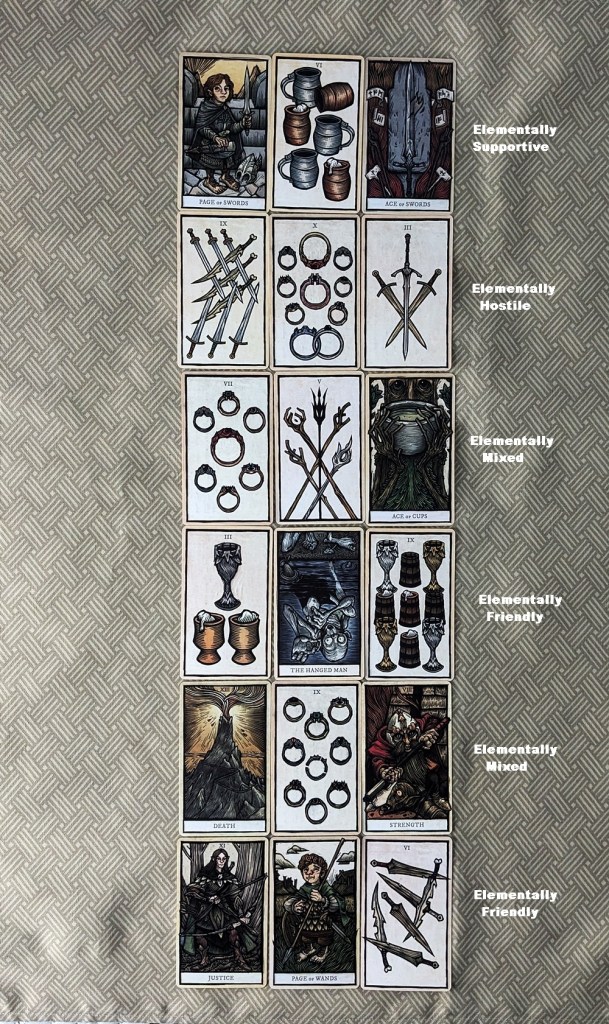
I (the reader) instructed him to reshuffle the remaining cards and he pulled the Hanged Man and the 5 of Wands to complete the layout. The Hanged Man, as the incipient remedy to the “faltering” shown by this line, is suspended between two cards of intense emotional stimulus, and is itself the trump card corresponding to elemental Water. The advice is to exercise exquisite patience in contemplating these intimations of a fortuitous destiny in the realm of feelings. There is also the possibility that the man will be overwhelmed by the “flood” before he’s ready.
The querent continues::
The 5 of Wands normally indicates conflict, but Aleister Crowley mentioned somewhere that it means “striving toward a goal” and not merely “strife” in the form of antagonism. It appears to be saying that, after a judicious period of waiting, I should just “go for it” with physical yearning and emotional promise driving me. Joseph Maxwell considers the Fives to invoke generally positive change, which aligns well with the theme here. As an aside, I was reminded of the Billy Squire song The Stroke (that center wand does seem to be “stroking”), which – despite the suggestive lyrics – is about sleazy record-industry manipulation and not sexual innuendo. In this context Saturn in Leo is inexorable, describing an uncompromising means to an end that is both physical and emotional. I hope the other person is not too thin-skinned.
The middle column can be treated as the main stem of the reading, and interpreting it as such advises that forbearance in the pursuit of physical gains will be emotionally rewarding as long as I “step up and take a swing” at the right time. Except for lines Three and Four, the side columns serve more as commentary.
 Parsifal's Wheel Tarot & Astrology