AUTHOR’S NOTE: I’ve encountered many productive parallels between the oracular character of the Chinese Book of Changes and that of the Western tarot cards, but this one seems particularly useful. (In this context I’ve consulted both the classic Wilhelm/Baynes English translation and Benebell Wen’s recent book, I Ching, The Oracle: A Practical Guide to the Book of Changes.) I used the Thoth Tarot (copyright of US Games Systems Inc, Stamford, CT) for my purpose here.
I set out to create yet another dual-path spread, but this time I’m using the I Ching concepts of auspicious tidings (top row); mixed auspices that nonetheless convey “no blame” in their pursuit (either row); and inauspicious auguries that carry a cautionary message (bottom row). I was inspired by the parable in Hexagram 63 of the fox that is crossing a stream but misjudges the depth and “gets its tail wet” before reaching the far shore.
It’s a three-row spread in which the middle row represents the “Great Stream” to be crossed (the lofty objective one has set), the upper line shows favorable progress while riding high on the flood (regardless of whether the cards placed there are less than optimistic, thus delivering “mixed auspices”); and the bottom one reflects being unexpectedly swamped by an inhospitable current (even if the cards there are not considered especially difficult). It uses upright and reversed orientation of the random pull to indicate shifting from one path to the other over the course of the forecast. The reading requires two decks, one to populate the predetermined “ideal course” and the other to impart the actual state of affairs going forward.
Interpretation involves looking at: 1) a preponderance of any one orientation or, conversely, their uneven distribution as a way to determine relative consistency or diversity in the outlook; 2) the card-by-card comparison of the “ideal” row to the projected course of events shown by the random cards to assess whether the inferred path to closure is aligned with or contrary to one’s stated aspirations; and 3) the “last word” on the matter as shown by the final card in the series, which could suggest either a decisive “slam-dunk” or a misstep just when the end is finally in sight. The imagery suggests an unstable “bridge of stones” that must be crossed with care, and some of them may sink beneath your weight and “wet your tail.”
Begin by pondering the outcome you would like to see and then intentionally select five cards from Deck #1 that describe the perfect route to accomplishment of your goal; the aim is to depict five discrete steps that lead to a significant achievement in the matter. Lay these cards face-up and upright in a row from left to right.
Next, shuffle Deck #2 in a way that allows for reversed cards and begin dealing five cards from the top, laying them from left to right as follows. If a card drawn is upright, place it above the corresponding card in the “ideal” row, and if it is reversed, place it below the related card in that sequence.
Read the random series of five upright and reversed cards as a path toward the goal shown in the pre-selected row, one that will substantiate the preferred course if predominantly upright or diverge from it in a less supportive way if reversed. Carefully consider the “mixed auspices” of inherently “good cards” when reversed and “bad cards” when upright to come up with a nuanced reading of their significance; in one case, favorable cards in the inauspicious reversed row could alleviate the severity of any decline by signifying prompt recovery after a “shallow dive” and, in the other situation, unfavorable cards could “clip the wings” of an otherwise upbeat outlook. The point is that the beneficial or detrimental path “is what it is,” but the cards pulled may be out-of-sync with its trajectory, flattening the curve “for good or ill.”
Here is an example reading to illustrate the process. The question involved a hypothetical relationship in which a man hopes to be amply rewarded for the emotional energy he puts into the connection, as displayed by the middle row.
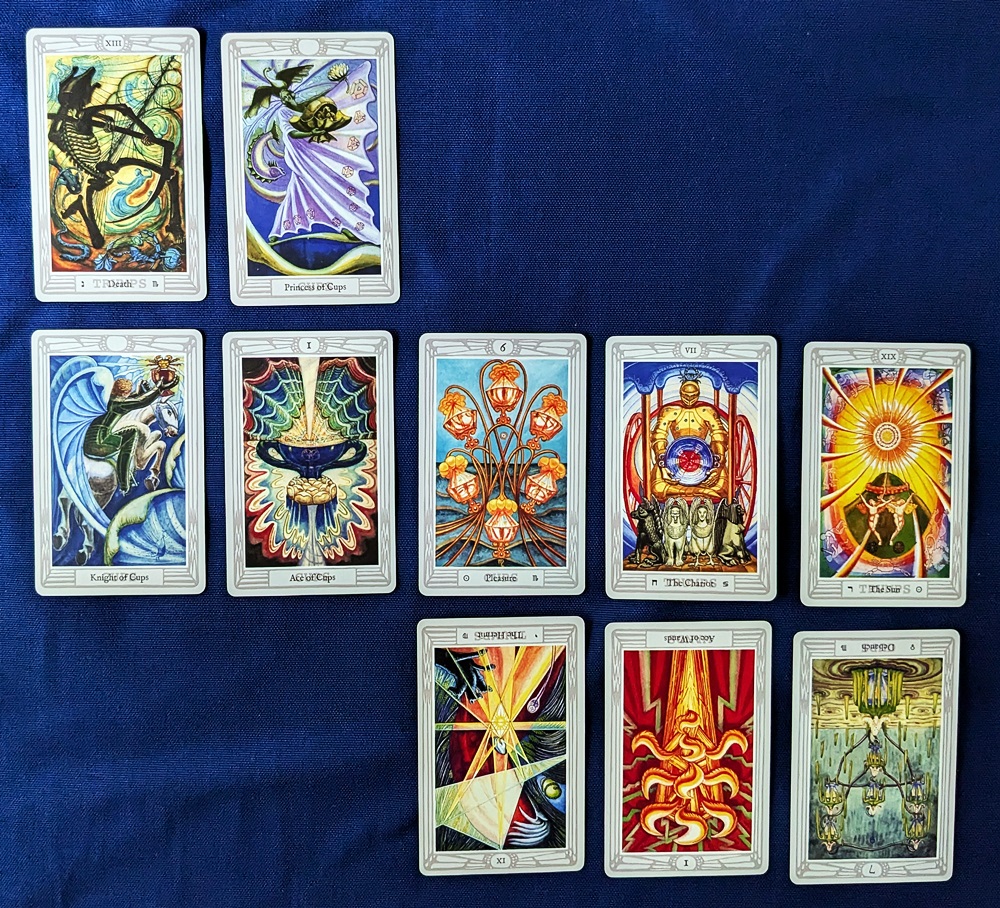
Death crowning the Significator (Knight of Cups) indicates that he could experience a life-changing emotional transformation by pursuing this course if he is willing to stick his neck out for it, but there are no guarantees that it will be salutary.
The Princess of Cups riding on the Ace of Cups (which does hint at a bit of “prodding,” doesn’t it?) can only be the object of his desire, and at first she seems amenable to (if not exactly overwhelmed by) his advances. You wouldn’t be too thrilled either with some bony guy breathing down your neck, unless he has no other heirs and is about to croak, leaving you millions. (The first four cards appear to disclose a substantial age difference between the two parties.)
But it all goes downhill from there. The aged Hermit reversed paired with the 6 of Cups shows retreat into isolation (in other words, “no pleasure”); the Ace of Wands reversed coupled with the Chariot suggests that the “torch he is carrying” for the young lady is likely to be extinguished, signifying “no conquest;” and the 7 of Cups reversed dogging the Sun implies that his salacious intentions will be exposed, producing “no glory.” The trailing-off of hope after the Princess of Cups indicates not just one misfortune but three in a row. (I’d hate to think it symbolizes impotence, but there is that to consider.)
It looks like this guy needs to “put it back in his pants” and find another target for his affections since they are clearly misplaced here.
 Parsifal's Wheel Tarot & Astrology