AUTHOR’S NOTE: First, a brief word of explanation: the title does not contain a misprint of “input.” In this spread the action begins with the “putting,” not the “receiving.” The underlying concept takes some effort (and more than a few glib nautical metaphors) to spell out but the spread itself is of a simple alternate-path design that examines whether the best approach to a situation would be direct or oblique.
Those familiar with freshwater boating know that a “put-in” is the access point on a body of water from which a personal watercraft can be launched. If it is on a river (as envisioned here) and one wants an excursion rather than simply aiming to cross to the far shore, two options are available once underway: 1) proceed downstream, “going with the flow” on an accelerated journey that may also be bumpy, cold and wet; or 2) embark upstream against the current, which bodes more arduous labor but also grants extra time to identify and avoid obstacles. In sailing jargon, one represents “flying before the wind” under full sail, while the other suggests the zig-zag course of “tacking” into it; when one is in a canoe or kayak, paddling upstream requires stamina and persistence, while in the opposite direction one enjoys an effortless ride.
In tarot terms, if the cards pulled for a reading are dynamic, it’s not hard to see which scenario is favored (after all, an unchecked plunge is the goal of the avid whitewater kayaker), but if they are more deliberate then the channel that at first seems easily-mastered may in fact harbor a daunting “Class VI” rapid just out-of-sight around the next bend (the riverbed equivalent of an inexorable “slippery slope,” from which there is no return.) That reality could contribute to further misfortune unless one can successfully “drop anchor” amid a spate of tumultuous events and plot a new course.
This spread provides for two countervailing opportunities, one leaping headlong downstream and the other crawling painstakingly upstream. (To successfully execute this reading, it would be prudent to mentally “sharpen your wits” regarding the characteristic disposition you attribute to each of the 78 cards; you will need them to make some subtle choices.)
To begin, shuffle the deck, allowing for reversals, while concentrating on the question, then deal one card face-up in the middle of the reading surface.
If the temperament of the card is firm and forthright, with no cryptic implications, that’s the earmark of an overt – i.e. straightforward and self-evident – path ahead, traditionally opening toward the right or downstream in this model. (The card doesn’t have to be encouraging, but it must be free of internal conflict or ambiguity in its interpretation; for example, even though the Tower is threatening it is also entirely overt in its action while the Moon is obscure and the Hanged Man is equivocal so they don’t meet the definition and are banished to the covert population.) Among the non-trump cards, although there are exceptions requiring finesse to sort out, the active Wands and Swords are typically more assertive (they don’t hesitate to “jump right in”) while the passive Cups and Pentacles can be more tentative, holding back from engagement.
If the “put-in” card is reversed, regardless of its inherent momentum, the rightward bias will be nullified and the focus will shift to the left side, or upstream, as discussed in the next paragraph.
If the card is of a less-resolute demeanor that shrinks from the thought of adventure (or if it is reversed), the direction of progress will retreat toward the left into a more covert (and perhaps devious) “side-channel” that will demand a good deal of cunning navigation to sail without fetching up on shallow, bottom-scraping rocks that could delay or even defeat the traveler in reaching the destination. Even if the sequence of cards that follows is more persuasive, the point-of-departure still suggests some difficulty in “righting the ship” in order to make headway. (The term “covert” as I’m using it here means “withheld from view;” it implies private rather than public initiatives and ambitions, while “overt” means observable and accessible “out in the world.”)
Once the quality of the “put-in” card is determined, deal three more cards to either its right or its left depending on the outcome of the analysis. One might read this sequence as figurative entries in a “ship’s log” documenting the voyage from Port A to Port B, while recognizing the possibility of a “mid-course correction” dictated by rebuttal from the intervening cards. If this ensemble is uniformly timid and seems reluctant to advance, the seeker may soon be confronting a “lost-at-sea” situation. (Note that reversal of these cards will not realign the focus as previously.)
If the “put-in” card is assertive and upright, the overt flow of circumstances can be entered without reservation, while keeping a watchful eye on the “slippery-slope” potential of the cards in the subsequent pull so they don’t run amok. If the leading card is indecisive or reversed, the covert trajectory beckons with its attendant need to carefully chart the least-strenuous course under the prevailing conditions shown in the spread. While movement to the right should generally be steady and unobstructed even when the inaugural card is adverse in its portent, the leftward outlet might seem impassable but its augury may in fact be cautiously optimistic when the inherent nature of the more circumspect “put-in” card has been assimilated. It all depends on the skill of the pilot and the wisdom of the navigator.
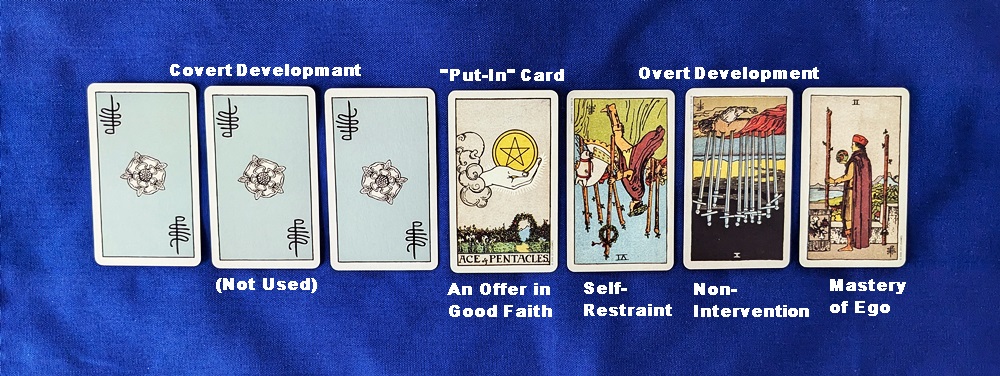
In this example reading I consider the Ace of Pentacles to be “overt” because it is plainly extending an offer and it is upright in orientation. I see it as making a forthright promise regarding some kind of material or physical benefit.
Both the reversed 6 of Wands and the reversed 10 of Swords convey an impression of refraining from active engagement once the proposal has been floated. These dormant cards exhibit a subdued “let the chips fall where they may” attitude that refuses to entertain false optimism but hasn’t quite succumbed to pessimism They seem to denote a slightly oppressive “wait-and-see” atmosphere.
The 2 of Wands becomes a “let’s make a deal” card since the nobleman is mirroring the gesture of the Ace of Pentacles while appearing to up the ante. This suggests impeccable self-control when approaching the bargaining table, and he is prepared to challenge the initial overture by making a compelling counter-pitch. Considering the advice of the previous two cards, his best bet would be to remain impassive and avoid overplaying his hand because he is in a secure position at the moment.
 Parsifal's Wheel Tarot & Astrology