AUTHOR’S NOTE: While I prefer to “just read the cards” and typically shy away from offering moral advice in my tarot readings, use of the cards for self-analysis and self-development invites its consideration in making value-based decisions about one’s life. The cards themselves are neutral on that score, so it’s a context-specific call the querent must make. Here is a spread that explores the possibility from a comprehensive action-oriented perspective.
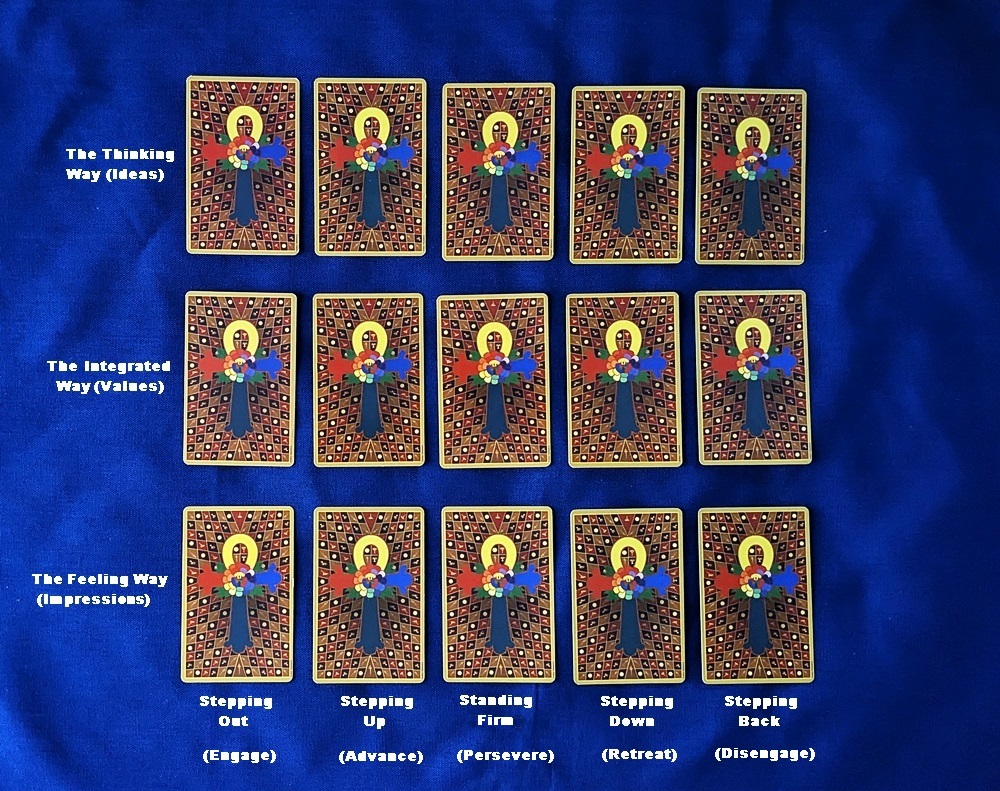
The ideal question to ask when using this spread is “What is the most conscientious way to proceed in the current situation?” The reading takes into account intellectual, emotional and moral (value-based) dimensions. The five columns show developmental aspects of pursuing these prerogatives, creating a rising-and-falling arc and reaching an end-point that invites reflection.
Begin by shuffling a tarot deck (reversals may be used) and then deal five cards left-to-right and face-up into the top (“Thinking Way”) row and five more into the bottom (“Feeling Way”) row. These rows show the boundaries of logical and emotional progress in the situation.
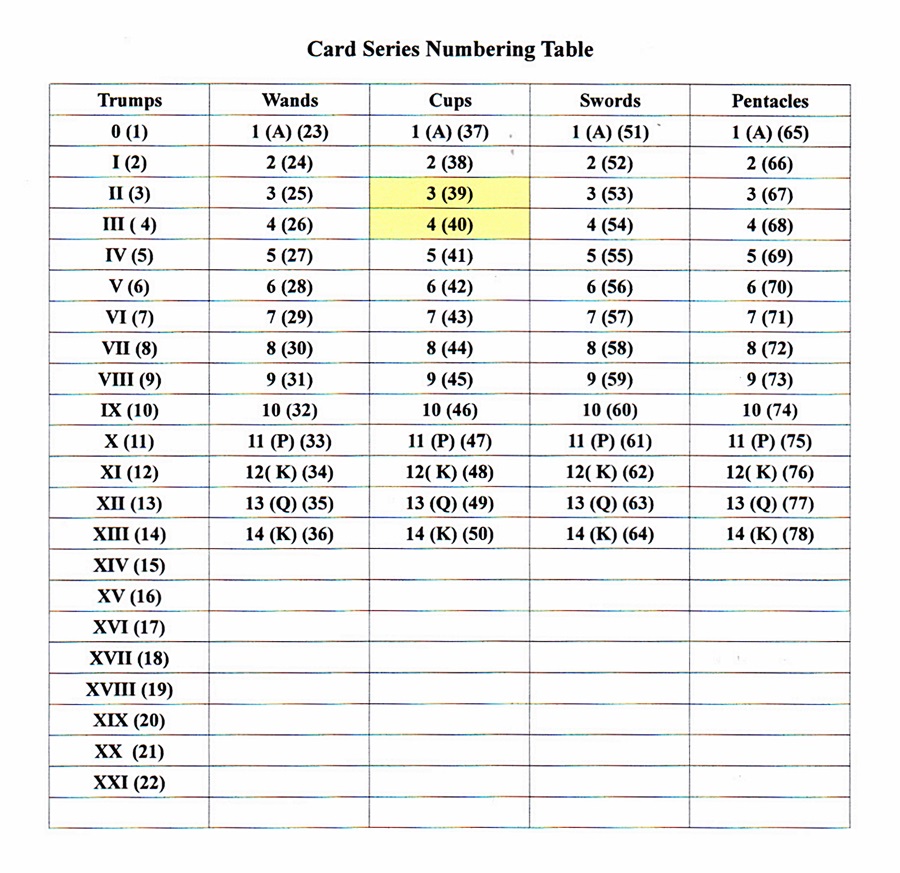
Next, using the attached table, identify the card that sits at the numerical midpoint between each pair of randomly-pulled cards and place it in the middle row, thus obtaining an impartial insight that integrates the two extremes (the split isn’t always equilateral, so you may be required to choose the most relevant option). This card is not conditioned by any other factors; it is just a “bridging” element that attempts to show the ethical upshot of the ideas and impressions that drive the matter forward. It should not be viewed as absolute but rather as advisory in nature, and it may not be balanced in its projection. It is up to the querent to decide whether, when and how to deviate from its advice.
Here is an example reading to illustrate the process:
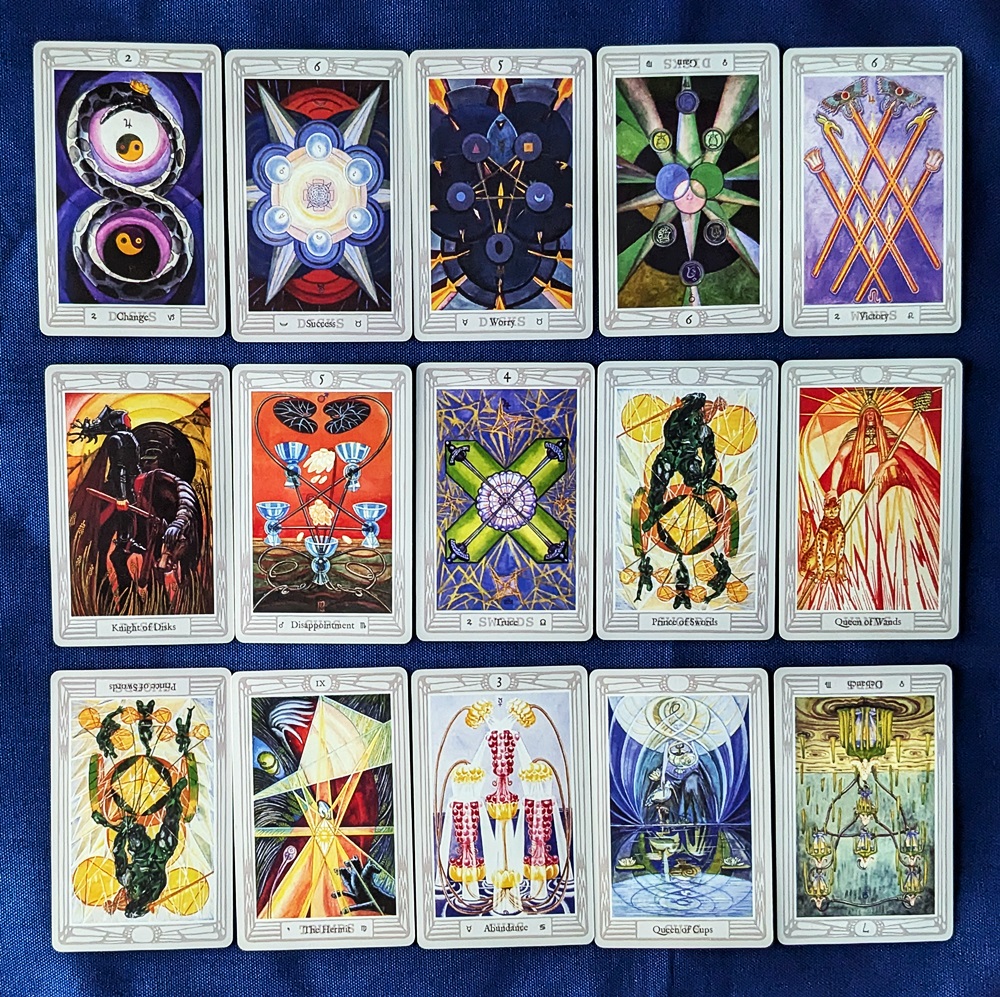
The “Thinking Way” presents an idée fixe in that it displays a single-minded focus on physical conquest. The 2 of Disks (Change) teaches the 6 of Disks (Success) some fancy footwork, but the motivating “two-step” does not reach a comfortable plateau with the 5 of Disks (Worry); however, the 9 of Disks (Gain) reversed signifies only a minor setback before the 6 of Wands (Victory) takes the spotlight. Earth and Fire are elementally cooperative, so (at least for the goal in mind) the outlook is favorable as long as it’s kept on the mundane level.
The “Feeling Way” is conflicted; it starts out dry-as-dust with emotions being withheld by the Prince of Swords reversed and the Hermit, but it gets “juicier” from that point onward. The 3 of Cups (Abundance) and the Queen of Cups are well-favored, but it all ends on a sour note with the 7 of Cups (Debauch aka “debasement”) as the parting shot. It implies leaving with a bad taste in the mouth. There is no hint of “happily-ever-after” in this scenario.
The “Integrated Way” shows a comparable decline in enthusiasm. The unsentimental Knight of Disks has one eye on the strategy unfolding above, knows exactly what he wants, and by all appearances is going after it. But the 5 of Cups (Disappointment) fails to offer him much traction, so he will have to settle for a stalemate in the 4 of Swords (Truce). The Prince of Swords makes another appearance as a “slippery character;” this guy is a “tap-dancer,” and here he’s going to “git while the gittin’s good” by dancing right out the door after stealing the Knight’s wallet. (The two suggest Shakespeare’s Falstaff and Pistol in The Merry Wives of Windsor.) Similarly, the Queen of Wands is planning to quit while she’s ahead and makes no bones about her exit: with the 6 of Wands hanging over her head, the Knight thinks he has her sewed up but she isn’t having any (and maybe that Prince of Swords is a bodyguard running interference for her).
I also might envision a domestic conflict in this sequence. The business-tycoon father (Knight of Disks) is severely disappointed (5 of Cups) in the son’s lackluster ambitions (4 of Swords), but the latter is a feckless “momma’s boy” (Prince of Swords) who is hiding behind her fierce protection (Queen of Wands). The father is too proud to admit defeat (6 of Wands) while the mother is being emotionally poisoned by the toxic situation (8 of Cups reversed). The son (initial Prince of Swords reversed) tried to make it on his own (Hermit) but had to be propped up (3 of Cups) and is now pretending to turn over a new leaf (Queen of Cups, or maybe that’s his meddling girlfriend . . . oops, value judgement) but is failing miserably (8 of Cups reversed).
Here is an alternate perspective using numerological convergence rather than numerical midpoints:
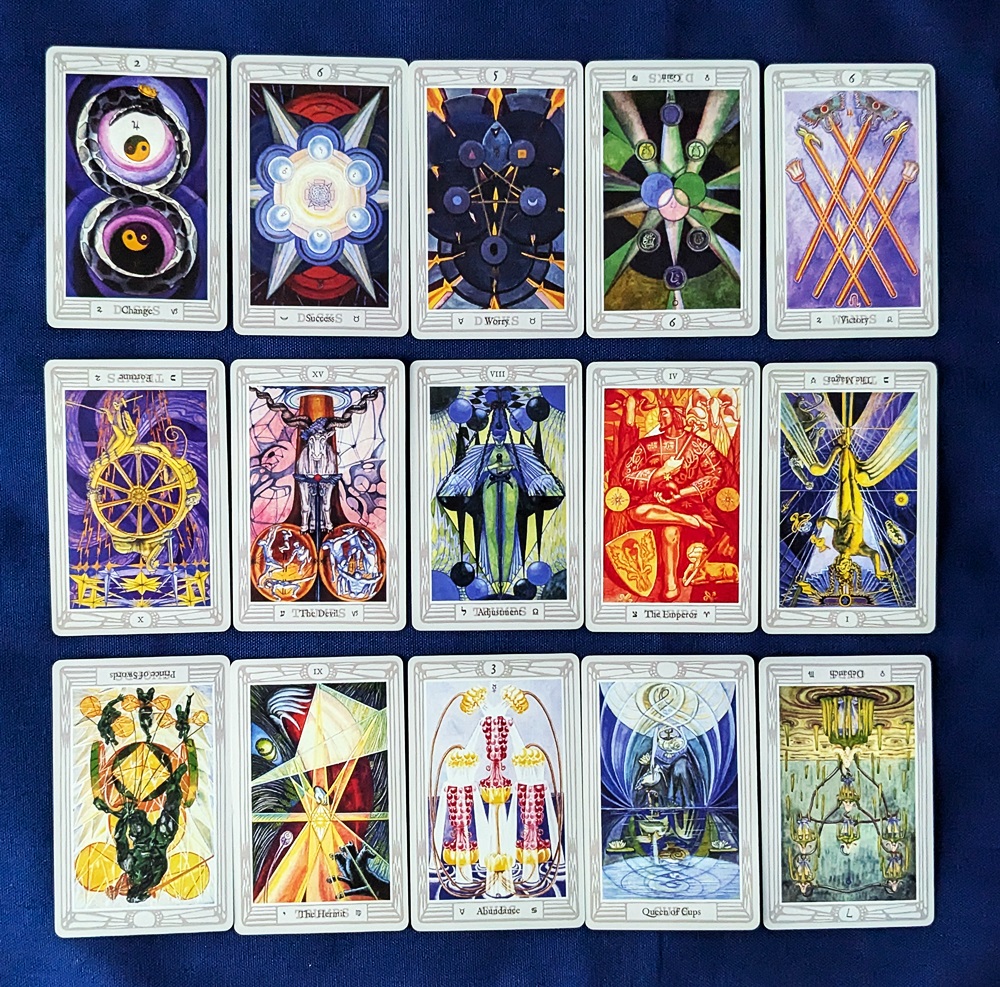
It’s possible to come up with a more profound verdict by calculating the “ternary essence” card for each of the vertical pairs and using them to populate the “Integrated Way.” The most interesting thing here is that the Devil and the Emperor face off across the scales of Justice (Adjustment).
It reminds me of the old “Donald Duck” cartoon in which Donald had a devil sitting on one shoulder and an angel perched on the other, both whispering advice in an ear. With the Wheel of Fortune reversed at his back, the Devil is likely to give the situation a devious “spin” while the Emperor is shadowed by the Magus reversed, causing him anxiety about the reliability of his “second.” The Magus and the Wheel of Fortune are “numerological counterparts” (10=1+0=1), so with their reversal there appears to be no solid ground for either party to stand on. Adjustment is going to have to “wing it” in deciding who has the better case, and the matter seems to end on a “false note” as the Emperor limps to the finish line on the back of the debilitated Magus. It could mean a “Pyrrhic victory” in which more is lost than won. The Devil just watches him go, satisfied that he’s “done his damnedest” to interfere.
 Parsifal's Wheel Tarot & Astrology