AUTHOR’S NOTE: Suppose that every card in a horizontal three-card line isn’t an isolated instance but rather the randomly-drawn locus of another perpendicular three-card set based on its “natural” position in the 78-card run. We would then have a nine-card tableau with “mini-storyboards” that can be read vertically and diagonally as well as in the usual linear, left-to-right way.
One of the enduring fallacies embraced by many tarot beginners when trying to get a handle on card interpretation is that each card has an “encapsulated” meaning that exists in a vacuum, and it must first be memorized before correlating it to the other cards in a spread. I would argue that each one is a member of a sequential continuum (here called a “matrix”) that involves an emerging or arriving influence; a steady-state or “indwelling” emphasis; and a fading or departing connotation. The preceding card “sets the stage,” the middle card describes the immediate impact, and the following card suggests the “fallout” or consequences of the interaction.
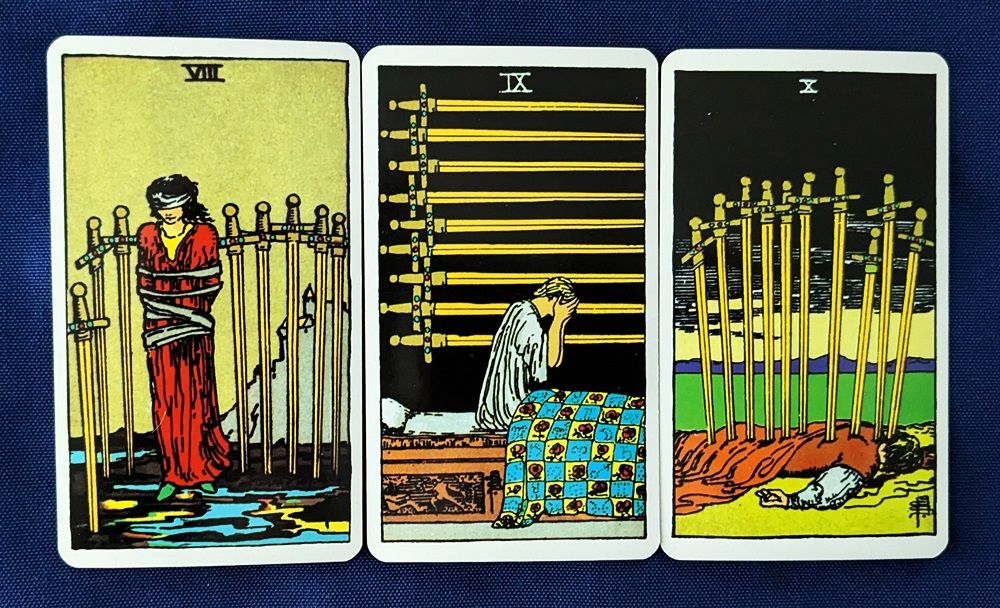
If we take an unbroken series such as the 8 of Swords, 9 of Swords and 10 of Swords, the outlook is quite bleak. The 8 of Swords conveys a feeling of being “lost;” the 9 of Swords depicts having just awakened from (and still suffering the effects of) a “nightmare,” and the 10 of Swords implies “you can run but you can’t hide” even if you escape unharmed from the “dark night of the soul” (we might dub it the “grim day of the reaper”). Any non-sequential card adjacent to one of these would most likely be tainted by its depressing aura.
This series reminds me of Paul Ruben’s character in Buffy the Vampire Slayer going “Ow! Ow! Ow!” or any number of apocalyptic rock songs (many of them by Bob Dylan). It has me thinking of The Weight by the Band:
I pulled in to Nazareth
Was feeling ’bout half past dead
I just need someplace
Where I can lay my head
“Hey, mister, can you tell me
Where a man might find a bed?
He just grinned and shook my hand
“No” was all he said.
(Doesn’t that 10 of Swords look like “sleeping under a bridge with the homeless?”)
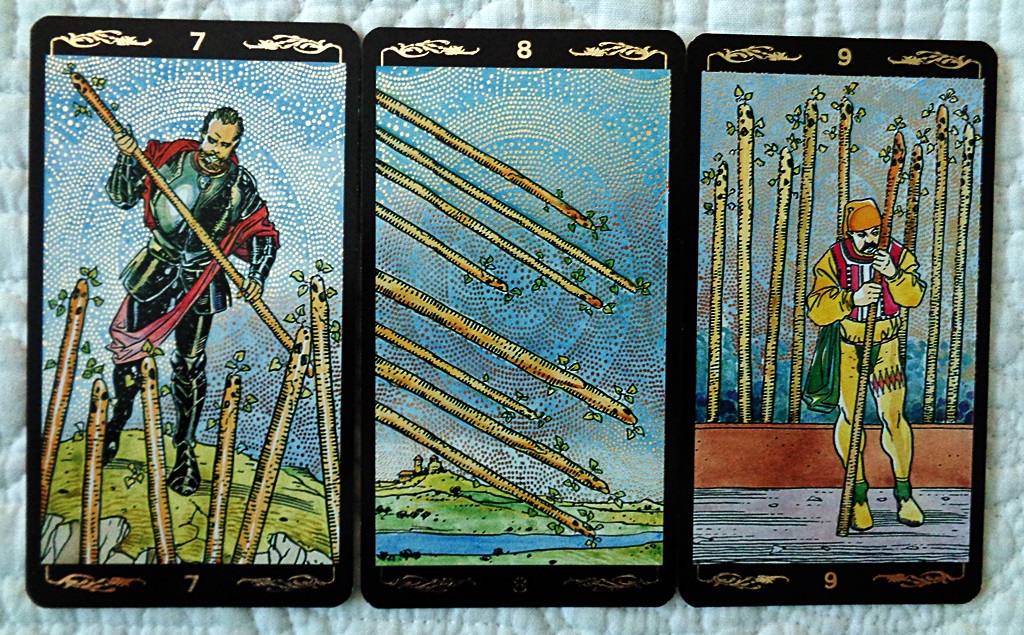
Another interesting anecdotal triptych is provided by the 7 of Wands, 8 of Wands and 9 of Wands (with the 10 of Wands as a “kicker”). I wrote an essay about this in 2018.
As the story goes:
A military scout encounters a superior force that he can’t handle; he fights a brave skirmish but is finally overwhelmed (7 of Wands). To avoid being captured, he beats a hasty retreat with the spears of the enemy falling all around him (8 of Wands). Wounded, he fetches up back at the fort, where he makes a “last stand” against the pursuing foe (9 of Wands). As a footnote, the battle may have been won but not the war; he is finally forced from the field and seeks refuge, carrying all his worldly possessions on his back (10 of Wands, not shown).
I see this model as a useful way to expand the reach of a three-card line. I’m proposing that we create a nine-card tableau from any randomly-pulled three-card set by finding the consecutive card preceding each drawn card and placing it above the original pull in a parallel row, and situating the card following it in the natural series below the first line in another analogous row. In this way, every card in a linear reading becomes part of a vertically-aligned triplet rather than merely offering single-pointed input. Consequently, instead of reading a single card for each position, I would present a top-to-bottom, three-card vignette that provides more detail while still remaining within the same field-of-operation (by suit, element and/or rank) as the primary card.
If the “focus” card appears at the end of its series, I would circle back to the beginning of the series and use the initial card for the complementary position (as I did twice in the example reading). I’m also toying with the notion of swapping the supplemental card placements if the main card is reversed; the flow of energy would then regress instead of progress, suggesting disengagement where the other way around it would show making headway. I decided not to reverse the supplemental cards to match a reversed “principal” card since their effects should be uninflected rather than conditional according to orientation.
After analyzing the three tripartite positions in this manner, I would read the upper row laterally as a tangential precursor to the main narrative showing “where the querent is coming from” at each phase of development, and the bottom row as a parallel successor commenting on “where they’re going,” with the aim of fleshing out the picture for a kind of “3D” perspective. It would also be possible to include the diagonal lines as revealing cross-cutting factors in the matter but I don’t think it would add much depth. Still, it might be worth a try if nothing else hangs together in the reading; in the example spread it seems to give the World substantially more “gravity.” This nine-card layout should provide a more atmospheric or environmental overview of the querent’s circumstances.
Here is an example reading:
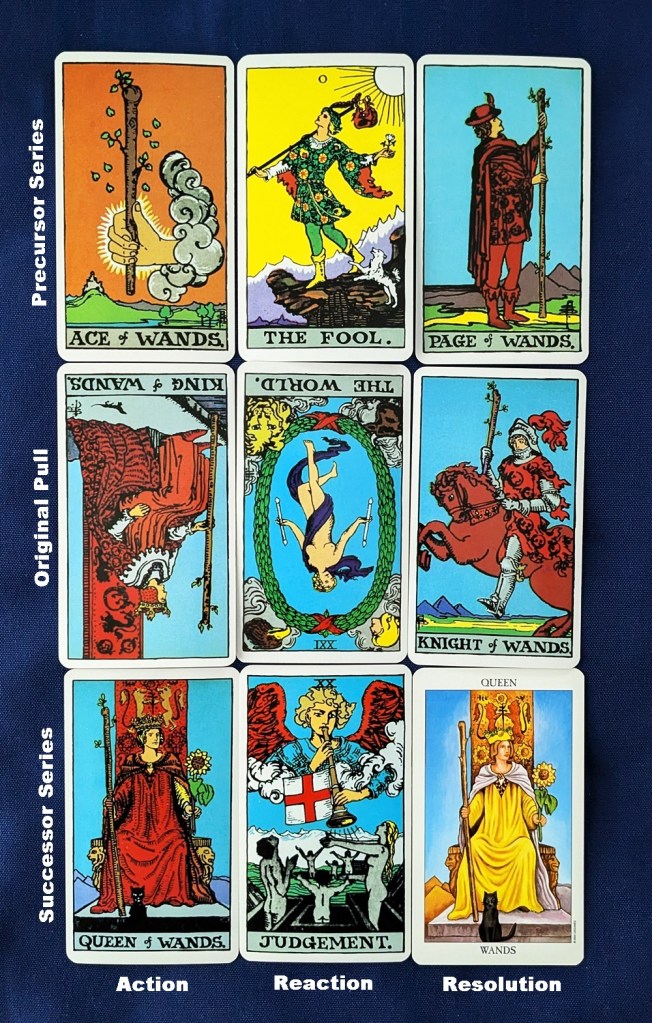
The subject of the reading is a situation in which it is incumbent upon me to act decisively but I have yet to do so. I asked what would happen if I choose to push my agenda forward at this time. I read this as an “Action/Reaction/Resolution” scenario.
The main narrative involves the King of Wands reversed; the World reversed; and the Knight of Wands. The first two suggest that the time isn’t right for mounting an ambitious effort, which is why I’ve been “hanging fire” rather than advancing. But the Knight of Wands is brash enough to push past those reservations, and the “Resolution” outlook seems to favor this as long as I have the energy to pursue it.
The King’s “matrix” includes the Queen of Wands and the Ace of Wands. Because the King is reversed, I placed the Ace above and the Queen below to imply moving from a state of potential to one of realization. The reversed King is willing to let the Ace of Wands reach its own level rather than forcing the issue, and this strategy looks promising since the Queen approves of being given this latitude.
The World’s “matrix” contains Judgement and the Fool. Once again, the World is reversed so I deposited the Fool above and Judgement below. Like the Ace of Wands, the Fool portrays an unforced initiative that says “What will be, will be.” However, Judgement insists on strong-arming circumstances into an unavoidable commitment, kind of a “collision course with destiny.”
The Knight of Wands’ “matrix” captures the Page of Wands and the Queen of Wands. The Page of Wands has similarities to the Ace of Wands in that it brings initiative and abundant energy to the table, but also a native aptitude that the Ace can’t deliver. The Queen of Wands is once again nicely attuned to this prospect and in this case represents a constructive advance from the of raw enthusiasm of the Knight, unlike its reservations about the hesitant posture of the King of Wands.
The “precursor” row of Ace of Wands; Fool; and Page of Wands is like a fuse waiting to be lit. Once ignited, the potential looks to be uninhibited in its energizing influence.
The “successor” row of Queen of Wands; Judgement; and Queen of Wands is an interesting proposition. The doubling of the fiery Queen along with the card representing Primal Fire could signify an endeavor that gets out of hand in its passionate execution. The twin Queens will see only the stimulating opportunity and not the cautionary implications of “an offer they can’t refuse.”
In essence, I need to be careful about “biting off more than I can chew” in my optimistic drive toward fulfillment. However, the impression I get is that the Queen of Wands has the matter well in hand both “coming and going,” so I can see no reason to resist taking a chance as long as I think I can live up to her expectations.
 Parsifal's Wheel Tarot & Astrology