AUTHOR’S NOTE: This is one I didn’t see coming, and I wasn’t quite sure where to go with it. But I think I got there in reasonable fashion.
I was reading about the Taiji concept of “patience” recently and unearthed an interesting fact: the two pictographs (aka “radicals”) that make up the Chinese logogram naixin, expressing the concept of “patience, endurance, perseverance or sufferance,” depict a blade and a heart. Here is a brief overview from the site Calligratherapy:
“The character for patience 忍 is composed of two radicals: 刃 (knife) and 心 (heart). This juxtaposition provides a visual representation of the meaning behind patience. The knife represents the act of restraining oneself, while the heart represents the motive or reason for doing so. Together, these two radicals illustrate that patience is an act of self-restraint driven by compassion or love.”
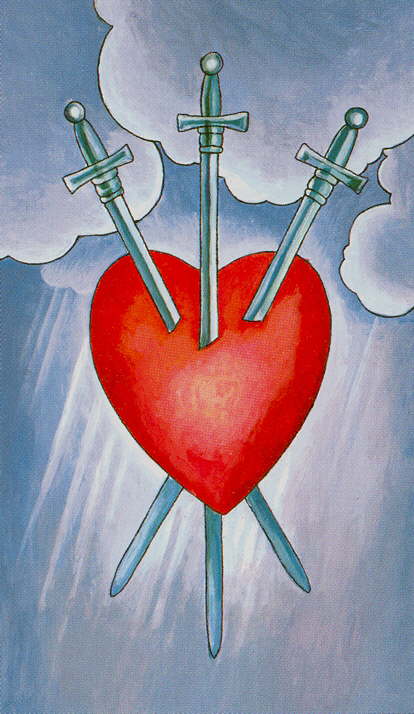
The conflation of these pictographs into a single symbol immediately struck me as a remarkable parallel to the 3 of Swords card in the Waite-Smith tarot and its inspiration, the late-15th-Century Sola Busca tarot. In that card, the image of a heart is transfixed by three swords entering from above, while somber clouds and rain dominate the background. It has me wondering whether commerce between Europe and China over the Silk Road until the mid-15th Century had anything to do with the cross-cultural appropriation of the “blade-and-heart” symbolism. Most of the tarot histories I’ve read propose that the Asian influence entered Europe by way of the Middle East and the Mamluk cards. Is it possible that this hypothetical link to Chinese mysticism leaped right over the Mamluk cards via a direct Silk Road connection?
Modern readers take one look at the pierced heart and say “It obviously means that heartbreak or some other emotional trauma is coming your way.” They seldom spare a thought for the fact that the coldblooded suit of Swords relates to matters of the rational mind in general, and to arguments or disagreements in particular. In that sense, the heart is a “red herring” that leads the observer astray into ominous predictions of imminent emotional angst. The fact that there is no blood dripping from the sword-points suggests a rather dry-eyed, unblinking confrontation; it reminds me of staring down an enemy.
But even if they did know about the cerebral nature of Swords they wouldn’t recognize that in esoteric number theory Three isn’t a harsh number but one of growth, expansion and opportunity; this must be reconciled with the impression left by the dismal scene. I chose to call it the “no pain, no gain” card that represents a surmountable challenge, but I think there is more to the story than that.
The nature of a sympathetic heart is to open up and embrace the object of its attention, while that of a sword is to separate and interdict. As envisioned in the quote above, I can certainly see the swords in this case as symbolizing the self-denial that shuts us off from making our expectations known (even if they aren’t related to feelings). The steadfast resolve to overcome this mental block is about as close to the idea of “patience” as I can come with this card.
There is a feeling of guarded self-preservation to it in which the swords offer a bulwark against sentimental vulnerability. I’m reminded of Aleister Crowley’s exercise in mind-control during which he cut himself with a razor every time he inadvertently spoke a word that he had resolved not to utter, although I’m not sure how much “self-love” there was in the act.
I once saw it defined as suffering a verbal attack or malicious gossip, and being seriously offended by it. Another thought that crossed by mind is being tongue-tied, bringing to mind the slightly awkward verse from Pink Floyd’s Learning to Fly:
“Can’t keep my eyes from the circling sky
Tongue-tied and twisted
An earthbound misfit, I”
The “circling sky” is perfectly portrayed by the gray, rain-swollen clouds, while the sword-points coming out the bottom of the heart were apparently seeking to bury themselves in the earth when they punched through. However, the strange image is still floating in the air and has nothing to strive against except its own malaise, so “twisting in the wind” is a serviceable metaphor that also implies stoic resignation. This idea of uneasy apprehension is one I’m going to use in my readings.
At any rate, nothing is happening in the immediate future, so we must wait it out as calmly as we can with the comforting knowledge that resolution driven by the dynamic Three is seldom long in arriving. For this reason I’ve always considered the adverse effects of this card to be shallow and short-lived, more a temporary inconvenience than a heart-wrenching disaster.
Postscript:
As part of a conversation about this essay on one of the Facebook pages, I made a few more observations regarding the 3 of Swords:
“I work with the Qabalistic model at the philosophical level and have since 1972, but I find that Pythagorean number theory works better for me at the practical, action-and-event-oriented level that I do most of my tarot work. I’ve wrestled for a long time with Aleister Crowley’s title of “Sorrow” for this card. I understand the connection to the “Dark Mother” in the Sephira Binah, but I once wrote an essay that talked about Buddha’s “sorrow of attachment to the world” that the transfixing swords seem to suggest.”
Thus, this card could signify being “pinned down” to something we would rather not face: an unpleasant thought or feeling; an onerous promise or commitment; a risk of exposure to some kind of mental anguish, however fleeting. In this sense of being caught in a bind, “twisting in the wind” is a compelling metaphor, although being “turned on a rotisserie” may be an even better one.
 Parsifal's Wheel Tarot & Astrology