AUTHOR’S NOTE: I’m always looking for new ways to pre-select a subset of the 78-card deck that shrinks the playing field and allows pulling the cards for the reading from a narrower population. This one uses a 24-card template that, with the addition of a single six-sided die, produces a four-card run complemented by a calculated numerical “quintessence” card.
Begin by identifying a Significator to represent the querent or the current status of the situation. This card can be intentionally chosen or drawn randomly from the deck, and it should be placed at the left side of the reading surface.
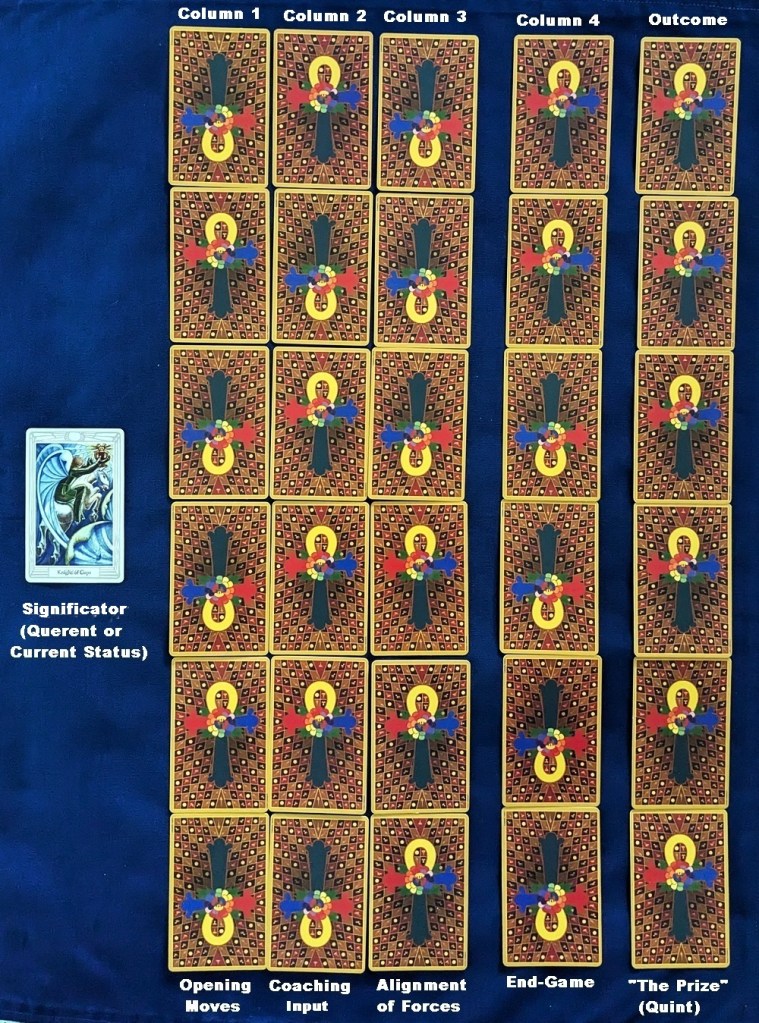
Shuffle the rest of the cards and deal 24 cards face-down into a “4-across-by-6-down” grid to the right of the Significator; set the remaining cards aside. These 24 cards represent the overall “developmental profile” for the matter, and they can be laid in any order. (This is the “maze” of the title.) The “quintessence” column at the far right is not dealt at this time and is only populated in the example for illustration purposes.
Roll the six-sided die four times, with each successive roll singling out a card from one of the six rows and four columns, moving from left to right and leaving those cards face-up. (See the second photo below, for which I threw a “two-spot” in the second row of the first column; a “one-spot” in the first row of the second columns; and a pair of consecutive “six-spots” in the sixth row of the third and fourth columns.)
Calculate a “quintessence” (numerical roll-up) from the face values of the four cards thus revealed. This number must be between zero and 22 or, if larger, it must be numerologically reduced to within that range. It will highlight a trump card to convey the long-range consequences of the near-term situational outcome. (If the designated trump isn’t present in the remaining cards it will already have been dealt, so take it from a second deck rather than hunting for it in the layout.)
The position meanings given in the examples are my own creation, but this spread can be read as you would any “4+1” layout such as the French Cross. My notion here was to view it as a “coached” sporting event with opening moves, mid-game redeployment (substitutions), a resulting realignment of forces, and a completion (or “end-game”) scenario.
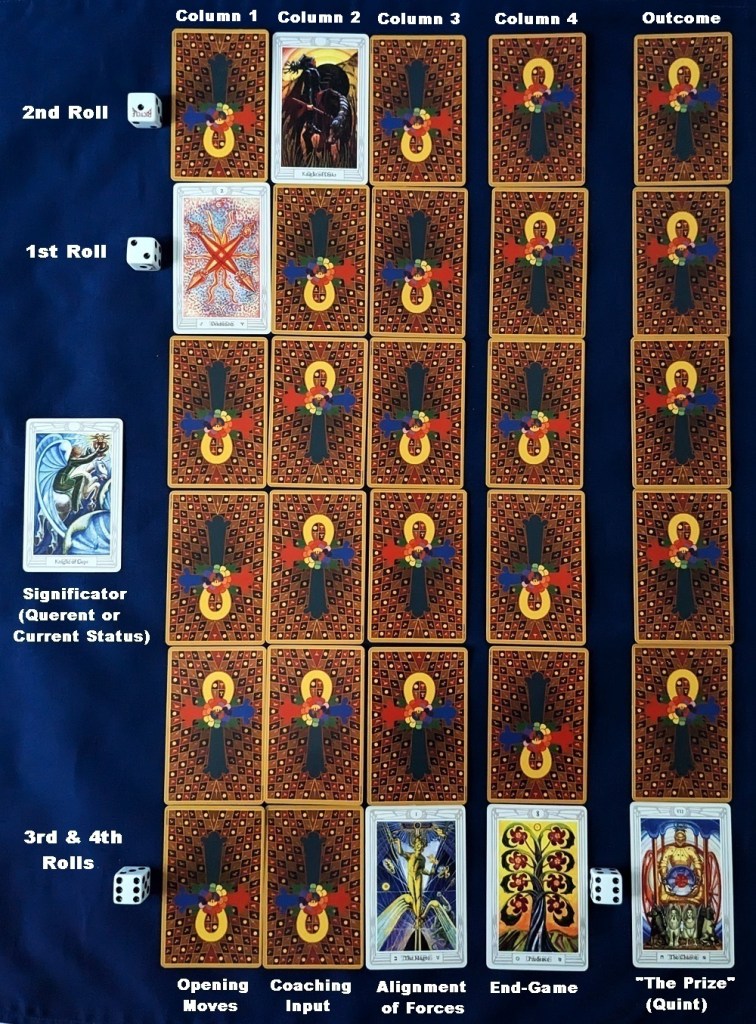
In this example reading I looked into a matter that has been on my mind for some time. The 2 of Wands (Dominion) in the “Opening Moves” column describes a bold and brash head-on charge into the fray, but the advice of the Knight of Disks in the “Coaching Input” column is “Slow and steady wins the race.” The Magus in the “Alignment of Forces” column shows that I have the foresight to recognize the wisdom of this counsel and therefore won’t go off half-cocked (although I’m certainly itching to). The 8 of Disks (Prudence) as the “End-Game” card suggests that the concepts of discretion and tact will take root in my awareness of the situation and will keep me in line. The upshot of all this measured heedfulness is the Chariot as “quint” card, a harbinger of triumph in physical matters. However, if I had reduced the sum using “casting out nines” rather than “Theosophical addition,” I would have received the Tower, with its warning that one false step could spell disaster. (I think I’ll stick with the Chariot.)
 Parsifal's Wheel Tarot & Astrology