AUTHOR’S NOTE: “Ace in the hole” is a stud poker-players term for a face-down Ace or similar high card that the other players don’t know about until it is played for the win. Here is a spread that uses reversals to create a “resource pool” of hidden cards that can be tapped when the predicted flow of events is unfavorable. Rather than suffering in silence, the querent can attempt to recover by replacing any unforgiving cards with others from the pool that will ideally be more agreeable. Consider it an anticipatory mid-course correction or detour around a foreseen obstacle.
This spread requires using a deck that has non-reversible backs so you can see the orientation before turning the cards face-up. Begin by shuffling the deck face-down in a way that introduces random reversals. Then, instead of pulling from the top, cut the deck anywhere in the middle and observe the upright or reversed condition of the card exposed. If it is upright, place it face-up in the top row, going from left to right; if it is reversed, place it face down in the bottom row. Continue cutting until you have five face-up and five face-down cards in the layout. (If you fill one row first, keep cutting and pulling until you complete the other one, disregarding any surplus of the opposite type.)

Examine the face-up cards in the “Flow of Events” row to see if any are any “hard spots” in the reading, any particularly troublesome auguries. After assessing the impact of those difficult cards, turn over the reversed card below each one in the “resource pool” as an “ace-in-the-hole” opportunity that will hopefully facilitate recovery.
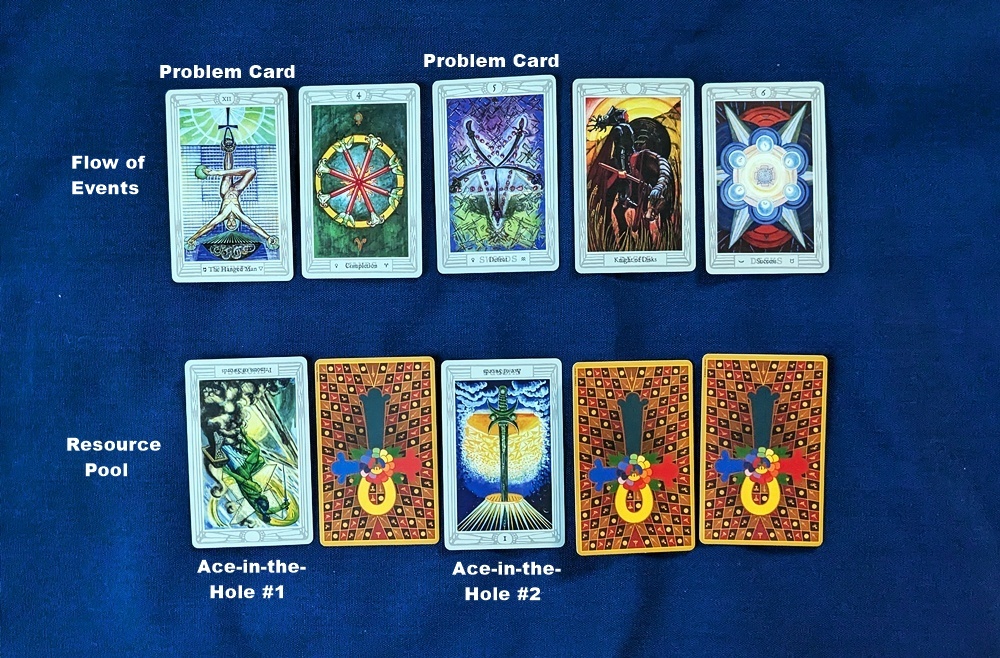
Replace the problem cards in the “Flow of Events” chain with the reversed recovery cards, maintaining their orientation. Read the reconstituted five-card line as an alternate narrative that reflects a slight change in course that may or may not arrive at the same destination depending on where in the original pull the recovery had to be initiated. Because the cards are still reversed, they will exhibit a slightly altered mode of delivery and angle of attack for their energy, creating inflection in the story-line. Here is the outcome of the example reading.
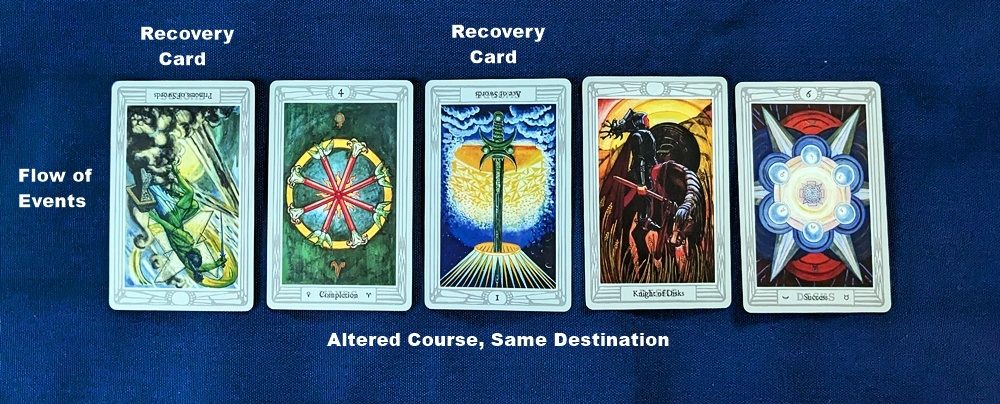
Because the Hanged Man and the 5 of Swords in the original pull were seen as sources of frustration in trying to wrangle the 4 of Wands, I replaced both of them with hidden recovery cards from the resource pool. The Princess of Swords and the Ace of Swords are sharply-focused, no-nonsense cards that add a little “bite” to the proceedings by tightening up on the general malaise of the Hanged Man and the 5 of Swords. There is no getting off lightly with this pair! Both reversed cards are elementally sympathetic to the 4 of Wands, providing clarification of its purpose that gives the Knight of Disks a more coherent situation to work with, but he will have to deal with their impatience because they are not only reversed, suggesting a contrarian attitude, but also elementally hostile to his suit. He might wind up thinking that the cure is worse than the disease, although he has broad shoulders and should be able to handle the criticism.
 Parsifal's Wheel Tarot & Astrology