AUTHOR’S NOTE: I’ve tried numerous methods of reckoning the likely date (or at least the date-range) for the occurrence of future events using the tarot, both conventional techniques and those of my own design, but I’ve never been satisfied with the results. In recent years I’ve used a “block timing” approach to generalize the window but found it too vague to be useful. Here is another attempt along those lines that comes down in the middle, offering a flexible “binning” approach that avoids having to assign specific time periods to individual cards. It also recognizes that the farther out in time we go from the date of a reading, the broader the “bins” become due to the possible intervention of unexpected factors.

There are two ways to make this call. One is to select a card from the deck that best portrays the anticipated event, leave it in the deck while shuffling, and deal the cards from left-to-right into the layout until the selected card appears to reveal the target period. A second approach is to use the outcome card from a previous reading that had an inconclusive end-date, leave it in the deck and proceed as above.
Another optional step is to examine any cards that land in the significator’s stack before it turns up in the draw. These underlying cards can describe the circumstances leading up to conclusion of the matter.
As always, the proposed duration of any delay should be in line with the span of time that is typical for an event of the type being considered, assuming that it isn’t completely open-ended in the sense that it may not happen at all. (If its likelihood is uncertain, the first question should not be “when” but rather “if” it will transpire.) When a forthcoming event has a reasonable projection of a month or less in the future (for example, hearing about a job application), it may be prudent to truncate the layout to the first five cards, while at the opposite end of the spectrum (say, for an event that is “seasonal” in nature), if it can only occur under certain conditions the target range could be similarly narrowed.
I one wrote an essay titled “Fudging, Hedging and Guessing: Random Thoughts on Timing” that included the following observations and opinions that I still stand by:
“Some readers think it’s prudent to take the position that tarot should not be used to foretell upcoming events and circumstances in the first place, thereby dodging the whole question of chronology. If we don’t try to predict the future, the timely appearance of any conceivable scenario becomes a moot point. Unfortunately, this won’t meet the expectations of many (if not most) seekers after the tarot’s wisdom who want to know both “what” and “when,” so we should be prepared to at least offer an opinion on the ‘ETA’ of anything we propose as an outcome.
Even in the most tenuous cases, we should be able to glean a little insight from the cards in the form of an educated guess, although my mildly cynical take on tarot timing demotes it to more of a ‘SWAG’ (scientific wild-ass guess). I hate to be evasive in my professional observations, but the phrases ‘fudge factor’ and ‘hedging our bet’ (although I wouldn’t use them with a client) also belong in our vocabulary when tackling a matter of timing.”
Here is a brief example reading using the present model. Our daughter and her husband have been thinking seriously about moving back to New England from North Carolina to be near family. I chose the Waite-Smith 10 of Cups as the “significator” and asked when we are going to hear more about their plans. It showed up in the “2 Quarters” (or 180-day) time-frame with the 6 of Pentacles and the 4 of Wands beneath it.
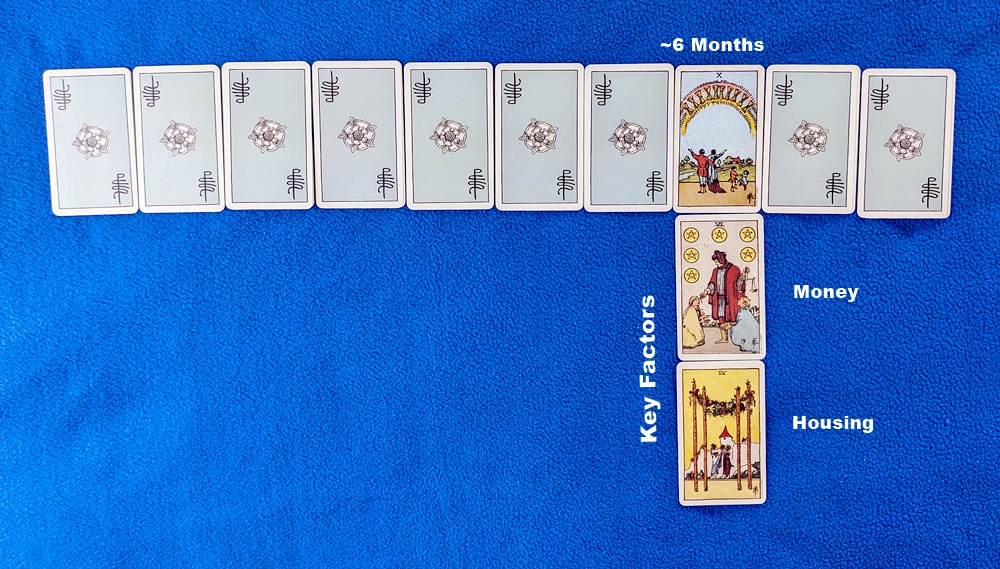
The reading indicates that it will be in the vicinity of six months before they’re in a position to make a final commitment. As shown by the cards beneath the significator, money and the availability of affordable housing are key factors in this decision, but there is nothing to indicate that they will be “show-stoppers.”
 Parsifal's Wheel Tarot & Astrology