AUTHOR’S NOTE: The five-card French Cross spread (officially the tirage en croix) is an ideal layout for gaining insights about straightforward action-and-event-oriented scenarios. Not long after I discovered it on Aelectic Tarot back in 2011, I searched the web and found the Cartomancier site (linked below), which I’ve been using for guidance ever since. The author of the article mentioned that there are many personalized versions of the spread, so here is another one.
The historical definitions of the four arms of the pattern and the middle position are as follows:
Position 1 represents you facing the question, the positive aspects of the situation.
Position 2 represents what works against you, the negative aspects of the situation.
Position 3 is the advice, how to deal with and judge the positive and negative aspects of the question, represented respectively by positions (1) and (2), and how to resolve them.
Position 4 is the outcome, what happens when following the advice of card (3). This is the final result.
Position 5 is the synthesis, what links everything together.
I decided to give each position a more strategic connotation, with Position #1 (at the left) describing the opportunity that presents itself for consideration; Position #2 (at the right) indicating any strictures that hamper pursuit of that opportunity; Position #3 (at the top) advising the strategy that would be best to adopt; and Position #4 (at the bottom, renumbered #6 here) showing how enactment of the strategy is likely to play out. I turned Position #5 at the center into a two-card tableau defining the tactics that serve as a kind of “glue” binding the other four elements together; the cards are numbered #4 and #5 because tactics usually aren’t unplanned, they evolve from strategy. The top card of the pair reflects the “overt” approach to achievement of the goal, and the bottom card conveys a more covert or clandestine success path.
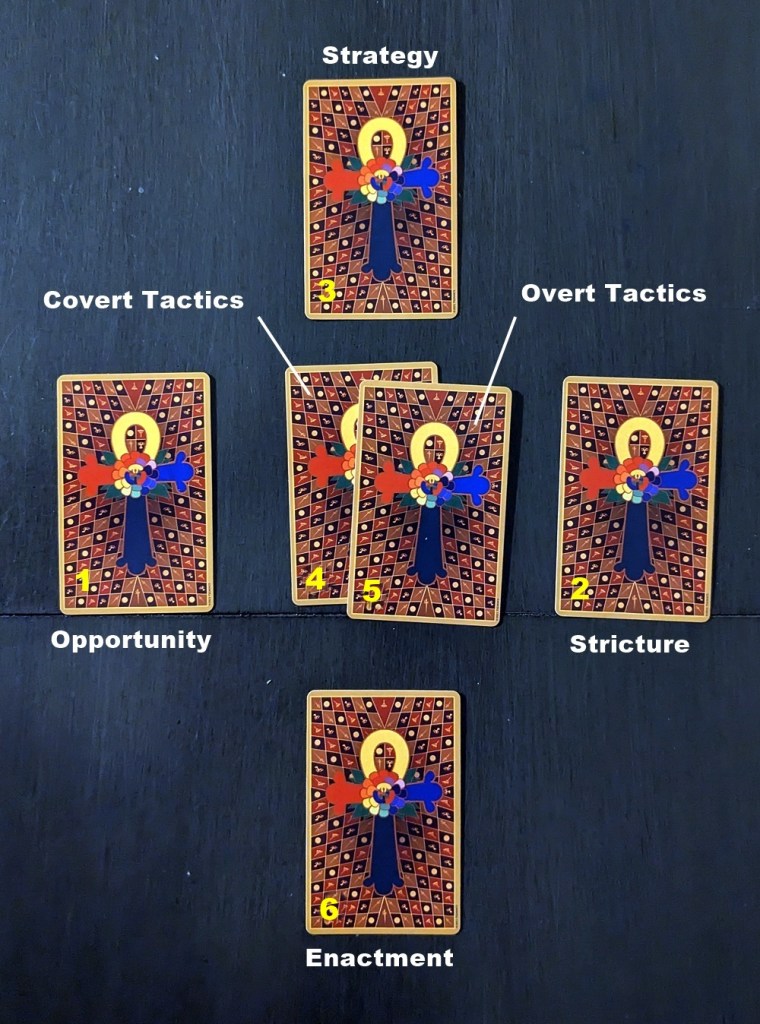
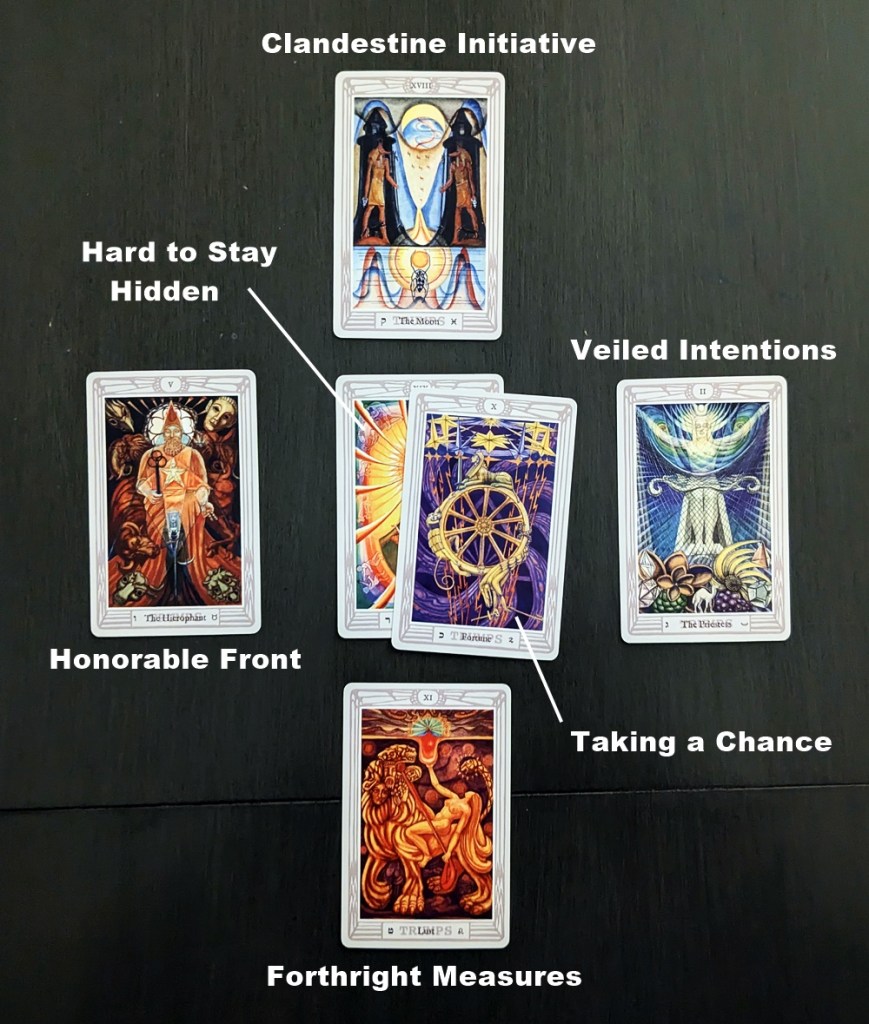
The tirage en croix is traditionally used with only the 22 trump cards. My own belief is that the trumps, rather than showing major events of great significance, provide more of a broad environmental or atmospheric backdrop for the events and circumstances revealed by the court and pip cards. Therefore, I elected to split the reading into two operations: the first one is performed with only the trump cards to obtain a “lay of the land” perspective that underlies the specific – and more actionable – details of the second operation that is populated with the rest of the deck.
Here is an example reading to illustrate this method. It involves what was ultimately a failed ambition, although in truth the objective was not particularly ethical in the first place. The trump-card pull displays the seeker presenting an “honorable front” (Hierophant) but harboring more ambiguous and eventually devious intentions (two lunar attributes exhibited by the conjoined Priestess and Moon), then trying to make good on them with a bold gamble (Wheel of Fortune and Lust), but I think the irrepressible Sun in the “covert tactics” position gives the game away prematurely, drawing unwanted attention to the querent’s pushy display of force. It suggests being “caught red-handed.”
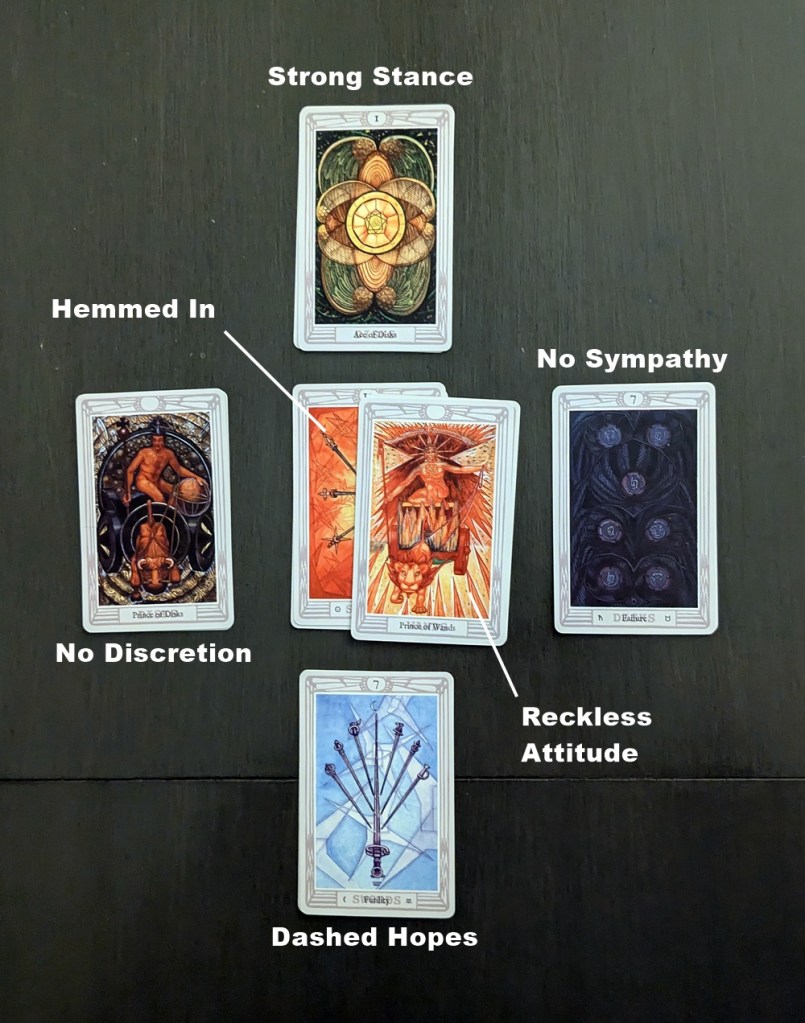
Following this high-level overview, I shuffled the rest of the deck and drew six more cards; laying them in the same sequence on top of the original trump cards. The Prince of Disks in the Opportunity position implies a lack of finesse in approaching the objective, a certain ham-handed clumsiness that evinces little self-awareness. It shows that the noble presentments of the Hierophant run only skin-deep. The 7 of Disks (Failure) in the Stricture position makes it clear that this does not go unnoticed by the target of the querent’s interest. The Ace of Disks in the Strategy position gives the impression that the aspirant will try to force the issue by coming across as physically imposing or commanding (it suggests ostentatious “flexing”), thus doubling-down on the Prince of Disks’ insensitivity to nuance. (I’m envisioning Madeline Kahn in Young Frankenstein going “Woof!” when contemplating the creature’s supposed “endowment,” and I don’t think Aleister Crowley would have demurred.)
The Prince of Wands in the Overt Tactics position has an air of desperation about it as it tries to blow by the mundane constraints of the previous three cards; although it is in tune with the Wheel of Fortune, it may be out of its league. The 10 of Swords (Ruin) in the Covert Tactics position intimates that the effort will go nowhere, as the querent’s every move will be exposed to scrutiny in the glare of the Sun; it looks like “checkmate” to me. The 7 of Swords (Futility) in the Enactment position might as well pack up and go home since there is nothing to be gained by pursuing the tactical agenda. The two Swords are elementally hostile to the three Disks, and the slapdash Prince of Wands doesn’t have the horsepower to carry the day.
 Parsifal's Wheel Tarot & Astrology