AUTHOR’S NOTE: The panorama of 78 tarot cards is often described as a “map.” Some say that it portrays the dimensions of the objective Universe, others consider it a “roadmap of life” into which we can dip to extract the itinerary for a particular leg of the journey (stay tuned, there may be a new spread in this analogy). Still others view it as displaying the mystical or spiritual “real estate of the Mind.” In this essay I will try to get my head around what it means in my own practice. (Copyright information for all cards used in the examples is provided in the linked posts.)
Various attempts have been made to lay out the full deck in a miscellany of arrays that purport to convey meaning; I’ve developed a few myself. (Alejandro Jodorowsky comes to mind in this regard.) The challenge is to produce a pattern that has practical uses beyond merely offering a fascinating graphic image. Most of those I’ve seen resemble mandalas that can be used for meditation, but I’ve encountered very few that are of any immediate value in divination.
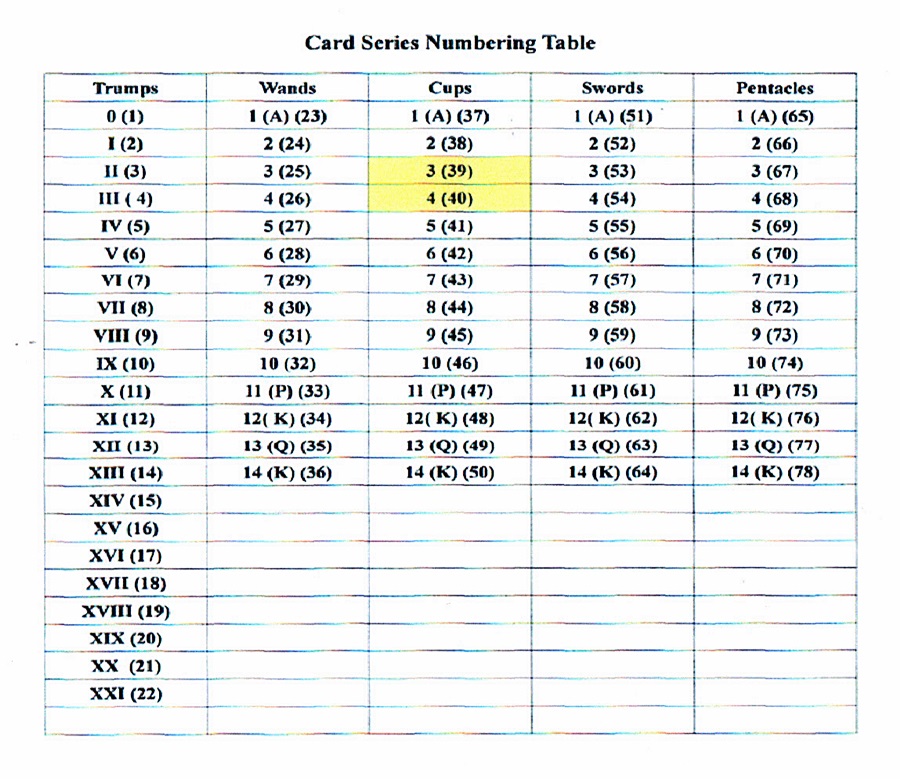
One of the most effective versions I’ve created turned into a table that displays the sequential trump, pip and court-card numbers but not the actual card images. I use it to find the numerical median card between any two random cards in a spread, which forms an approximation of midpoint theory as it is applied to astrological aspect analysis. This “hub” card receives special emphasis as the “mediator” for the energies of the two satellite cards.
The numbers highlighted in yellow below straddle the midpoint between 1 and 78, a situation that will occur at different points in the array whenever the cards at the extremities of a series are separated by an even number of intermediary cards. When this happens, the reader must make a choice as to which card of the bracketing pair best serves the mediating function for the energies involved.
This sounds more difficult than it is. In the “baseline” layout, the midpoint between the Fool (1) and the King of Pentacles (78) – which happen to be elementally antagonistic to one another – would be either the 3 of Cups (39) or the 4 of Cups (40). Since the harmonious 3 of Cups can’t really come to grips with the hostility between the two antagonists except to “pour oil on troubled waters,” I would go with the moodier 4 of Cups, which at least promises some stabilizing – and perhaps moderating – potential.
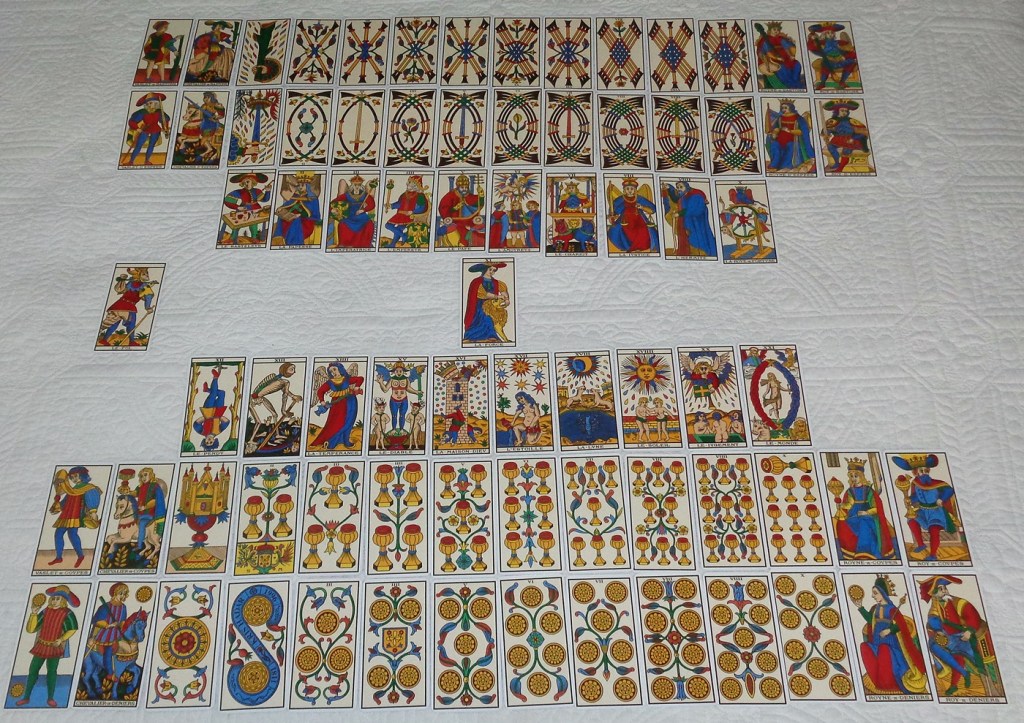
Another personal example is my layout of the Tarot de Marseille in a structured arrangement based on suit, rank and number. This pattern highlights the fact that Fortitude (Trump XI) holds a key position as the fulcrum or “tipping point” between the two segments. There is also an interesting numerical relationship between the trump cards above and below Fortitude. Under the photo is a link to the post that explains it.
In the realm of metaphysical syncretism, there is a powerful visual correlation between all (or at least most) of the cards when they are brought into play to link the Golden Dawn’s “Chaldean” model of astrological correspondences to an actual birth chart. (The three “primary element” trumps and the twelve “planetary” trumps don’t appear in the model but do show up in most “real-life” natal maps.) Below are the Golden Dawn’s zodiacal diagrams, followed by my own horoscope done up in tarot cards, and a link to a post describing what I did.
One useful way to draw information from this pattern might be to find the trump cards that are related to any planetary aspects in the horoscope (one aspect pair or group at a time, not all at once), then pull in the pip and court cards related to those specific degrees to create a spread that mirrors the energies, kind of like a tarot adjunct to aspect analysis. At the risk of generating too much information, it could also be reasonable to bring in the cards related to the house cusps for those planetary placements since the presence of planets highlights those areas of life.
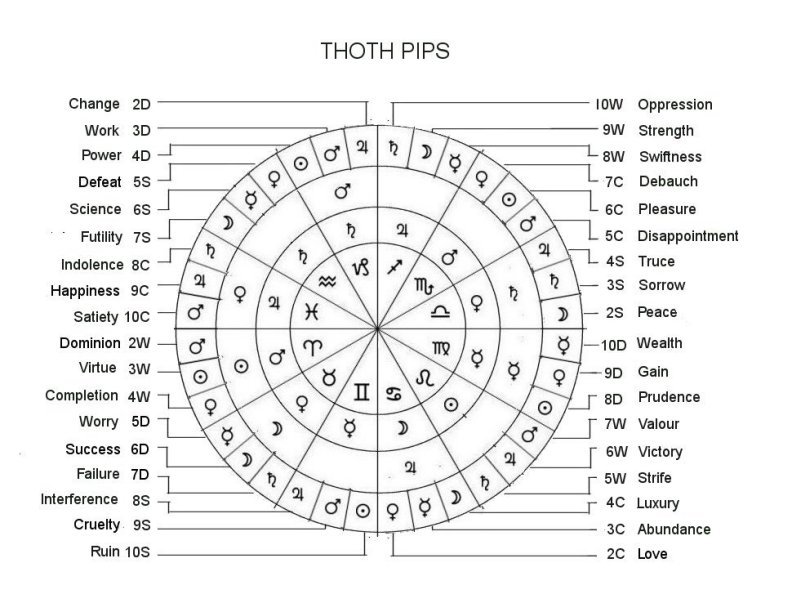
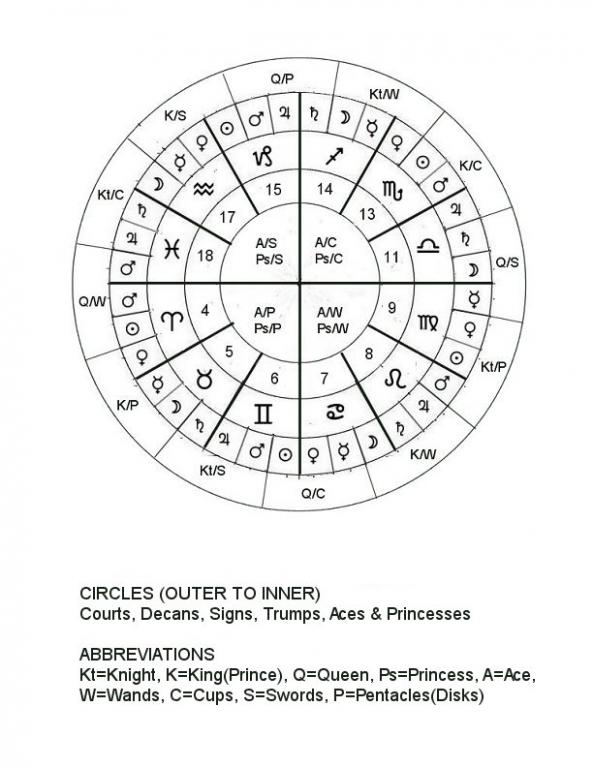
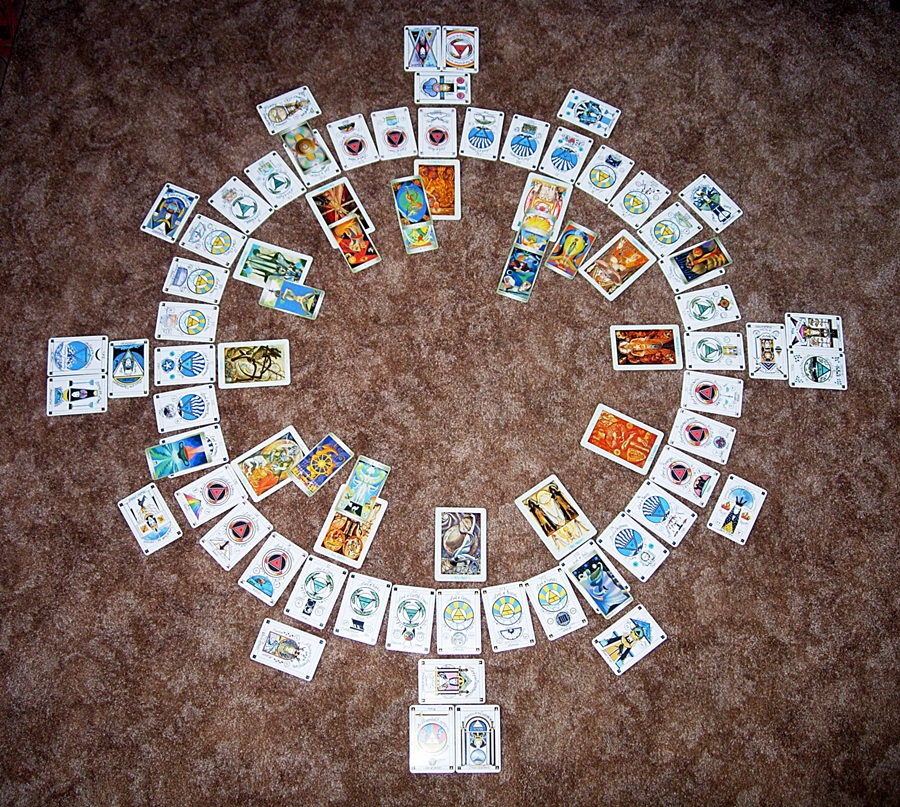
Finally, although I seldom use the 78-card astrological layout of the Golden Dawn’s “Opening of the Key” method because – when performed in combination with the other four “Operations” – I find it to be a case of “information overload,” I have a number of spreads that use all 78 cards in their performance, one of which is my “Train to Nowhere” missing-person spread. The objective is to lay out all of the cards face-down into thirteen piles of six, then find the Significator in one of the piles and interpret the cards surrounding it as the narrative for the reading. This approach has similarities to the initial step in the First Operation of the “Opening of the Key.” I don’t have a jpeg image for it but you will find it attached to the following link.
https://parsifalswheeldivination.org/2017/07/31/the-train-to-nowhere-missing-persons-spread/
These examples show the most significant ways in which I’ve addressed the panoramic presentation of a full tarot deck. I’ve created a few others that split the deck into segments (usually by suit or element) for much the same purpose. In general, I find working with the full population to be unwieldy from the standpoint of practical divination, but it has its uses as a kind of topographical map of the landscape similar to the Lenormand Grand Tableau but much more expansive. Watch out for the spread that I mentioned above!
 Parsifal's Wheel Tarot & Astrology