AUTHOR’S NOTE: In my previous post about 78-card tarot arrays I hinted that I might come up with a new spread based on that premise. Here it is, and there are two suggested ways to use it that will identify a subset of cards for the actual reading. (Obviously, I don’t advise attempting this sprawling monstrosity during a face-to-face client session.) All images are from the Albano-Waite Tarot, copyright of US Games Systems Inc, Stamford, CT.
Begin by shuffling and cutting the deck while concentrating on what you want to know. In the example reading my question was “What will become of an initiative I’ve been contemplating?” As noted below, this tableau lends itself to multiple questions on the same theme, so make the first inquiry as broad as possible.
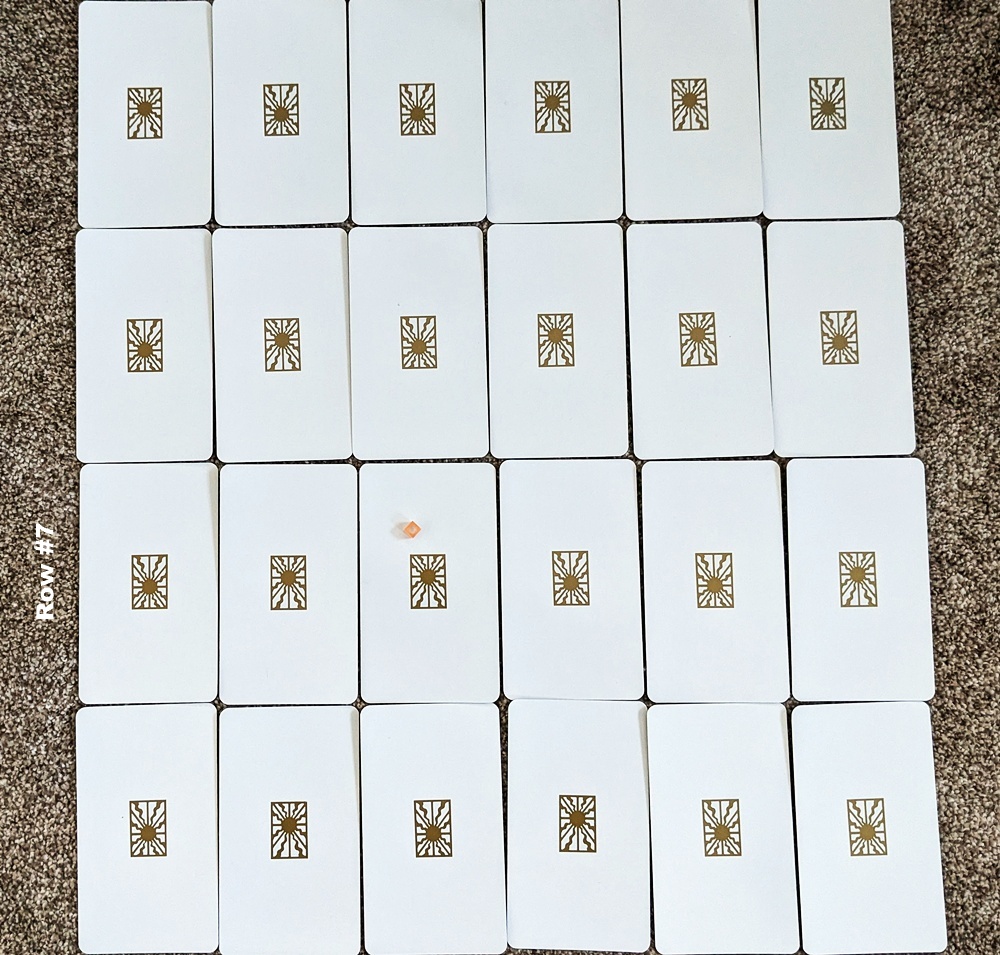
Then deal the cards face-down into 13 rows of six cards each as shown below. I generally avoid spreads with an even number of cards in each row because there is no “hinge” or transition card that might signify a turning-point in the matter, but here – because the math doesn’t work out – I’m assuming that Cards #3 and #4 represent a gradual rise-and-fall in the querent’s circumstances rather than a sharp “cliff” or steep decline in momentum after the turnaround.

Next, randomly select one of the rows for interpretation. You may come up with another method, but the one I chose was to cast a small, lightweight token of some kind onto the layout. (I use a plastic bead that won’t scatter the cards when thrown onto them.) My original thought was to have a “backsplash” – the black barrier in the photo – off which to bounce the token (like the crap-shooter’s wall in back-alley gambling) so it could conceivably rebound across the whole pattern. But in practice it kept landing on one of the top three rows because it was too light, so I changed my mind.
Instead, I turned my back on the cards and threw the bead over my shoulder onto the array. This could take some practice to get right, but I hit it on the first try, highlighting Row #7 of thirteen. (If the token slides off the cards, try again until you get a toss that works.) Because this layout is so laborious to set up, it may be prudent to throw the token more than once, each time concentrating on a different aspect of the topic or on a related question; if it falls on the same row as before, the tarot is essentially saying “I already told you.”
Turn the cards in that row face-up and read them from left-to-right as a narrative describing evolution of the situation in six “acts.”
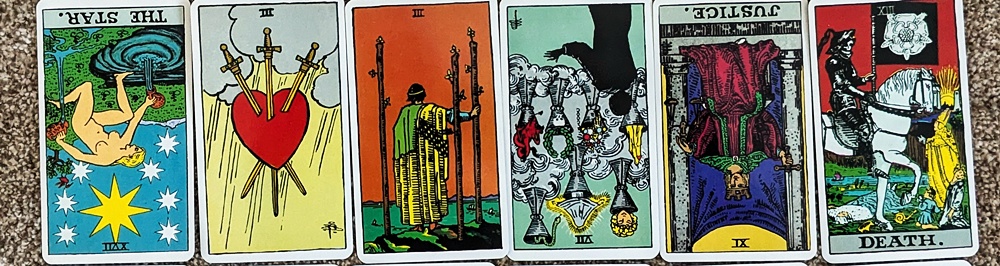
This is a moody reading that suggests “dashed – or perhaps unrealistic – hopes” (Star reversed); anxiety (3 of Swords); patience (3 of Wands) that goes unrewarded (7 of Cups reversed); and a “stay” in the verdict (Justice reversed) that remains “on hold” until something ends (Death). I see a “to be continued” message here.
One variation in approach that dispenses with the random selection is to view the first twelve rows as covering the twelve Full Moon episodes of the year, with the thirteenth row showing the “Blue Moon” that can occur randomly during one of them every ~2.5 years.

Although for the example reading below I singled out the Full Moon for this month (March 2025) using the already-pulled cards, I suggest that, at the beginning of each year, the spread should be laid out face-up and a photograph taken so you don’t have to go through the arduous task of dealing it anew every month.
I would first perform a general overview of the whole year to determine which months look most auspicious, then on the day of the Full Moon in each successive month I would analyze the six cards of that row in detail for their impact on the next few weeks.
I would only include the “Blue Moon” row for any month in which that rare event occurs, and I would treat it as adding another layer of significance to the main reading. (Realistically, you could just pull six cards on every Full Moon, but that wouldn’t serve my purpose in this essay.)
Here is the March 2025 Full Moon reading:

The two Wands indicate ambitious intentions at the beginning and end of the period, with the energy and enthusiasm tailing off by the time the 10 of Wands reversed is reached. The 8 of Wands followed by Judgement reversed implies a “rush to judgment” that is turned back, while the Hanged Man “puts an exclamation point” on that statement of deferral. (It reminds me of the line from the film “What’s Eating Gilbert Grape?” that is often misquoted as “You’re not going anywhere, Gilbert!”)
The King of Pentacles embraces the stimulation of the next New Moon and carries on stoically after the rebuff, with the Wheel of Fortune rewarding his persistence, but the 10 of Wands reversed shows that he still faces an uphill battle. To me, it looks like the second half of this cycle will be more encouraging than the first half since it shows a step-change in stability and dedication with the King of Pentacles.
As far as timing, there are eight sub-phases in a lunation cycle but only six cards per month in this model, so some have to do double-duty.
The first card covers the seven-day span from the inception of the Full Moon to the end of the Waning Gibbous phase;
The second card signifies the ~3.5-day duration of the Third Quarter;
The third card offers the ~3.5-day outlook from the beginning to the end of the Waning Crescent phase;
The fourth card encompasses the seven-day range from the advent of the New Moon to the end of the Waxing Crescent phase of the April lunation;
The fifth card addresses the ~3.5-day term of the First Quarter;
The sixth card conveys the ~3.5-day stretch from the beginning to the end of the Waxing Gibbous phase leading up to the April Full Moon.
Thus, the first and fourth cards represent the most prominent time-frames in the reading, when the influences of the Full Moon and the New Moon have a chance to “settle in” for a week. In the example reading, those cards stress “forthright and purposeful effort in the face of inertia.” (All durations are approximate and may change slightly from month-to-month.)
 Parsifal's Wheel Tarot & Astrology
Pingback: An “Open Field” Tarot Tableau | Parsifal's Wheel Tarot & Astrology