AUTHOR’S NOTE: I was just reading a post of quotes from comedian and TV personality Stephen Wright and came across this humorous philosophical puzzler: “What’s the speed of dark?” In the past I’ve done some work with a Jungian psychologist on use of the tarot to explore both the persona and the shadow side of the character in a single spread, and I took this as a sign that I should poke further into the latter. (For reference I’ve included a link to my essay on the subject and I’ve presented a couple of other tools to implement my suggestions below.)
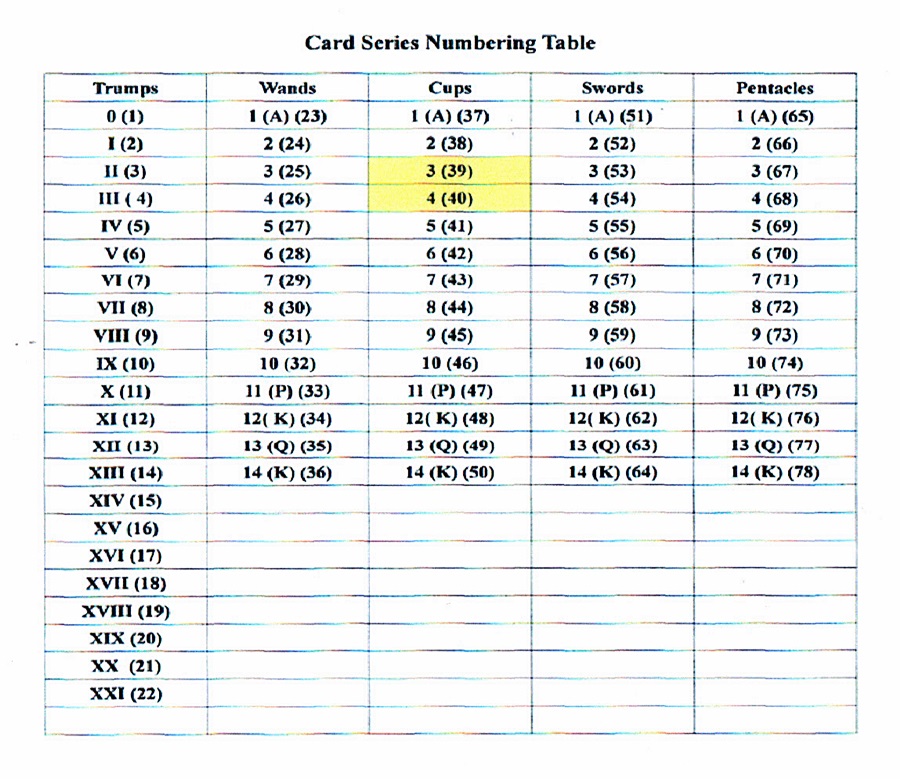
One way that tarot readers attempt to explore the “dark side” of the querent’s personality or of the matter at hand is to look at the card on the bottom of the deck after the shuffle and cut, the so-called “base” or “shadow” card. I’ve always found this to be entirely too shallow and random. Instead, I prefer to analyze the cards that sit at the opposite end of the 78-card series to those in the spread, as shown in my “numerical separation” table. If the tarot is in fact a mirror of the subconscious mind, we might consider these inferred twins to show the more-deeply-buried subjective unconscious “in the rear-view mirror,” so to speak. I’m also reminded of placing two mirrors opposite one another, creating an infinite perspective of diminishing scale; you may have seen this idea embodied in carnival “fun-house” installations.
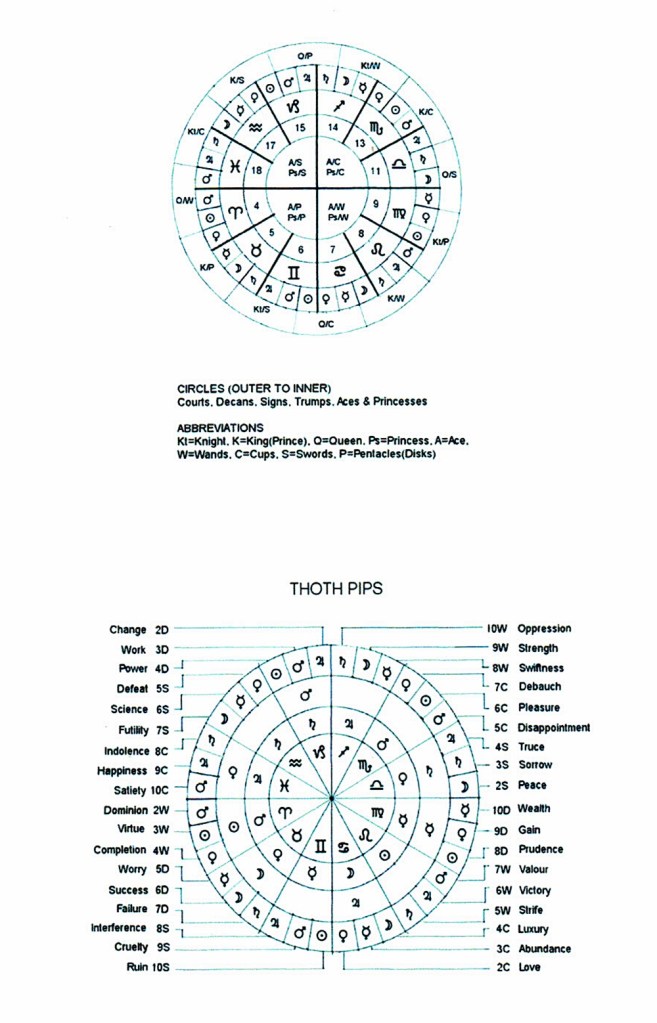
In the reading template included in the linked post I covered only the Major Arcana, bringing to bear their inherent nature as one way to create this sense of division. However, from a broader angle consonant with the “numerical separation” routine, it can also be instructive for all of the cards in a reading if we find the complementary cards that lay directly across the wheel of the “Chaldean” zodiac in the Golden Dawn’s system of correspondences (more “inferred twins”) and create a parallel spread with them to be read as a secondary focus, treating it as a veiled “echo” of the original. This has the added advantage of fleshing out the mirror image with astrological considerations.
For the 22 trump cards it may be better to use their “numerological counterparts” (cards whose digits sum to the same value); every trump except the Fool has at least one while the Magician, the Priestess and the Empress have two, kind of like multiple personalities. The companion book to the DruidCraft Tarot covers the idea of numerological counterparts in some detail, as does the large instruction manual for the Voyager Tarot (although the technique used by James Wanless is more akin to the decimal-equivalent approach of Alejandro Jodorowsky in The Way of Tarot than it is to standard “Theosophical addition.”)
Because I no longer invoke the tarot much for my own psychological self-analysis, I would use this innovation more for revealing hidden aspects of the situation or of another person involved in it. I’m also thinking that it might be more valuable when applied only to any reversed cards in the original spread, which already suggest oblique or indirect influences. Locating their literal “opposite numbers” could open a door to a deeper understanding of their upset orientation and its clandestine significance by unearthing more detail about its covert impact.
In his advanced tarot book, Paul Fenton-Smith proposes that a reversed card refers back to the previous upright card in the numerical progression that may still hold “unfinished business” for the querent; I would rather view the phenomenon as pointing toward its “inferred twin,” creating a cognitive leap away from the usual interpretation that may be an intrusion of the “shadow” or just an intuitive hunch. By looking into this “mirror-within-a-mirror” (or maybe it’s more like the “picture-in-picture” feature of modern TVs), we may see things that surprise us, things that could have been “hidden in plain sight.” Consider it another example of my premise that such methods can lead us down byways in the matter that might otherwise remain unexplored.
As a result of my pondering of the unsatisfactory “shadow” card notion, these concepts arose mostly off the top of my head and have yet to be probed for their potential. I see them primarily as philosophical constructs that expand our interpretive palette in unique ways. My assumption is that the tarot practitioner already has a solid grasp of the traditional card meanings.
 Parsifal's Wheel Tarot & Astrology