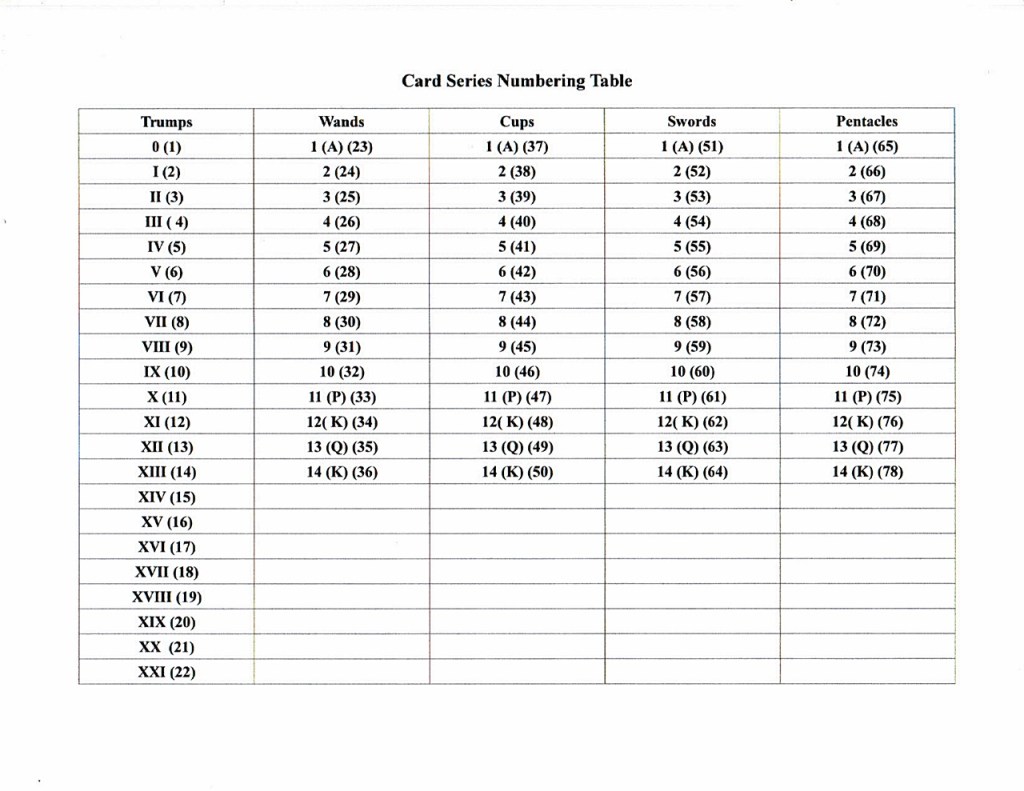
AUTHOR’S NOTE: The assumption behind this spread is that the top tier of cards is more likely to be “fast-tracked” to closure, the middle tier will play out more gradually and the bottom tier will be substantially delayed. The table at the end of the essay offers a tool to determine which tier a card will land in if it isn’t obvious from the degree of suit or rank separation. The more cards there are in any tier, the more emphasis there will be on that being the path to the outcome. Reversals may be used to indicate indirect or oblique energies entering the matter.
Begin by shuffling the deck and then deal one card into the first position of the middle tier.
Pull another card and, using the table as necessary, determine whether it is five or more numbers above or below the middle-tier card. If it is 5+ higher, place it in the second position of the top tier, and if it is 5+ lower, place it in the same position of the bottom tier. If it is less than five numbers above or below the middle-tier card, place it immediately to the right in that tier; do the same for any subsequent pull that repeats in the middle tier. (Another way to look at is that “below” means “prior to” or “earlier” and “above” means “subsequent to” or “later” in the series of numbers.)
Draw a third card. If it is any value higher than, or less than five numbers lower than, a top-tier card, place it immediately to the right in the same tier; if it is five or more numbers lower than a top-tier card, place it to the right in the middle tier.
If it is any value lower than, or less than five numbers higher than, a bottom-tier card, place it immediately to the right in the same tier. If it is 5+ numbers higher than a bottom-tier card, place it to the right in the middle tier.
Continue this up-and-down displacement by dealing more cards until you have five cards in any one tier, then read the cards in that tier as showing a rapid, gradual or tardy outcome. These five cards will produce the narrative-of-record for the reading, while the other two truncated lines are to be ignored.
Here is an example reading to illustrate the process.

The reading concerned a long-standing situation that has been unresolved for a couple of years. The first card pulled was the Knight of Disks, which I placed in the first position of the middle tier.
The second card was the Magus reversed. Because it is the second card in the 78-card series and the Knight of Disks is the last card, the Magus is significantly more than five numbers below the Knight, so I placed it in the second position of the bottom tier.
The third card was the 10 of Swords reversed, which is more than five numbers higher than the Magus so I bumped it up to the third position of the middle tier.
The fourth card was the 3 of Swords, which is more than five numbers below the 10 of swords, so it slipped back down to the fourth position of the bottom tier.
The fifth card was the 7 of Wands, which is lower than the 3 of Swords, so it remained in the fifth position of the bottom tier as the third card in that series.
The sixth card was the 9 of Wands reversed, which is less than five numbers higher than the 7 of Wands, so it remained in the sixth position of the bottom tier as the fourth card in that series.
The seventh card was the 5 of Wands, which is lower than the 9 of Wands, so it remained in the seventh position of the bottom tier as the fifth card in that series. This completed the five-card set in the bottom tier, indicating that closure of the matter would continue to be greatly delayed.
I read the line as follows:
The Magus reversed suggests that an unexpected “twist of fate” will change the landscape of the situation but only serve to delay it further.
The 10 of Swords accelerates the timeline slightly but it remains an outlier in the narrative that won’t be analyzed.
The 3 of Swords implies that a traumatic episode of some kind will intervene that will push closure back even more.
The 7 of Wands indicates struggling to maintain the “moral high ground” as progress continues to languish.
The 9 of Wands is a card of preserving integrity as the situation drags on, although the reversal indicates potential erosion of stability.
The 5 of Wands shows that nothing will be resolved as the scenario enters a “holding pattern” for the foreseeable future. It should be revisited with a follow-up reading six months down the road if nothing happens in the interim.
 Parsifal's Wheel Tarot & Astrology