AUTHOR’S NOTE: Conventional wisdom is that tarot is ineffective for addressing simple “yes-or-no” questions because it is more suitable for telling stories. I’ve always taken issue with this opinion, believing that the cards will provide an answer for any inquiry that is phrased properly. So rather than wanting to know “Will I or won’t I get what I want?” it’s more instructive to ask “What will happen if I take a specific action to pursue my objective or just let it ride and see where it goes?” By doing so we will still obtain an impression regarding which path will yield a more favorable outcome, we will just have to be shrewder about the interpretation and take a longer view of the projected results. Needless to say, this isn’t “daily draw” territory.
A couple of days ago I was working with a querent on just such a request and decided to apply my personal “tweaked” version of the French Cross (aka tirage en croix) spread in tandem to examine both sides of the picture. This is a straightforward layout that is excellent for practical forecasts akin to those often put to the Lenormand cards. The example pull below is not the instance mentioned but one I performed for my own circumstances to give the technique a more formal workout. I used my two Fournier TdM decks for this exercise, both copyright of Napes Heraclio Fournier, Vitoria-Gastelz, Spain. As always, I do not use reversals with the Tarot de Marseille.
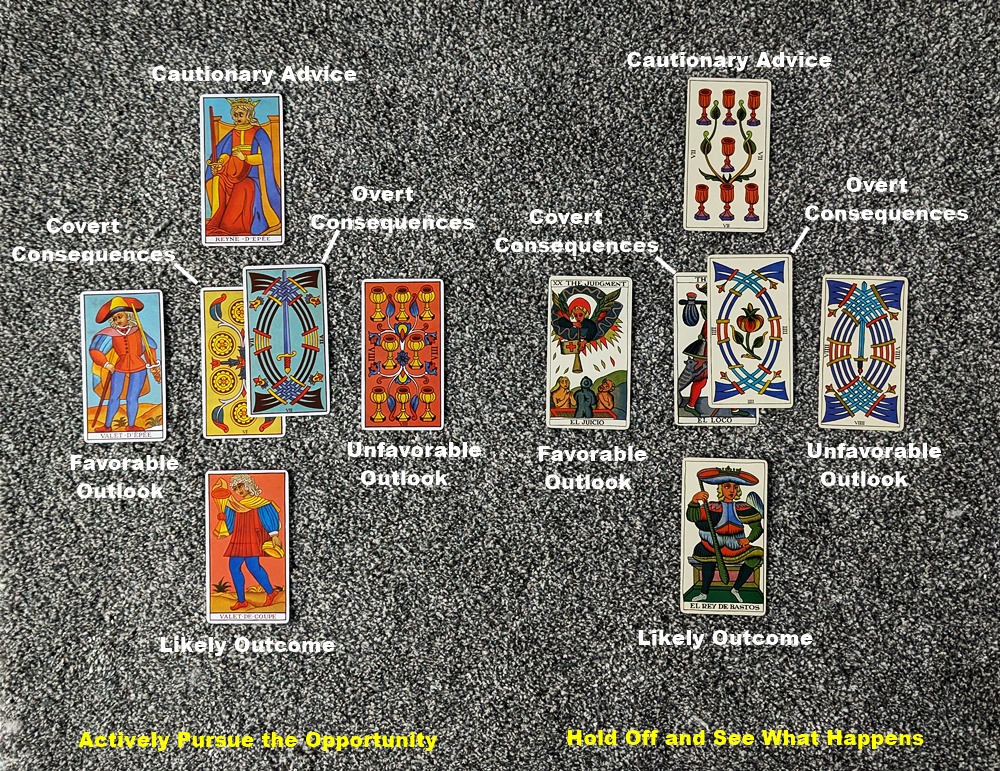
In the standard French Cross, Card #1 at the left shows positive aspects of the matter; Card #2 on the right reveals more negative aspects; Card #3 at the top offers advice for reconciling the two, and Card #4 at the bottom provides a likely outcome. Card #5 at the center is intended to summarize the entire reading in a kind of narrative “roll-up,” and it is traditionally obtained via the numerical “quintessence” calculation using the face values of the other four cards to derive a trump card for this purpose.
But other European readers draw this card randomly and that is the method I generally employ with my Lenromand “cross” readings, for which I pull one of the two middle cards between Cards #1 and #2 in the flow of the deal, and the other between Cards #3 and #4. The first card goes on the bottom of the pair to signify covert factors in the “big-picture-consequences” scenario, and the second card is placed on top to identify more overt implications. The four major positional meanings are self-explanatory as noted above, with the two central cards requiring a more nuanced approach.
In the “just do it” spread at the left, the Valet of Swords (modern Page) suggests a certain self-possessed but naive confidence while the 8 of Cups implies lurking disappointment and the Queen of Swords shows the need for unflinching discrimination in charting a course. Coupled with the Valet of Swords, the Queen has a “Mother-knows-best” vibe to it, while the Valet of Cups looks a bit “chastened” and appears to be limping away from the encounter; I’m reminded of Coleridge’s “sadder and wiser” wedding guest. The “covert” 6 of Coins hints that the status quo will be resistant to change anyway, and the “overt” 7 of Swords (never a good omen) conveys the futility of even trying. All signs are that it is best not to push too hard on my agenda.
In the “wait and see” spread at the right, Judgement portends that significant change will occur in the affair in it’s own good time, while the 9 of Swords shows slightly sharper distress than was portrayed by the 8 of Cups (as Shakespeare might have said, it “doth protest too much”). The 7 of Cups is telling me to take nothing at face value, and the King of Batons (Wands) indicates that I will be fully in command of the situation at the end of the day. The “overt” 2 of Swords I read as a pending decision that is “held in check,” while the “covert” Fool lobbies against stepping out too aggressively in my quest for closure. The latter reminds me of the ancient nautical maps with uncharted regions annotated “Here be dragons,” and the pair advises not becoming too anxious about “getting there.”
All-in-all, the spread on the right is more encouraging. I have my eye on Judgement as the “driver” that will dispel any ambiguity (my favorite definition is “an offer you can’t refuse”), with a nod to the Fool’s reluctance to act precipitously for fear of making a misstep.
 Parsifal's Wheel Tarot & Astrology
Very interesting
LikeLike