AUTHOR’S NOTE: The title of this essay refers to the fact that I already posted on the subject of “deja vu all over again” in the Lenormand category. Here the target of the famous Yogi Berra quip is the Minor Arcana series of the Waite-Smith (aka “RWS”) tarot. (Note that although I much prefer the Thoth deck to the RWS, the latter lends itself to this analysis while – except for the court cards – the Thoth does not.)
In his book Tarot Master Class, Paul Fenton-Smith observed that the RWS 9 of Wands is the only minor card of the suit that displays an awareness of the previous conditions that led to present circumstances; the rest he portrays as emphatically future-oriented. As justification he mentioned the fact that the embattled figure is looking warily over his right shoulder, nervously awaiting the next onslaught of the foe that left him so battered the first time around. We could say that he is struggling with a foreboding sense of “deja vu” over events that are bearing down on him. (The assumption is that he should have learned a lesson that will render him less vulnerable to the next attack.) As we shall see, I don’t entirely agree with the singularity of this estimation in the suit of Wands, but the point is a valid one.
In tarot reading, cards placed to the far left in a line spread and those with figures looking in that direction are typically considered to describe prior situations (or at least awareness of them) that still have a bearing on current and future developments. I wrote some tine ago about the second half of this population in my essay on the “gaze” or “facing” that is evident in the RWS court cards, and here I’m expanding it to all of the Minor Arcana. My thinking on this phenomenon is that if one of these past-oriented cards also appears in the far-left position of a line spread, it creates an even more profound emphasis on examining earlier occurrences that may have brought the affairs of the moment to a head, unresolved matters that are frequently but not always difficult for the querent depending on the nature of the card. Obviously, reversal will swap the orientation, suggesting that regardless of spread position, something that went before is being ignored at precisely the instant that it should be scrutinized most carefully.
Below is a graphic presentation of the cards that I believe belong in this group, along with a detailed discussion of their orientation.
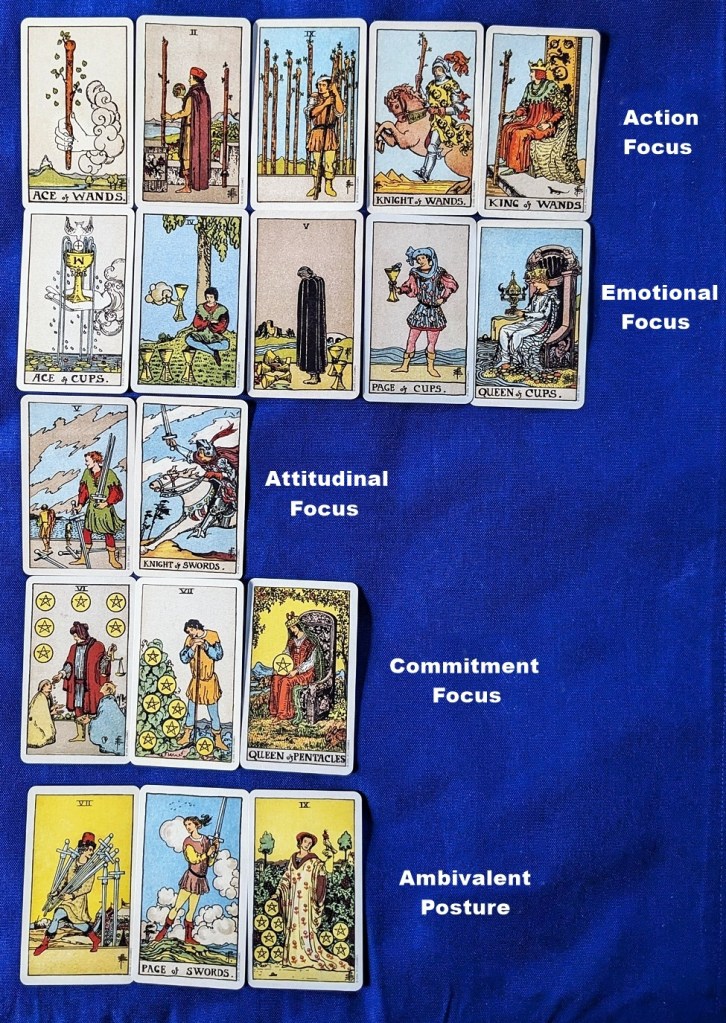
Fifteen of the 56 cards exhibit a leftward “facing,” implying a focus on unfinished business from the past that is still churning in the querent’s subconscious. Wands are related to questionable actions that may still be regretted at the time of the reading; Cups to lingering remorse over emotional turmoil; Swords to unsound ideals or beliefs that have overstayed their welcome; and Pentacles to halfhearted commitments made but not fully endorsed. The three ambivalent cards will be addressed later in this essay,
The Ace of Wands suggests having bought into an unsolicited offer of the “too good to be true” variety that probably should not have been accepted without further study of the long-term consequences. Reversed, it could indicate having been “oversold on” (or “roped into”) a sketchy opportunity simply because it seemed like a good idea at the time. There may be a sense of denial over having made a bad move while simultaneously eying the next dubious hustle that promises something worthwhile for very little effort or investment (it smacks of the proverbial “prime real-estate – aka swampland – in Florida for cheap”).
The 2 of Wands is a “planning” card in which the figure has turned his back on lackluster future prospects (the lower of the two staves on the right) and is considering how he might leverage past successes (the staff in his left hand) to the benefit of his present worldview (the globe in his right hand.) The implication is one of diminishing returns as the aspirant returns to the well once too often for self-renewal. My personal regret regarding this observation goes back to something I cheekily told a middle-aged acquaintance back in the 70s who was letting the hair fringing his balding pate grow long to embrace the “hip” image of the day. He wanted to know what I thought and I honestly but tactlessly told him “Ed, it looks like more of less.” Similarly, the plan in this case may have been “safe” but shortsighted, more of the old and less of the new. Reversed, there could be the belated realization that just “winging it with fingers crossed” when striving to move forward was not the best course since better planning would have gone a long way.
The 9 of Wands needs no further explanation. (See my opening comments.)
Both the Knight and King of Wands seem to believe that going back over the same arid ground will yield a more fruitful harvest than it did the first time around (although the Knight is more adamant about it). I’m reminded of the definition of insanity: “Doing the same thing over-and-over again and expecting a different result.” You’d think they would be forward-looking visionaries (a role they leave up to the Page and Queen of Wands), but they appear to be content “playing it safe” and staying within their comfort zone. Wands may be ambitious and adventuresome, but the Knight and King would not be considered unprincipled opportunists.
In this context the Ace of Cups could signify fond memories of past emotional connections (often but not always romantic), and perhaps a wistful hope for reconciliation (I’m referring to the perennial “Will my ex come back to me?” inquiry that is often put to the tarot.) I think it is a much more accurate “nostalgia” card than the miscast 6 of Cups, which in the Golden Dawn system represents simple “Pleasure.” Reversed, it could mean having been lured into an unsatisfactory emotional “situation” and pondering ways to make a graceful exit.
In the 4 of Cups, the regressive emphasis could be on a prolonged stretch of emotional stasis that left behind a residual malaise that is impossible to shake off. It’s another card of seemingly “safe” inertia, this time subverting the calm stability of the Four with an uneasy immobility: “If I don’t stick my neck out, maybe I won’t be hit on the head again.” My euphemism for it is the “one big yawn” card, and unlike the “Four-to-Five” transition in the other suits, the 5 of Cups does nothing to dispel the mood. When reversed, it suggests hiding in the “psychic basement” where all manner of self-defeating assumptions and impressions fetch up.
The dejected figure in the 5 of Cups is clearly “crying over spilt milk” (I guess he didn’t get the memo). He is so bogged down in his private sorrow that he lacks the time, the energy and the inclination to turn around, grab the two full cups that hold what remains of his dignity, and walk away from the mess he has made. He needs to appreciate that Five is a number of “change,” but he must also be willing and able to undertake an emotional make-over. For the time being he will just wallow in his grief. Reversal of this card suggests being plunged head-first even more deeply into the morass, but at least the individual is looking in the right direction (if he would only raise his head).
The fish in the RWS Page of Cups is said to refer to “memory” that wells up from the Unconscious. The image implies investing all of one’s emotional capital in what may only be a phantom of remembrance, while feelings that deserve a hearing in the present are neglected. Because the Pages are standing still, I interpret them as feeling an urge to take a step in a new direction but not yet committing to do so; when reversed they all lack traction, with their legs waving feebly in the air like the euphemistic “dying cockroach.” The reversed Page of Cups wants to make a decisive departure from the past but that fleeting phantom is still clouding his vision with its self-indulgent allure. As an illusion that won’t withstand close scrutiny, it should be dumped into the dirt and trampled on in order to advance. (Don’t tell PETA I said that,)
The Queen of Cups is also lost in reverie over the contents of her imposing chalice; her bulky throne is at her back and hovering over her head, discouraging any movement in that direction. But this is the second-most patient and contemplative of the Queens so it’s unlikely she is about to get up and saunter off into the future. She might be considered a repository of “cultural memory” that everyone of the same demographic is steeped in from the time of birth. When reversed, her throne opens a path to the right but it is bearing down on her with all its ponderous weight, making for sluggish progress on a journey she wasn’t prepared to undertake.
The 5 of Swords was assigned the keyword “Defeat” by the Hermetic Order of the Golden Dawn (the architects of the modern esoteric tarot), but Pamela Colman Smith’s image does a poor job of conveying that idea, causing considerable confusion for those trying to reconcile the RWS card with the Order’s tarot curriculum, Liber T. The smug victor seems to be saying to himself “That’ll teach ’em!” as his enemies flee, without recognizing that, in the proverb attributed to Aristotle, “One swallow does not make a summer, neither does one fine day,” to which I would append “nor does one victory win a war.” It invokes another “Yogi-ism” (“It ain’t over till it’s over”) and brings to mind the verse from the Gordon Lightfoot song Sundown:
“Sometimes I think it’s a sin/
When I feel like I’m winnin’ when I’m losin’ again”
When this card is reversed, the obvious advice would be to “watch your back.”
The Knight of Swords is charging headlong into a dead-end of outworn ideals and attitudes that not even “all the king’s horses” would be able to revitalize. He looks like Don Quixote tilting at windmills that have long since vanished; in other words, a man without a mission who is just going through the motions. When reversed, he appears to be running away from a past that is almost certain to swallow him up in its inane redundancies.
In the Golden Dawn system, the 6 of Pentacles signifies “Material Success;” it has little or nothing to do with generosity or charity. Wealth is to be pursued for its own sake, not with an eye toward spreading it around. The RWS image is one of impersonal distribution, in which the scales imply that the man is a government functionary doling out to each beggar his appointed due. No well-off person is likely to be performing that duty unless he has an especially guilty conscience and the leisure to volunteer his time as a way of assuaging it. So it isn’t necessarily about kind gestures but instead reflects a burden of responsibility. This is another card where Smith’s narrative vignette sends the wrong message; I would be prone to see the man as looking back ruefully on mismanagement of funds that diminished his net worth. Maybe he lost a court case that sentenced him to make reparations to those he injured. I don’t see any benevolence in his demeanor and he is dropping the coins from a height that makes it clear he finds physical contact with the recipient distasteful. It looks like nothing more than the discharge of an obligation, and he is lamenting how he let himself get in this deep as he carries out the task. When reversed, he may have fallen on hard times and is himself seeking a handout from the public coffers.
The man in the 7 of Pentacles has his head bowed in a manner similar to the one in the 5 of Cups, but here we can see his weary resignation. Popular opinion about this card is that it conveys a moment of patient contemplation, as if he is enjoying a brief rest before completing the harvest, but this assumption is not borne out by its esoteric definition of “Success Unfulfilled” (or outright “Failure” in the Thoth deck). It implies approaching the end of an effort only to have it go sour at the last minute. From a regressive standpoint, he could be scolding himself for letting the situation get away from him to the point that he may not be able to recover before the yield is past its prime, Reversed, he is feeling the drag of unfinished business but is trying to convince himself that it is OK to cut his losses and move on.
The Queen of Pentacles has many similarities to the Queen of Cups but with an even more profound feeling of placid composure that sees no need to rush because nothing is going anywhere any time soon. In a backward-looking sense, there is immense pleasure in revisiting the successful outcome of past endeavors but little inclination to repeat any of them. It could be the exemplar of the “been there, done that” sentiment that is willing take a pass on burnishing earlier accomplishments since there is no more to prove. George Santayana would get no satisfaction out of her because not only does she remember the past, she basks in its glories and is perfectly happy to let it linger undisturbed. The only reprise to be found here would be in nostalgic self-congratulation, and the only downside would be a staunch reluctance to admit that the “good old days” weren’t always that great as an argument against doing anything different now and in the future.
In addition to these left-facing cards, there are three that exhibit an ambivalent posture in that the gaze of the figure points one way and the body language leans in the other direction.
The most interesting one is the 7 of Swords because the man is being drawn inexorably into past entanglements (maybe he has a “contract” for five purloined swords that he had better not break) but is peering longingly over his shoulder toward a future that is presently out-of-reach. He may just be looking anxiously behind him for signs of pursuit, but if he is good at his trade there won’t be any. (Note that all of the would-be pursuers are otherwise engaged in the distant background of the scene.) Consequently, I prefer to think that he spies a better life that he is in no position to claim as his own because his momentum is carrying him away from it; all that beckons are the two upright swords that he will have to return for later. When the card is reversed, the man may be edging closer to his goal but he is unlikely to gain any ground because he is overburdened with baggage from his previous life. All he will do is alert authorities to his indiscretion, in which case the two remaining swords might be imagined as a closed gate preventing his return to anonymity.
The Page of Swords is plainly of divided mind. He feels the pull of past attitudes and beliefs quit strongly but is off-balance and about to lurch forward into the future holding his sword defensively in front of him, more in deflection than as an aggressive maneuver. There is a great deal of indecision in his stance, but my bet would be that he will have to let go of his prior attachments and strike out in a new direction. When reversed, his head is too close to the ground for him to see the landscape ahead, so with his sword he is about to plant a “stake in the ground” of known circumstance as something to hang onto that will keep him from losing his bearings.
In its idle complacency, the RWS 9 of Pentacles reminds me of the urban myth about “boiling a frog.” Although the woman is making a pretense of welcoming her destiny, there are more coins to the left than to the right, making it obvious exactly where her true sympathies lie as revealed by her covetous hand resting on the stack of five. She will hold onto the past just as long as she can get away with not doing anything about the future except approach it as an interesting abstraction. She is prepared to sacrifice three coins to retain a firm grip on five; this lady is “playing the percentages.” The reversed orientation flips the script, leaving her to juggle five coins in a risky venture while standing on her head, with only three coins “in the bank” on which to rely for solvency. Her gaze is turned somberly in that direction, and perhaps it has dawned on her that if she doesn’t change her ways she won’t have the wherewithal to feed her bird, much less herself.
 Parsifal's Wheel Tarot & Astrology