AUTHOR’S NOTE: One problem with tarot spreads based on the four classical elements of Fire, Water, Air and Earth is that there is often a significant qualitative mismatch between the elemental position meanings and the nature of the cards that land in those positions, requiring vigorous mental gymnastics on the part of the reader to accommodate their divergent testimony. (There is only a 1-in-4 chance that a card of the same element will appear in any position, although there is an almost 50% probability that it will be of a compatible positive or negative polarity.) It can certainly be argued that overcoming this dissociation is part of the normal process of deciphering the message, so it should just be taken in stride. From a professional standpoint I agree with this opinion, but I’ve been contemplating ways to “pre-load” such spreads with relevant content right from the start.
In this outing I began by separating a tarot deck into four sub-packs reflecting the different elements ascribed to the cards in the system of astrological and qabalistic correspondences created by the Hermetic Order of the Golden Dawn. The 56 minor and court cards are clearly denoted in the four sets of 14 Wands/Fire; Cups/Water; Swords/Air and Pentacles/Earth, while the 22 trump cards embody the qualities associated with the signs, planets or “primal” elements given to them by the Golden Dawn. (For example, the Fool represents “Primal Air, while the World is “Earth” in the form of Saturn.)
As it turns out, there are 40 cards defining the two active elements of Fire and Air and 38 cards signifying passive Water and Earth. This should provide sufficient range and depth of meaning in both the “positive/active” and the “negative/passive” categories to offer nearly the variety that random selection delivers across the likely scope of a querent’s situation without portraying improbable scenarios. I realize that this is slanting the playing-field in order to “shape” the output along elemental lines, but the benefits seem to outweigh the disadvantages from a rational and practical perspective
Next, I created a simple four-card-column layout with Fire at the top, followed in descending order by Water, Air and Earth. The card that is dealt into each position is intended to show how those aspects of the question that fall within the purview of that element can be prosecuted to best effect: the Fire position conveys how querents can “act” decisively to achieve their desires in the matter; Water how they can “feel” their way through it; Swords how they can impartially “analyze” their options; and Earth how they can best “live in the moment” with little need for acting, feeling or thinking too strenuously about it.
I shuffled each sub-pack separately starting with Fire and placed one card in each of the designated positions. (For a more complex overview that displays a measure of development over time, it could be instructive to lay several element-specific cards in a row to the right of each starting position, thus producing an expanded tableau, but that complexity is beyond my purpose at present and might just be an overstated exercise in “piling on.”) By applying this filter to each position and its resident card, I propose to create a sharply-defined take on how that element can most effectively discharge its mandate. I decided to allow for reversals so I can receive oblique inferences regarding how events and circumstances will play out.
My goal is to provide a delimited perspective on the situation in four discrete “flavors” individually oriented toward proposed actions, emotions, thoughts and natural inclinations. Interpretive blending and shading between the four elemental fields of operation can then occur vertically in order to generate a comprehensive narrative covering the full range of circumstances, in which one aspect may stand out as more well-favored by card/position “friendliness” than the rest and thus offer the best advice for dealing with the matter. (If there are two or more salutary matches, the recommendation may be to advance along a broad front.) In this way I hope to arrive at an ideal solution that invokes just the right elemental focus.
Here is an example reading to show how it works. The question was simply put as “What is the best course to take in this matter?”
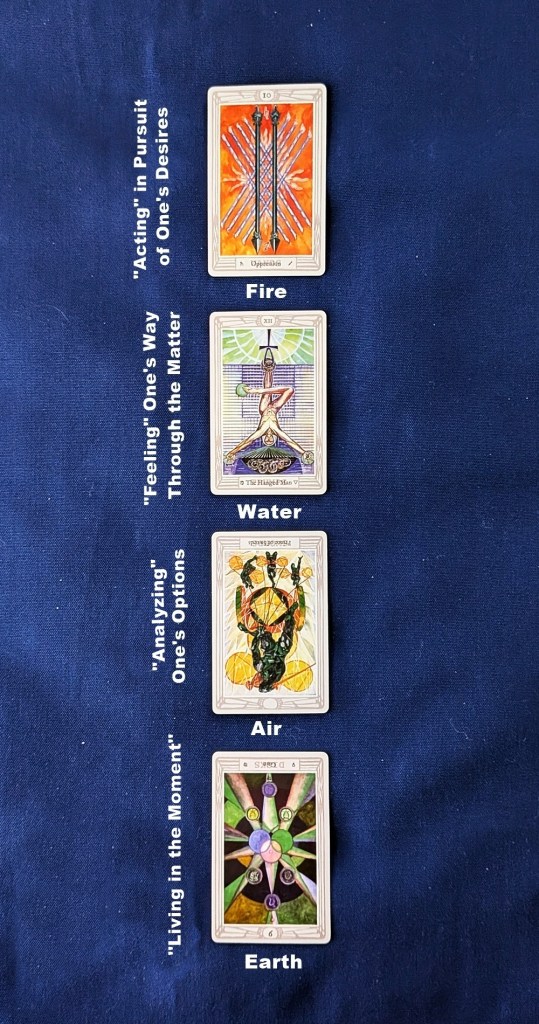
The 10 of Wands (Oppression) in the Fire position suggests that any forceful action on my part would be viewed as overbearing. The tip-off is to avoid becoming too intense.
The Hanged Man in the Water position is the quintessential “Wait for it!” card that diffuses the frustration inherent in the 10 of Wands by taking the philosophical “long view” (although there may still be feelings of long-suffering forbearance).
The Prince of Swords reversed in the Air position advises against trying to get too clever. It could reflect the risk of over-thinking my next move and perhaps “putting too fine a point” on my intentions. This is not a patient or persistent card, but rather one that seeks “instant answers,” so the reversal may be wise counsel of the cautionary kind.
The 9 of Disk (Gain) reversed describes slow, steady progress in which little is gained but nothing is lost by toeing the line. (This is one of the most favorable “passive” cards in the deck, and here it implies prudent sidestepping as recommended by the Hanged-Man.)
All-in-all, this narrative comes across as plainspoken guidance that substantially proves my point in developing this spread.
 Parsifal's Wheel Tarot & Astrology