AUTHOR’S NOTE: As part of the “homework” assigned to readers of his book, Tarot Architect, Lon Milo DuQuette advises them to “kiss” each of the cards as a curious but charming ritual blessing before laying it on the table. This is just a little too “precious” for my own intellectual sensibilities so I won’t do it, but his suggestion made me realize that I do in fact silently “salute” each card as I place it in a spread.
Having “lived with” the cards of the Thoth tarot on a daily basis since 1973 as recommended by Aleister Crowley in the Book of Thoth, I’ve come to recognize that each one exhibits a unique “vibration” (call it a vital essence) that announces its arrival. This phenomenon is not equaled by the prosaic images of the Waite-Smith tarot, nor by most of the other 80+ decks I’ve bought and used in the meantime, and I ascribe it to the remarkable artistry and evocative color palette of Lady Frieda Harris as guided by the metaphysical genius of Crowley. (Their results are simply more “visceral” than other renditions.) These 78 avatars of spiritual teaching are indeed “living beings” with a nobility that deserves our respect, so adopting a “right-minded” attitude toward their sovereignty seems entirely appropriate. I’m not one to anthropomorphize bits of cardboard by bestowing upon them a semblance of personality, but in this case I’m willing to make a mystical exception (up to a point).
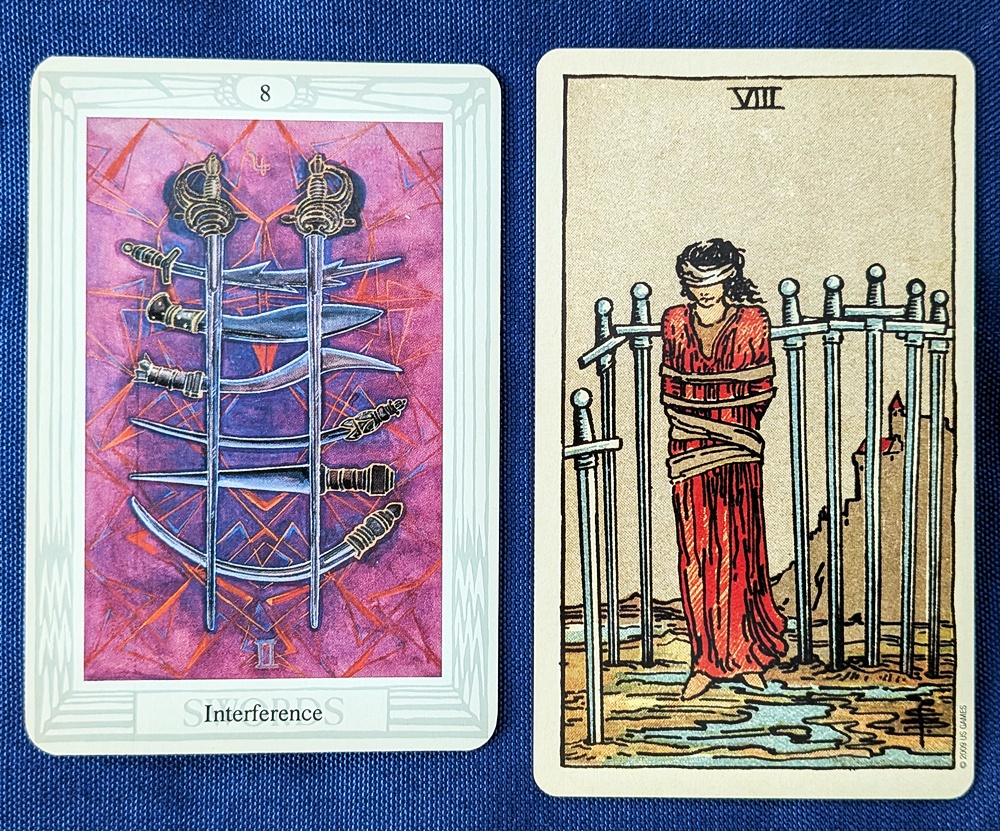
As the saying goes, “The magic isn’t in the cards, it’s in the reader.” I’ve always believed that any human qualities that might be attributed to them are in fact only a reflection of the the artist’s ability to evoke a sympathetic response in the mind of the beholder. We see what we’ve been conditioned to see, although I think the Thoth deck “breaks the mold” in this regard. Harris nailed Crowley’s vision to near-perfection. This distinction can be seen clearly in the 8 of Swords, “Interference.”
The Golden Dawn assigned Jupiter in Gemini to this card, which echoes the antagonism inherent in the combination. Jupiter can be indiscriminately expansive in its exuberance while Mercury, the ruler of Gemini opposing Jupiter’s domicile in Sagittarius, is almost painfully particular in its insistence on technical precision, surpassed only by its anal preoccupation with “minute and tedious detail” in Virgo, the other sign it rules. (Astrologically speaking, opposite signs and their rulers are at an uncomfortable standoff in any forced collaboration.) In short, Jupiter is “hot-and-loose” while Gemini is “chilly-and-tight,” making for a hostile working environment.
The RWS 8 of Swords succeeds only in capturing the “outer” implications of this impasse, showing obvious anxiety at being stymied by circumstances but not the more profound angst of misaligned archetypal energies that fosters implacable resistance. As is usually evident in the RWS “pip” cards, Smith’s “canned narrative vignette” overshadows the more esoteric interpretation. (To be fair, Waite set out to conceal much of his Golden Dawn knowledge from the uninitiated, so Smith must have had her marching orders, but – according to more than one tarot historian – she frequently inserted her own views into the vacuum left by Waite’s reticence even though she had his text to back her up. I can’t buy into this pastiche when I have the Thoth as my “gold standard.”)
In a reading, the Thoth 8 of Swords reminds me of the pugnacious “No way, no how!” of the Cowardly Lion in The Wizard of Oz while the RWS card is much less vociferous in its demurral, implying the possibility of sidestepping the worst of the impact. One is clearly confrontational while the other is meditative; either one can work depending on the context of the question but I’m more inclined to highlight the potential difficulty than to downplay it by presenting a tepid assessment of consequences. There are some scenarios where vague abstractions just don’t cut it, and we owe it to our clients not to sugarcoat the inevitable.
The Thoth card shows six mongrel daggers and short swords that are barely contained by the two interdicting rapiers while jagged shapes jostle one another in the moody background, which speaks volumes about the clash of ideologies. The woman in the RWS card seems to be urged gently forward by the flowing water lapping at her unbound feet and not at all held back (or “interfered with”) by the eight swords, most of which are behind her. There is a striking contrast in messages here, and the more forbidding one seems consistent with the existential hardship imposed on genial Jupiter by exacting Gemini.
 Parsifal's Wheel Tarot & Astrology