“You will be calibrating the tuning-fork of your personal consciousness to the great turning-fork of universal consciousness.” – Lon Milo DuQuette in Tarot Architect.
AUTHOR’S NOTE: These are deep waters, and as the ancient nautical cartographers used to warn, “Here be dragons!” One of the most effective ways I’ve found to understand complex esoteric subjects is to put them to practical use.
In the quoted passage, Lon Milo DuQuette is speaking to the act of creating one’s personal tarot deck using the trump-card assignments on “the Cube of Space.” As I mentioned in my previous essay on the subject, I find my own “great tuning-fork” in the Tree of Life, but I’m intrigued by the Cube and decided to deconstruct or “unpack” the three-dimensional model into a flat layout that can be used as a tarot spread. As you might expect, this took a substantial amount of creative engineering so hopefully I pulled it off. (Full Disclosure: I haven’t seen this two-dimensional pattern anywhere else but I haven’t finished reading Tarot Architect yet, so I’m making no claims of originality at this time.)
In my design I placed the Empress to the right at the East Wall because that is the direction in which the woman on the Universe card is facing (hidden in the photo by the central axes of the Fool, the Hanged Man and Aeon), then I worked counterclockwise around the other three faces with the Tower (North Wall), the Wheel of Fortune (West Wall), and the Sun (South Wall).
Next, I laid out the Emperor as the vertical Northeast edge between the faces of the Empress and the Tower; Adjustment as the vertical Northwest edge between the Tower and the Wheel of Fortune; Death as the vertical Southwest edge between the Wheel of Fortune and the Sun; and the Hierophant as the vertical Southeast edge between the Sun and the Empress. (The 3-D structure has always baffled me, so I flattened the verticals in the image instead of trying to depict them as upright, and I’m trusting you to use your imagination. Anyone who remembers the “swimming pool” scene from the 1982 Paul Bartel/Mary Woronov black comedy Eating Raoul will see what I did here.)
Finally, I added the cards that occupy the horizontal top and bottom edges adjoining the four verticals at their extremities. (The cards in each set actually meet at right angles but they are splayed out and repeated for 2-D clarity.) If you fold the four “satellite” complexes like a cardboard pop-up and place the “Above” card (Magus) on the top and the “Below” card (Priestess) on the bottom, you will arrive at a closed box that emulates the Cube of Space as shown in DuQuette’s illustration (but resembles segments of a broken-down picket-fence here, or maybe four tie-fighters escorting an Imperial raider . . . damn, now I can’t “unsee” that).
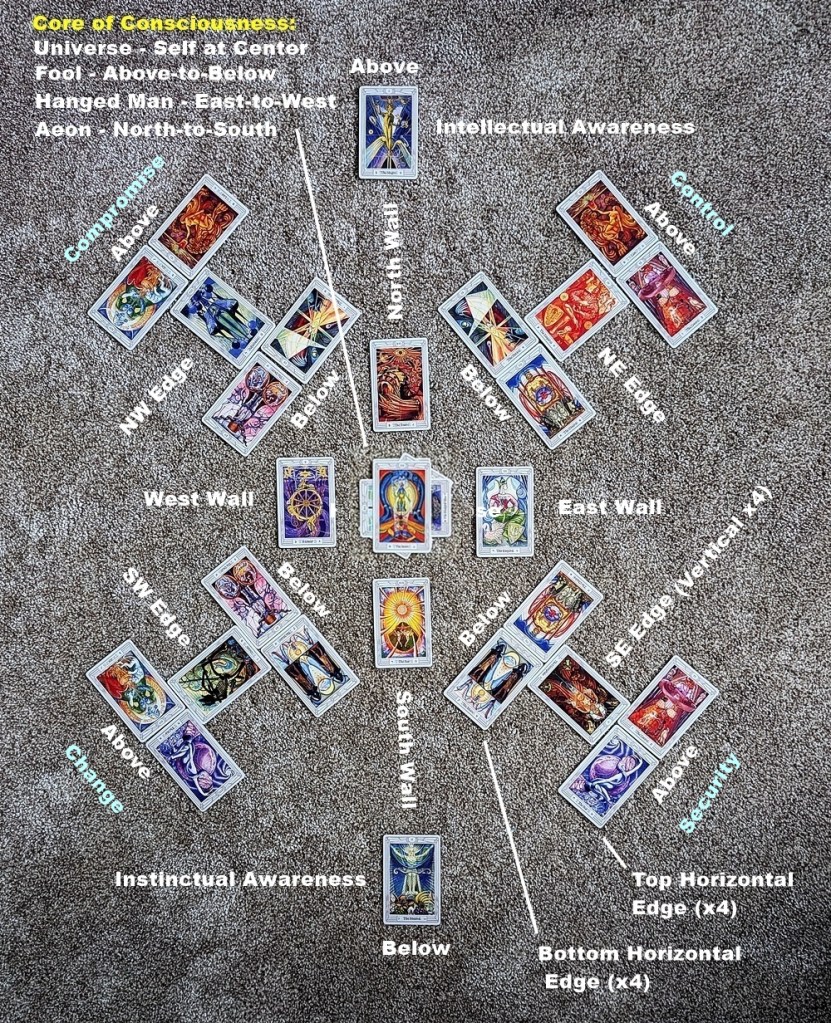
To apply this layout as a spread, first populate the “Universe” position with a card to represent the querent or the topic of interest, either selecting it intentionally or drawing it randomly.
Next, pull three cards for the “Fool,” “Hanged Man” and “Aeon” positions that will act much like the “covering and crossing” cards of a Celtic Cross spread by revealing the “situation as it stands” and the “environment of the question.” To broaden the perspective and provide more detail, read these cards in combination with the “wall” cards and the “above” and “below” cards with which they connect as follows: “Fool-position” card with the cards in the “Above” and “Below” positions; “Hanged-Man-position” card with the cards at the “East and West Wall” positions; “Aeon-position” card with the cards at the “North and South Wall” positions.
I’m also considering whether to read the “four walls” as a timeline beginning at the East and moving clockwise (echoing the diurnal path of the Sun) for short-term developments, or counterclockwise (its annual path through the zodiac) for a long-range projection. For even more nuance, the nature of the various “template” cards can be brought to bear on the interpretation of the random cards that land in their positions, a technique that can be used with the four “satellite” complexes as well.
Continue by pulling five cards for the “Emperor” complex in the Northeast, placing them in any order you choose, and read the mini-tableau as showing how the matter can be brought under control to optimize its benefit and manage any advantages and disadvantages that might be encountered while doing so. As a general rule, I would interpret the central card in all of these supplemental arrays as the main “plot device,” the “Above” cards as what can be easily comprehended about the situation and the “Below” cards as ambiguous or hidden aspects. Here the Emperor holds court.
Follow this effort by pulling five cards for the “Adjustment” (aka “Justice”) complex in the Northwest and read them as suggesting the “give-and-take” that could be experienced in navigating the situation. This could conceivably involve external authorities. (As the old “Pigmeat” Markham comedy routine had it, “Here come da judge.”)
Then pull five cards for the “Death” complex in the Southwest and read them as reflecting any major transformations or endings that might be forthcoming as the matter unfolds.
Finally, pull five cards for the “Hierophant” position in the Southeast and read them as a “safe zone” where the querent might fall back on “tried-and-true” principles and methods in dealing with the conditions that could emerge. It may also indicate ways in which the seeker can obtain help.
Create a narrative of these five “summary” readings that touches on the central theme in each of the areas, recognizing that this will produce a “progress report” but not a conclusion. To come up with an “end of the matter” scenario, read the randomly-drawn “Above” and “Below” cards along with the cards in the “Universe” and “Fool” positions as a revelatory sequence that brings the querent two forms of awareness about the likely outcome (intellectual and instinctual) and a situational “reality-check” regarding how these might be aligned with the individual’s span-of-control (Universe) in accord with (or in spite of) the guileless contrivances of the Fool. Present it as an inspired leap-of-faith (Universe/Fool) if it strikes you that way, or as an opportunity to avoid a misstep (Fool/Universe) if the cards agree. As I see it, there would be no fault in looking at both possibilities.
 Parsifal's Wheel Tarot & Astrology