AUTHOR’S NOTE: I liken tarot reading to “peeling an onion ” because what we see in the cards at a surface level isn’t always what is going on in the hidden depths of the situation, and we must “drill down” to find the reality. Here I’m turning that concept inside-out by proposing that the truth of the matter is only attainable by starting with an informed hunch about its buried core and working outward from the center, after which everything else is subjective elaboration until the concluding statement.
I agree with French tarot writer Joseph Maxwell on the subject of vaticination (“the faculty of being able to read the information possessed by the enquirer about his past, present and future”), but in this case I’m assuming that the underlying origin of a problem can be tapped beforehand with input from the querent rather than through intuitive guesswork in the middle of the session. I would do this by simply asking what motivated my client to seek the reading and then drawing inferences from the revelation that will help me zero in on the subconscious “root cause” and hopefully nudge it toward resolution. (I’m not a trained psychoanalyst but the methods aren’t unknown to me.) The other important point Maxwell makes in this regard is that “Intuition is a good guide, but in the interest of making a full and helpful divination, it is necessary to verify with the enquirer at each step if the intuition is taking the right path.”
The Qabalistic model I’m suggesting supposes that the “heart of the matter” springs from the spiritual impulse that is driving it from deep within. It is then clothed in constructive ideas that will help bring it to fruition; it is put through a formative wringer that shapes its final dimensions; and it is ultimately thrust into manifestation in an entirely objective way. As a former engineer, I can equate this to a product-development cycle that starts life as a stroke of pure inspiration and imagination, morphs into a feasibility study, embarks on a detailed design evolution that yields a prototype, and is finally subjected to “beta-testing” before being released to production.
This spread originates with a single card at the center representing the “situation as it stands.” It is ringed by a three-card tier that can be applied as the “Hegelian dialectic” of thesis, antithesis and synthesis (or “action, reaction and resolution”) leading to a third level of realization in a surrounding “square” that projects the conceptual analysis into a penultimate vision of the outcome, a four-card tableau that prefigures the “end of the matter” as expressed in a five-card pentagram casting the answer in human terms of realistically achievable results.
It looks like this. (I’m taking an informal poll here: does it resemble a “Transformer” toy or a roadkill humanoid?)
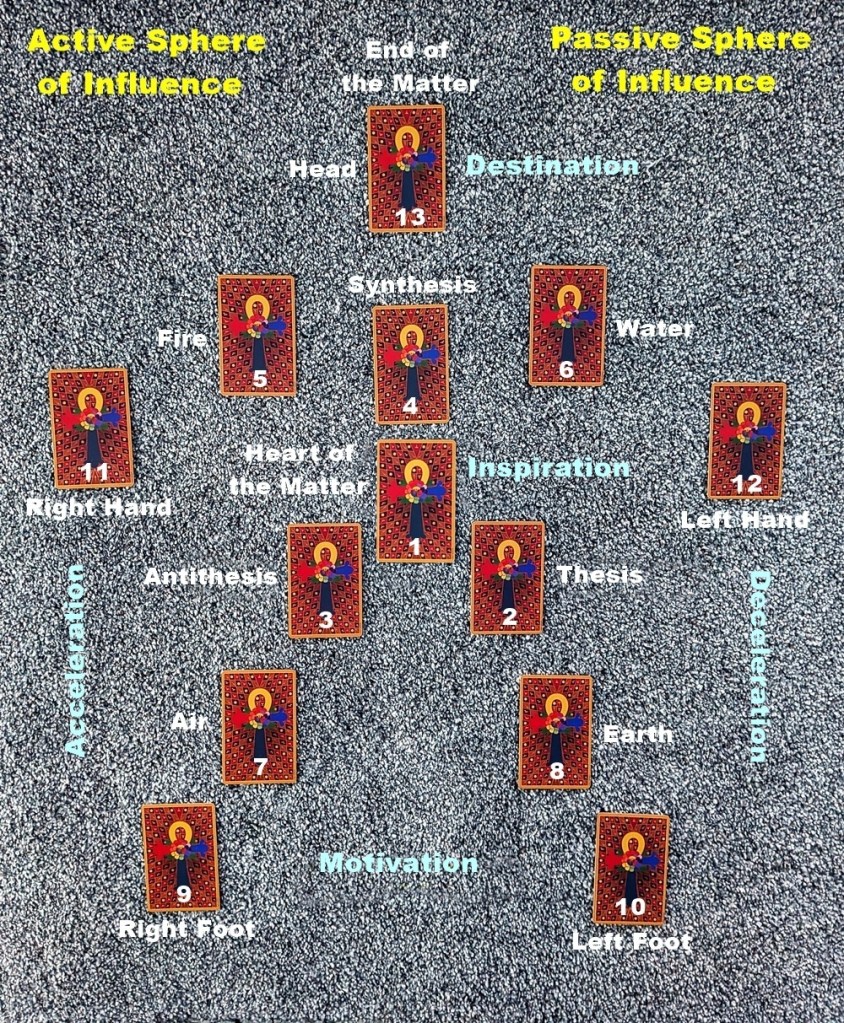
Here is a hypothetical example reading that illustrates use of the spread:
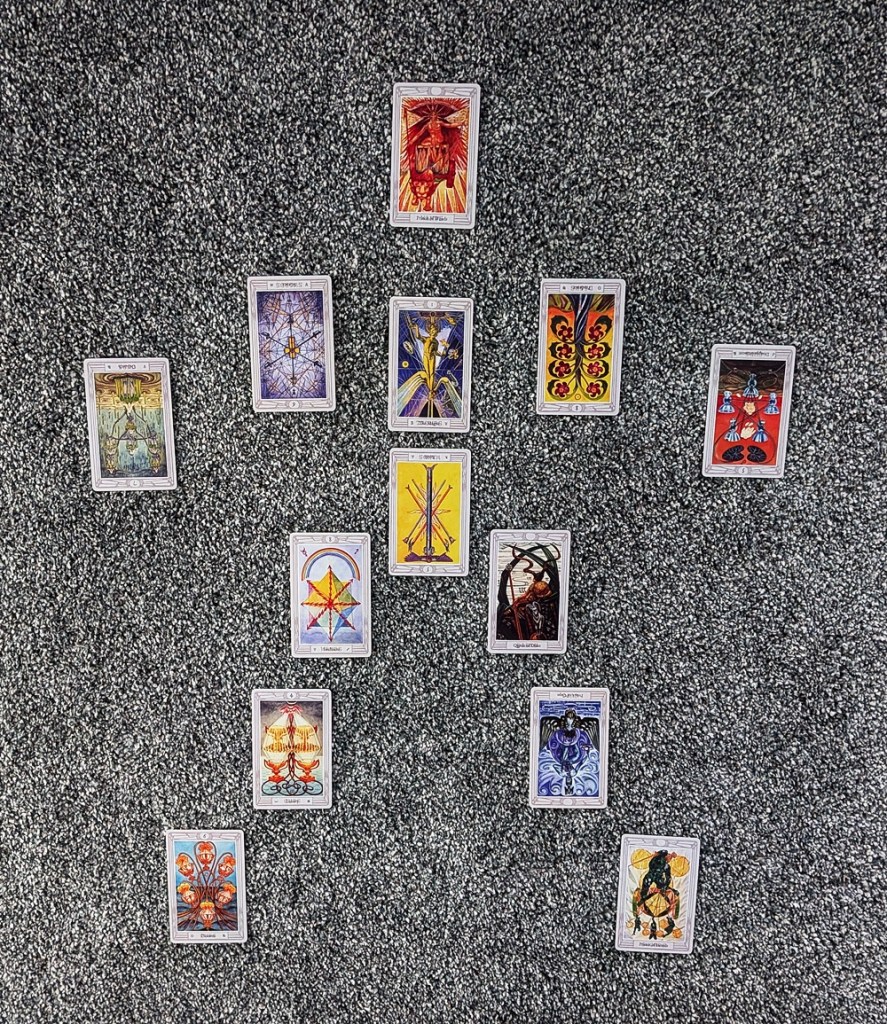
Card #1 – The Heart of the Matter: The reversed 5 of Wands (Strife) suggests “conflicted ambitions,” which is a fair assessment of the situation.
In the spread design I wanted the even-numbered cards at the right and the odd-numbered cards at the left, so I placed Thesis as Card #2, proposing anticipatory measures to circumvent (aka “logic one’s way around”) the obstacle presented by Card #3, Antithesis or “what the querent is up against,” leading to Synthesis of the opposites at Card #4. When using the “Action/Reaction/Resolution” premise it should follow the same sequence.
Card #2 – Thesis: With the Queen of Disks, the plan should be to avoid offending her by not upsetting her peaceful composure. Patience is the key to success. (If the card represents an aspect of the situation and not a person, the advice is to move quietly and methodically toward the objective.)
Card #3 – Antithesis: The 8 of Wands (Swiftness) as the obstacle to arriving at the goal cautions against imprudent haste; there is wisdom in slowing down and remaining sensitive to the Queen’s preference for tranquility.
Card #4 – Synthesis: The Magus will need all of his finesse to reconcile the two since the Queen is not easily persuaded. The elevated tempo and increased savvy of Cards #3 and #4 hint at being able to outmaneuver the Queen of Disks.
I’m viewing the four-card “square” (Cards #5 through #8) as the “elemental quotient” in the matter indicating practical considerations.
Card #5 – Fire/Ambition: The 6 of Swords (Science) reversed takes a page from the playbook of the Magus and recommends tempering the unbridled enthusiasm of Fire.
Card #6 – Water/Emotion: The 8 of Disks (Prudence) reversed in the Water position is emotionally aligned with the Queen of Disks, but restlessness is evident.
Card #7 – Air/Reason: The 4 of Cups (Luxury) in the Air position sees no good reason to doubt that things will work out as desired.
Card #8 – Earth/Sober Reality: The Prince of Cups reversed may be too devious for his own good and could wind up in a muddy quagmire of stymied expectations.
Cards #9 and #10 are intended to show motivating influences.
Card #9 – Active “Best Foot Forward:” The 6 of Cups (Pleasure) speaks for itself. It echoes the optimism of the 4 of Cups in attempting to advance in the situation.
Card #10 – Passive “Standing Back and Observing:” The Prince of Swords is taking the rational approach and carrying on the agenda of the Magus and the 6 of Swords.
Cards #11 and #12 are designed to convey how to decisively “get a handle” on the circumstances, both actively and passively.
Card #11 – Active “Manipulation:” Trying to leverage the 7 of Cups (Debauch) reversed would be like trying to squeeze a handful of (tainted) water. There is little hope of getting a grip on it, and to do so could be unhealthy.
Card #$12 – Passive “Sitting-on-Hands:” The 5 of Cups (Disappointment) reversed offers no more encouragement than its predecessor. This is shaping up to be an emphatic “No way!”
Card #13 – The End of the Matter: The Prince of Wands has me thinking that matters will be taken out of the querent’s hands and could accelerate beyond their control. “Exit, stage left” may be the most prudent course of action before they get run over.
Summary Conclusion: Elementally, there is a slight preponderance of passive Water and Earth cards and a secondary emphasis on active Fire and Air cards, suggesting that “slow and steady wins the race,” although the placement of the latter may mean that an excess of optimism can still “run away with” the querent.) It’s notable that five of the six “motivational” cards at the foot of the layout are upright, while five of the seven cards above are reversed. The implication is that a situation that starts out from a firm foundation unravels as it approaches the end. Only the Magus offers any kind of hope, but he will have to wrestle that incorrigible Prince of Wands to a standstill if he is to prevail (“cooler heads” and all that). The 5 of Wands occupies the first (Saturn) decan of Leo, which begins on the 23rd of July and runs from 0-to-10 degrees of that sign, so something significant could “break” (as in transpire, hopefully not self-destruct) in the matter at that time. But the card is reversed, indicating that the occurrence may be postponed until near the cusp of the second (Jupiter) decan that hosts the 6 of Wands (Victory) starting on the 3rd of August. This delay could be a very good thing for the querent’s self-esteem, but the Prince of Wands and the “Lust” trump card are also associated with Leo, so it could be a wild ride. The staggered horizontal row of cards looks like an impenetrable “picket-line,” but the Prince of Wands has reached “escape velocity” despite the staunch resistance of the Magus. I’m thinking of the old bath-powder commercial: “Calgon, take me away!”
*This spread is designed around the “Four Worlds” architecture of the Qabalistic Tree of Life – Archetypal or Spiritual (Fire); Creative or Intellectual (Air); Formative or Emotional (Water) and Material or Practical (Earth) – in a “1-3-4-5” progression. The orientation of the positions should be approached as if the querent is standing within the structure, looking out.
 Parsifal's Wheel Tarot & Astrology