AUTHOR’S NOTE: In Lon Milo DuQuette’s Tarot Architect, the author proposed that students build a personal “house” of knowledge and wisdom in their consciousness with the 78 cards of the tarot. I see it as a practical way to pursue Aleister Crowley’s vision of “living with the cards” that is more organized than daily divination.
DuQuette offered his own inner house of cards as an example, and I was struck by how closely – at least in concept – it resembles a similar tableau I put together back in 2017. His structural arrangement is different from mine, but he applied the same term I did to describe the trump card separating the upper part of the array from the lower section: the fulcrum. However, he used Justice (whether numbered VIII or XI) for this purpose while in working with the Tarot de Marseille (see the link below) I chose Fortitude (aka Strength) as XI. In addition, I set the Fool aside as “a thing apart” in the same way Rachel Pollack did in 78 Degrees of Wisdom since combining zero with anything accomplishes nothing (unless you’re selling diet soda). In this way, Fortitude becomes the “linchpin” between the first ten trumps and the last ten. (Some writers have dubbed these semi-cycles the “personal development” and “social evolution” arcs, so Trump XI is transitional, signaling that the strength of conviction is essential to transcending one’s private “bubble.”)
In order to compare the two models, I bought DuQuette’s deck, the Tarot of Ceremonial Magick, which I believe is going to become my second-favorite working deck after the Thoth Tarot and ahead of the Tabula Mundi Colores Arcus and the Magical Tarot of the Golden Dawn.
Here is what it looks like, with my annotation pointing out the fascinating numerical interplay that occurs between the upper and lower series when 11 (“Lust” in this deck) is used for the “fulcrum.”
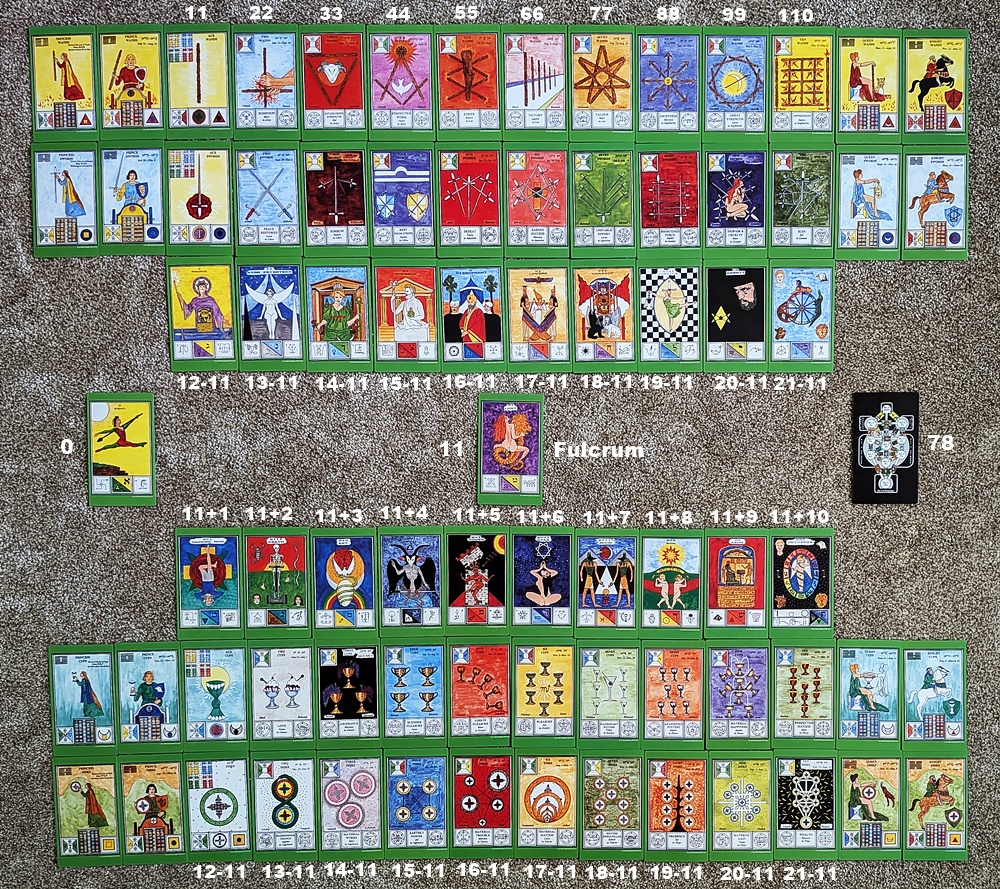
In a “cumulative” sense, adding 11 to a trump card in the upper row brings one to the trump card immediately below it in the lower row, while in a “reductive” manner, subtracting 11 from a trump card in the lower row yields the trump in the upper row. This points out that Lust (I prefer “Strength” or “Fortitude” for this exercise) serves as a kind of “conductor” or “translator” linking the energies between the two series; it is instructive in this regard that, in the TdM deck, the Woman appears to be opening the jaws of the Lion contrary to Waite’s revised version. (See Paul Foster Case’s commentary on this subject in The Tarot: Key to the Wisdom of the Ages.)
The Minor Arcana exhibit two different correlations:
In the Wands and Swords rows, each of the two “pip” cards directly above a trump card bears the same number as that trump, while “stacking” the digits of the pips in each column produces a number that is divisible by 11 (specifically, 11, 22, 33, 44, etc.), except for the Tens, which are a special case in which I elided “10-over-10” to become “110” or 10×11. Each division by 11 creates a quotient identical to the value of the associated trump card.
In the Cups and Disks rows, subtracting 11 from the trump card of the lower series at the head of each column produces the number of the two pip cards below it, which also matches the number of the corresponding trump card in the upper series, further tying together the “above” and “below.”
The court cards have no numerical designation in this pattern, but I decided that the Princesses and Princes have more in common with the Aces as I demonstrated in a recent post, so I placed them at that end of the suit-card rows, while the Queens and Knights share the “established” quality of the Tens at the opposite end. “Wheels-within-wheels,” as the saying goes. There is more here as discussed in the linked essay, but this is enough to chew on for now.
 Parsifal's Wheel Tarot & Astrology