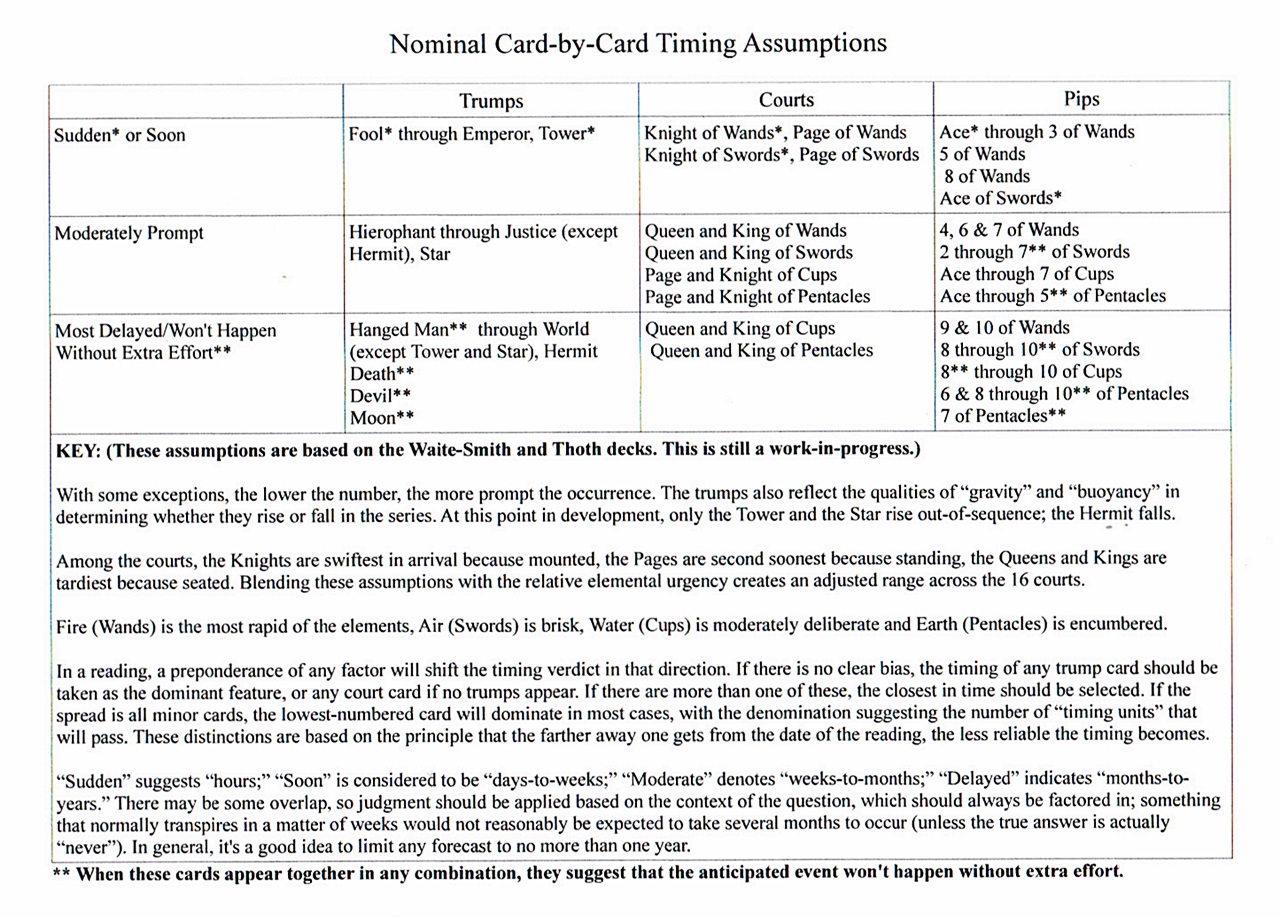
AUTHOR’S NOTE: While re-reading Paul Fenton-Smith’s Tarot Master-Class, I rediscovered his observation that the reversed 10 of Pentacles can exhibit an exceptionally attenuated “trigger point” (on the order of 18 months from the time of the reading), portraying financial distress that is likely to be more consequential in broad societal terms than intensely personal at the time of its arrival. This put me on the scent of the following essay, in which I take a comprehensive look at long-range timing in general. (As the example reading demonstrates, this analysis takes far less effort to perform than to explain.) Some time ago I made a stab at sorting all of the cards according to their relative promptness or tardiness of expression; although it doesn’t align perfectly with my current thinking, I have included it at the end of the text.
When not engaged for purely psychological or philosophical reasons, tarot symbolism is typically used to explore one’s immediate or near-term involvement with external circumstances. However, there are times when individuals harbor a more profound communal urge: they see themselves as “outsiders” and they “want in” to a particular social environment, or they are “insiders” and “want out” but can’t see a reasonable path to that goal. This can be a daunting proposition that demands considerable initiative and grit to pursue successfully, and it isn’t always obvious where to start. Tarot to the rescue!
Recognizing the arduous road ahead and therefore setting a preliminary target date of one year from the reading, we can look at groups of cards that convey ways and means for jockeying oneself to the objective over the long haul. The initial projection acknowledges the difficulty associated with breaking into an entrenched culture or breaking out of a firmly-established pattern of habitual behavior, and envisions a spell during which we are still seeking our footing in the matter. (One instance would be trying to read and process the cultural signals in a new work environment. A more common task would be assessing the post-startup route to solvency for a new business venture, many of which don’t make it past the one-year milestone.) It is a “worst-case scenario” that under special circumstances (and with sufficiently urgent cards) can be accelerated, but most often it will be a gradual evolution that can trail out even further into the future.
This analysis entails applying a combination of element, suit, rank and number theory. I see it as an ideal way to employ the three-card line spread in its formulation of “Present/Near-Future/Distant-Future (Outcome).” However, the first step in any reading prior to consideration of timing is obviously to confirm that the cards pulled support the querent’s stated purpose. If prospects for success are dim, there is no point in assigning an extended timeline to the proposed denouement; we can simply use the nominal range of the spread to capture a less-salutary result.
Because there are two main features to the analysis (element/suit and rank/number) and nine general sub-categories – one set of 22 trump cards (which I’m treating as a unit for the purpose of gauging “preponderance”), four sets of four court cards (4×4) and four sets of ten “pip” cards (4×10) – I figured it would be prudent to offer some additional guidance.
In practice, the element or suit should be allotted primary importance within the timing model, and then fine-tuned according to the relative immediacy of the cards representing them. The trump and court cards would command larger swaths of temporal real estate, while the numerical sequence of the “pip” cards suggests sub-tiers that parcel out briefer increments of time. For example, if Earth cards convey a span that extends from 18 to 36 months beyond the one-year “run-up” period, an abundance of Aces would stipulate the first ~2 months of the shorter cycle and numerous Tens the last ~3.5 months of the longer one, with the rest distributed equally in each series. The target ranges for different elements and suits would be subdivided appropriately.
Trump-card timing in a reading would be allocated according to the relative “speed” of its corresponding planet (or planetary ruler of its associated sign) in the following order, from fastest to slowest: Moon, Mercury, Venus, Sun. Mars, Jupiter and Saturn. (The “primal element” trumps should be taken in ascending order from the simplest [the Fool representing the opening third of the period] to the most complex [Judgement as the closing third], with the Hanged Man in the middle region.)
Similarly, in a 36-month forecast the court cards would partition the overall time-span in equivalent segments, 9 months each beginning with the mounted Knights as swiftest and therefore earliest, followed by the standing Pages and then the seated Queens and Kings. If there is a jumble of disparate trump, court and “pip” cards in the pull with no commonality, give the lowest-numbered pip or trump card(s) precedence over the higher ones on the premise that the former are more dynamic and motivated, while the court cards should be ranked from earliest to latest by comparative mobility.
All of the Fire cards (the Wands minor and court cards and the “Fire” trumps), along with the other three Knights and the other nine Aces, Twos and Threes convey an opportunity to act promptly and decisively in ways that focus the temporal outlook on the near end of the spectrum (e.g. within a couple of months of the arbitrary inception date of one year). The Aces represent the “itch that needs scratching,” the Twos show initial (and still tentative) steps toward realization, and the Threes reflect “hitting one’s stride” in creative and constructive self-application.
Embodying the second most spontaneous of the elements, all of the Air cards (the Swords minor and court cards and the “Air” trumps), along with the other three Pages and the other nine Fours, Fives and Sixes reveal an acute awareness of the path to closure and how to navigate it with economical precision. The Fours symbolize briefly idling or “plateauing” to take stock of one’s status, the Fives augur becoming restless with the status-quo to the point of overturning it, and the Sixes imply reaching a transitory state of equilibrium from which to launch further expansion. The window of opportunity for this evolution would extend from six to nine months out from the targeted inception date.
All of the Water cards (the Cups minor and court cards and the “Water” trumps), along with the other three Queens and the other nine Sevens, Eights and Nines signify moving more deliberately to secure one’s position, whether incoming or outgoing. The Sevens suggest a necessary but sometimes ill-timed and poorly-planned step in a new direction; the Eights provide for a “course correction” to rein in and moderate the overreach of the Sevens, and the Nines present a more enduring foundation for advancement than that afforded by the Sixes. Embracing “lunar” symbolism, the temporal envelope would reach from nine to eighteen months from the inception date.
All of the Earth cards (the Pentacles minor and court cards and the “Earth” trumps), along with the other three Kings and the other three Tens define the least energetic and least determined response to the stimulus for fundamental change. When not entirely moribund, they can be patient to a fault. In elemental language, the Ten of a suit represents the exhaustion of the original force that arose in the Ace. There isn’t a lot of raw material left with which to work, inviting a sense of complacency that can produce what Monty Python once characterized as a “lying-down-and-avoiding” mindset. They are also cards of acknowledging one’s limitations. The “point-of-entry” for the manifestation of all of these cards would span from eighteen months to three years from the inception date.
Once the attainability of the desired outcome has been established as described above, look for a “preponderance” of any one elemental, hierarchical or numerical influence to emphasize the likely time-frame for its accomplishment. Since the intent is to identify an overarching sphere of applicability, the sequential timeline furnished by the spread positions is not critical to the judgment. But if there is no marked abundance of any one feature (e.g. two or more in a three-card spread), turn to the last card in the series for the answer.
Here is a brief example reading to illustrate the process. The question involved when I can expect to see a turnaround in a long-delayed ambition I’ve been nurturing. (I did not use reversals for the purpose of this demonstration.)
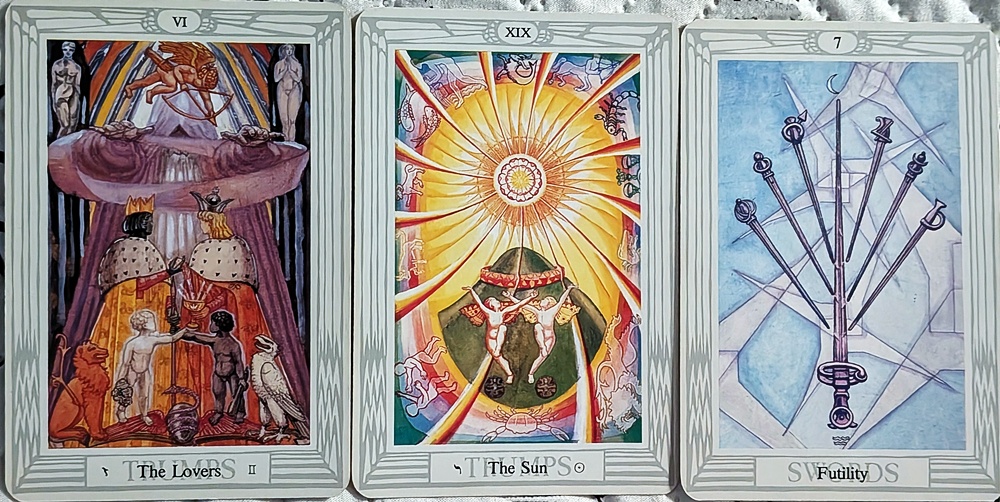
With the preponderance of two trump cards and the Lovers as the lowest-numbered of them corresponding to Air and Mercury, I would go with six to nine more months beyond the target date (which was already well over a year in the past) until resolution of the matter. (The Sun displays higher energy but Mercury is swifter.) The 7 of Swords is outranked by the two trump cards, but it is the second of two Air cards in the spread, backing up the testimony of the Lovers and locking in the prediction. Regarding the cards themselves, the Lovers suggests that an important decision will be made that has high hopes attached to it (Sun), but it isn’t likely to go anywhere with the 7 of Swords (Futility) at the end. The best that can be said about this scenario is “It will be fun while it lasts, but then reality will kick in.”
 Parsifal's Wheel Tarot & Astrology