AUTHOR’S NOTES: Since the rise of the Jungian approach to tarot during the early days of the “New Age” era, a sea of literary ink (both physical and digital) has been spent on explanation of the “Fool’s Journey” as it applies to the Major Arcana. Here I’m proposing a similar concept for the Minor Arcana.
Rather than archetypal on a grand scale, my more modest allegory is based on number and suit theory, in that order, as reflected in the cards involved. The numbers represent stages in the journey while the suits convey the quality of the experiences encountered at each step. It will become apparent as I work through the sequence that this odyssey mimics a pendulum swinging between periods of stability and countervailing instability.
The Ace represents packing your bags in preparation for leaving.
The Two indicates stepping out the door with a direction and a destination in mind.
The Three describes getting off the train when the end of the first leg denotes arrival at an outpost on the frontier of self-discovery. (This is where “rapid transit” stops; after this point you’re on foot and advancement slows.)
The Four conveys settling in and getting to know the neighborhood.
The Five advises that further renovations are needed to become perfectly at ease in your new home.
The Six shows attaining a measure of serenity that puts the disquiet to bed for the time being. (The implication is “Enjoy it while it lasts, because it won’t last long.”)
The Seven suggests that restlessness has not been completely vanquished; there is a lingering sense of “something missing” from the complacent tranquility of the Six. and a compulsion to chase after it.
The Eight describes offsetting action that will rescue the Seven from its the wandering ways. This involves helping it regain the path before it goes completely “off the rails” due to the frustration of unrealized dreams. (Some numerologists define the Eight as a “show of strength” but I see it as not so much a strong-arm tactic as an encouraging inducement that “paves the way” due to its harmonious binary nature; it delivers an invitation, not an ultimatum.)
The Nine implies “re-centering” at a level that is more mature and therefore more enduring than that of the previous “rest stop” represented by the Six and the “early arrival” signified by the Three. Since the Nine is said to embody “the fulfillment of the energy of its suit,” this return to balance can reflect the awareness that herein lies the “the best that can be achieved” from the pilgrimage. (For the philosophically-inclined, there is a parallel account in the “Three Perfections” of the ancient Greeks – Three, Six and Nine.)
The Ten symbolizes the recognition that the “last stop” has been reached and nothing is to be gained by trying to escape its inevitability. This supine attitude can be expressed either as exhaustion and resignation or as a stoic acceptance that acknowledges and abides within its limits. At its worst, the Ten can suggest paralyzing ennui or fatalism. An entertaining metaphor would be that it is either “ready to molt” into the Ace of the next suit (10 of Wands and Swords) or “comfortable in its own skin” (10 of Cups and Pentacles).
The court cards require shifting the focus to one that is predicated on the posture and the relative mobility of the figures on the cards.
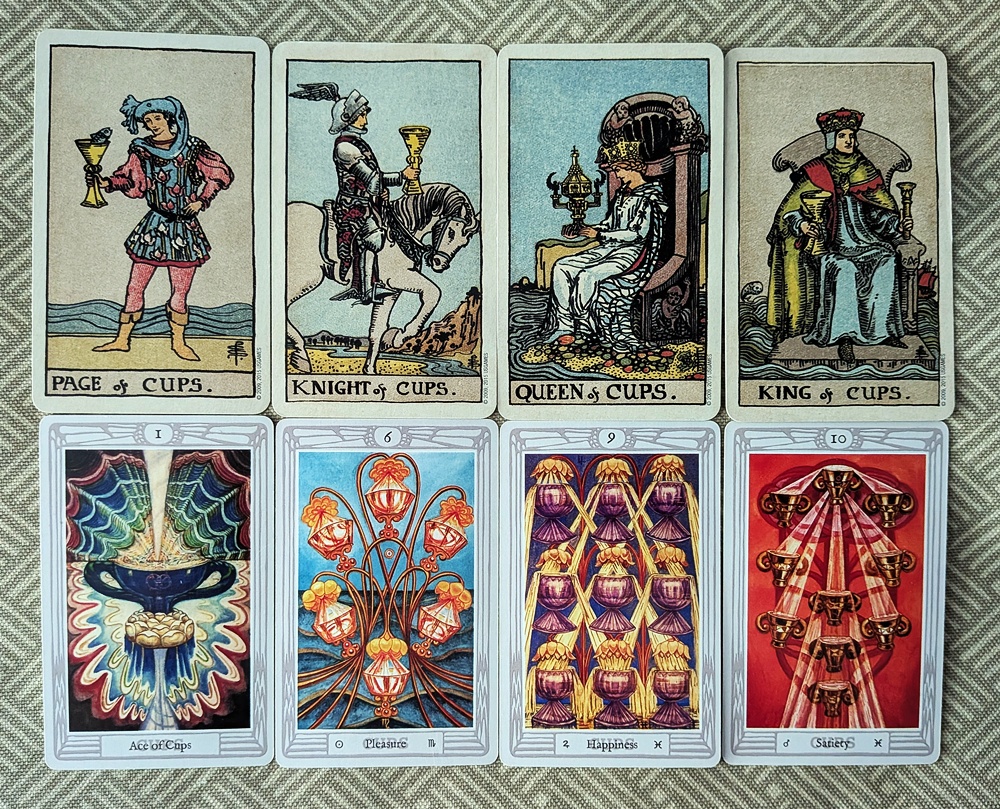
The Page shares common ground with the Ace in that the youth is standing bolt-upright and stock-still (as befits his occult connection to Earth), contemplating that first step but not yet committing to take it. However, unlike the Ace, that step when it comes will be more impulsive than planned.
The Knight is mounted and fully engaged in pursuing the goal. He is like a spinning top that maintains stability through constant motion, thus echoing the recovery of equilibrium inherent in the Six as it absorbs the unbalanced force of the Five.
The Queen is most like the Nine in her quality of maturity and patient forbearance. She is positioned to rein in the self-indulgent enthusiasm of the Knight by demanding his fealty and refusing to take “no” for an answer.
The King is in complete control but he is also unavoidably hemmed in by the obligations of his station; his plight is not unlike the forfeiture of mobility imposed on the Ten. The upside from a social accountability and reliability standpoint is that he isn’t going anywhere any time soon; the downside from a more personal perspective is that he isn’t going anywhere any time soon.
These alignments are best illustrated by a photo; here I’m pairing the RWS Cups court cards with the Thoth minor Cups. (Notice what I did here by mingling the decks: I completely avoided the debate over “When is a Knight really a King?”)
At each step along the way the suit of Wands will reveal a scenario that has to do with action, ambition, willpower or initiative, and that is related to the number or rank and inherent nature of the card pulled.
The suit of Cups invokes emotional satisfaction or dissatisfaction according to the state of evolution exhibited by the number or rank and the inherent nature of the card pulled.
The suit of Swords intimates an intellectual state of mind that will develop in complexity, subtlety and self-assurance as the progression unfolds, again according to the nature of the card pulled. Its present status will depend on its numerical place in the sequence, which can translate into an improved or degraded ability to make sound decisions and judgments.
The suit of Pentacles displays a focus on material matters with an eye toward gaining confidence in their management and disposition; there is a sense of “regulation” and “apportionment” in its operation that will change with the numerical position and nature of the card pulled.
 Parsifal's Wheel Tarot & Astrology