AUTHOR’S NOTE: This is a spread for the analysis of situations that offer three ways to confront the ethical choices facing the querent: a “High Road” of wisdom; a “Low Road” of folly; and a “Middle Way” of apathy. There are five factors on each path that are subject to optimization or abasement according to the cards pulled, and there are no presumptions of moral conduct; the answer comes down to “whatever works best.” This spread is ideally performed with three decks, one for each column, so all 78 cards are available to each independent path.
The goal of the reading is to assess which path provides the greatest potential for satisfying the seeker’s expectations. The ways of wisdom and folly are self-explanatory, while the way of apathy is intended to mean that the querent is indifferent and therefore resistant to the blandishments of the other two. The chips will fall where they may.
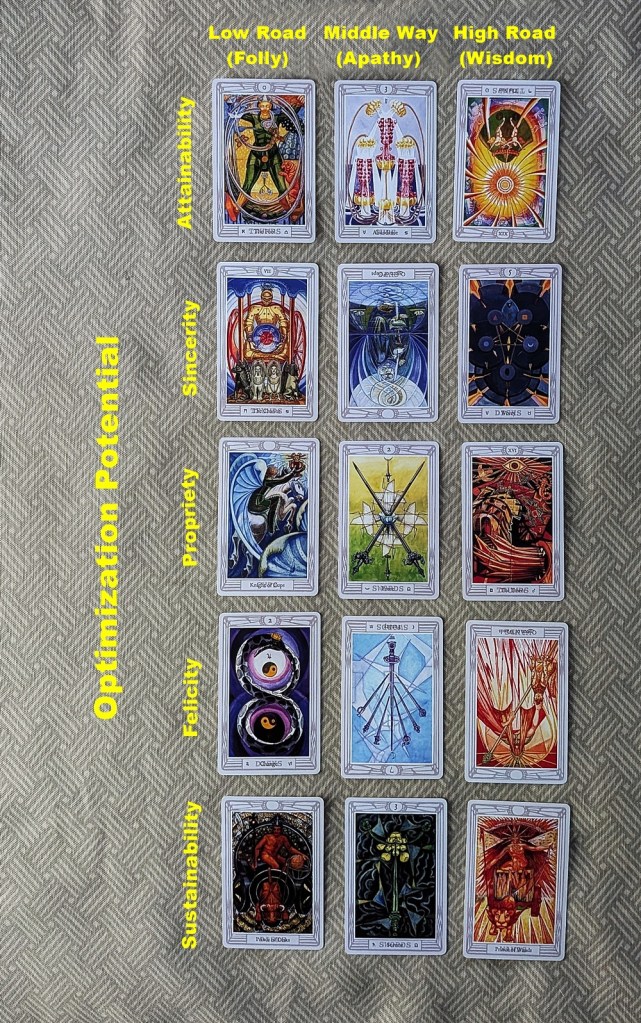
Here is a hypothetical reading for a matter that involves highly-charged ethical considerations. I’m reluctant to say it, but it looks like the Low Road offers the most compelling climate for optimization as long as the querent’s “inner Fool” is allowed to take charge. The Tower in the middle of the High Road appears to be demolishing false presentments of honesty and integrity, and the two Wands court cards – one self-absorbed and the other irresponsible – make any potential opportunity look like a “flash in the pan.” The Middle Way suffers from a preponderance of hard-as-nails Swords energy (with the 2 of Swords as “gatekeeper”) that won’t cut the Three and Queen of Cups any slack, so there is little hope of gratification in this outlook.
There is nothing about the Low Road (other than the fact that it is predicated on foolhardy assumptions) that seems at all risky. Based solely on the testimony of these cards with no second-guessing of motives and morals, my advice would be “Go for it!” and let circumstances sort themselves out once the deed is done. There is an old saying that it is easier to beg forgiveness after the fact than to request permission in advance. Assuming no irreversible harm has been done, the Fool can always apologize by admitting “I don’t know what got into me. It seemed like a good idea at the time.” In the present case, unless and until the “day of reckoning” arrives, it looks like the Low Road will deliver the best ride of the three.
Such reliance on serendipity is certainly not unprecedented, and numerous instances can be cited where blind faith (or dumb luck, take your pick) carried the day. In US football there is the “Hail Mary pass,” and in aerial warfare there is “flying on a wing and a prayer.” However, on the other side of the ledger we have the “fool’s errand” as the benchmark of futility: in gambling there is the “sucker’s bet,” while in military history there are the “Charge of the Light Brigade” and “Custer’s Last Stand.” We all know how those worked out.
Perhaps the best example comes from my own experience. When I was in high school they held air raid drills to prepare for imminent nuclear attack in which we had to line up in the hallway, sit down with our back against the wall, put our head between our knees and cover it with our hands, to which the wags added “and kiss your ass goodbye.” The planners were probably World War II veterans who had no clue what they were up against since the sheer magnitude of the event was beyond their comprehension. To me, this scenario has always represented the pinnacle of foolishness and the epitome of misplaced optimism.
 Parsifal's Wheel Tarot & Astrology