AUTHOR’S NOTE: I recently came across the opinion that fear as expressed in a tarot reading is not necessarily a bad thing because it keeps us sharply focused on our challenges while galvanizing us into action. In addition, fear in the form of anxiety is often the driver that brings a sitter to the reader’s table, seeking to understand the root cause and hopefully resolve it.
There are less-stressful times when it’s reasonable to let matters advance on “auto-pilot” as well as uncertain situations that require direct engagement and conscious steering to take us where we want to go, but on occasion the forecast is so daunting that we should consider retreating to reflect and regroup before we surrender to it.
Developing a feel for “when to hold ’em and when to fold ’em” is a sound strategy for undertaking any initiative, along with gaining a sense for when it’s advisable to just let circumstances take their own course. We can always fight our way through an unpleasant interlude, but it would be helpful to preview the obstacles we might face before we get that far, thus permitting an informed decision.
I began thinking about how the cards can be conveniently binned into these categories in order to bring them to bear on our readings with relative ease. I tackled the Major Arcana first, followed by the Minor Arcana (except for the court cards because I typically see them as “states of being” in the form of character profiles for the querent or other interested parties rather than as situational motivators). Overall, this is a slightly offbeat spin on the “good, bad and neutral” paradigm.
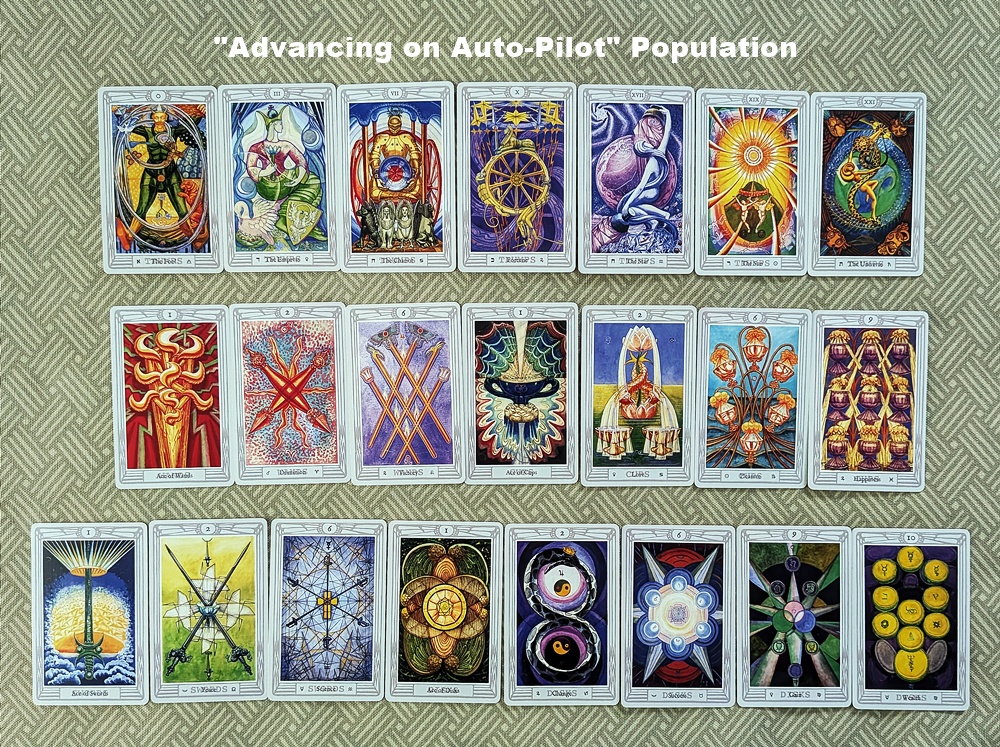
Before anyone comments, I’ve placed the Fool and all of the Aces in the “auto-pilot” population for a similar reason: the Fool is the archetypal nonentity who has no fixed agenda in mind, while in the minor cards coordinated movement doesn’t occur until the Twos appear. (I’ve expanded on the Twos below.)
As is usually the case in a random pull, we are going to receive mixed messages involving cards from all three groups. From the standpoint of actionable advice, I would focus primarily on those that appear late in the reading, such as in the “final outcome” or “long-range consequences” position, and secondarily on any that play an especially critical or sensitive interim role, as customarily signified by the “turning-point” or post-crisis “check-and-adjust” position in a line spread.
I’ve illustrated this essay with the Thoth deck (copyright of US Games Systems Inc, Stamford, CT) because many of the Minor Arcana titles dovetail perfectly with my premise.
Advancing on Auto-Pilot:
These are generally favorable cards that don’t give us much cause to intervene. (With the Fool and the Aces it would be premature, and with the rest there is no need for aggressive manipulation.) Quoting Bobby McFerrin, they are the “Don’t worry, be happy” harbingers of success.
Just a word on the somewhat cryptic Twos in this scheme: depending on their position in the spread, I see them as “bridging” cards that suggest “putting one’s best foot forward,” either at the beginning of an activity or at any juncture where the need for a new direction is indicated. In my own practice I view them this way: 2 of Wands – leveraging our ambition; 2 of Cups – radiating love and compassion; 2 of Swords – making a rational decision; 2 of Disks – welcoming change.
Engagement and Steering Required:
These cards represent a range of mostly upbeat influences that we can and should work with to our advantage. They typically won’t hand anything to us “on a platter;” we still have to strive for it by corralling and applying their energy.

Retreating and Regrouping Advised:
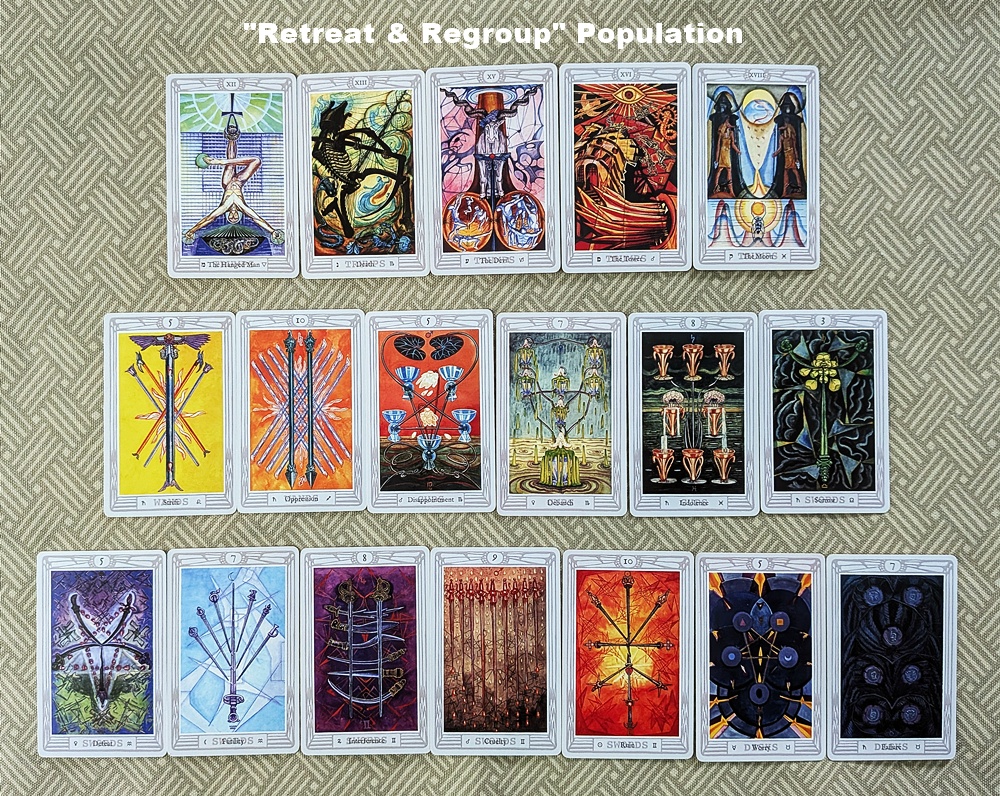
There are discouraging cards that convey little or nothing in the way of satisfaction, so it may be better to backtrack and start over with a different plan. There is a visceral quality to the titles of the “small” cards that says it all: Strife, Oppression, Disappointment, Debauch (aka Debasement); Indolence; Sorrow; Defeat; Futility; Interference; Cruelty; Ruin; Worry; Failure. These 13 cards are as ugly as it gets; unlike the five trumps in this population, they are difficult to approach philosophically and can instigate an irrational “knee-jerk” reaction.
 Parsifal's Wheel Tarot & Astrology