AUTHOR’S NOTE: The Golden Dawn’s system of tarot timing relies on the zodiacal position of 68 of the cards within the “Chaldean” array of twelve astrological signs. In this essay I’m going to challenge the conventions that have been established for its use.
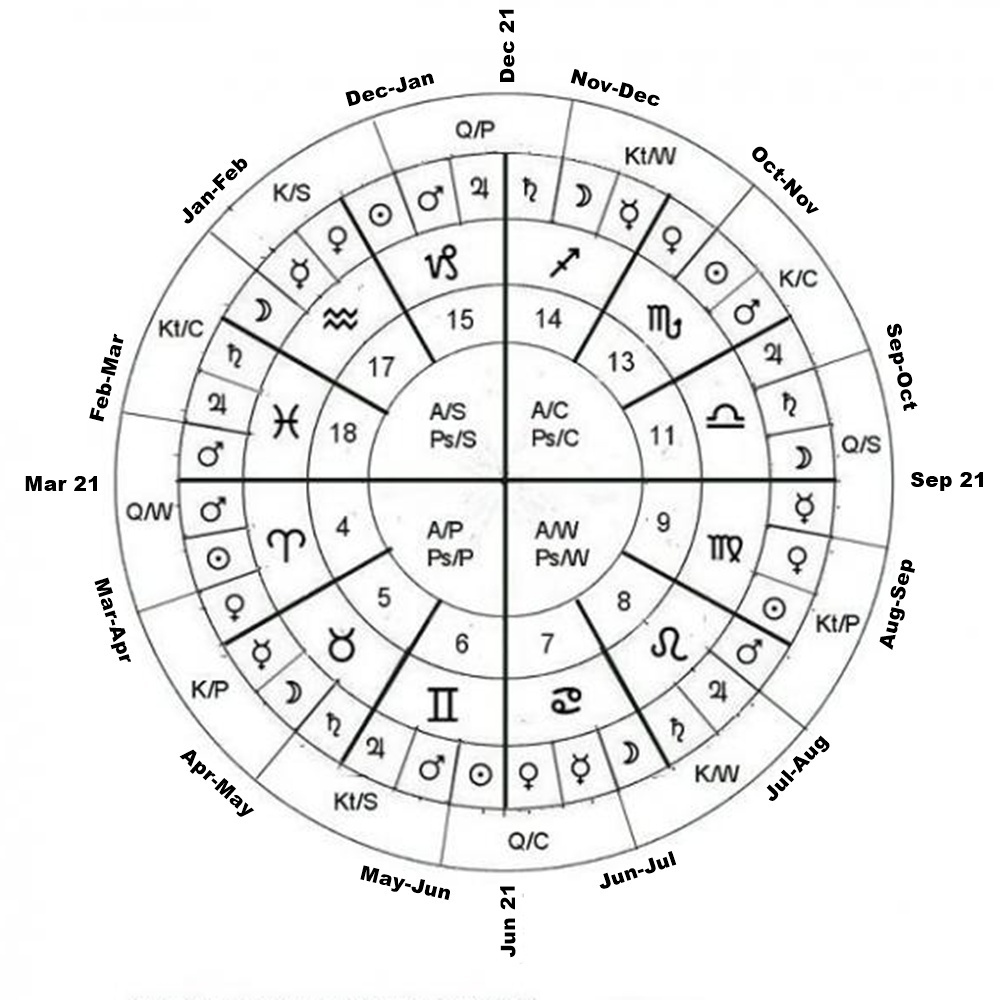
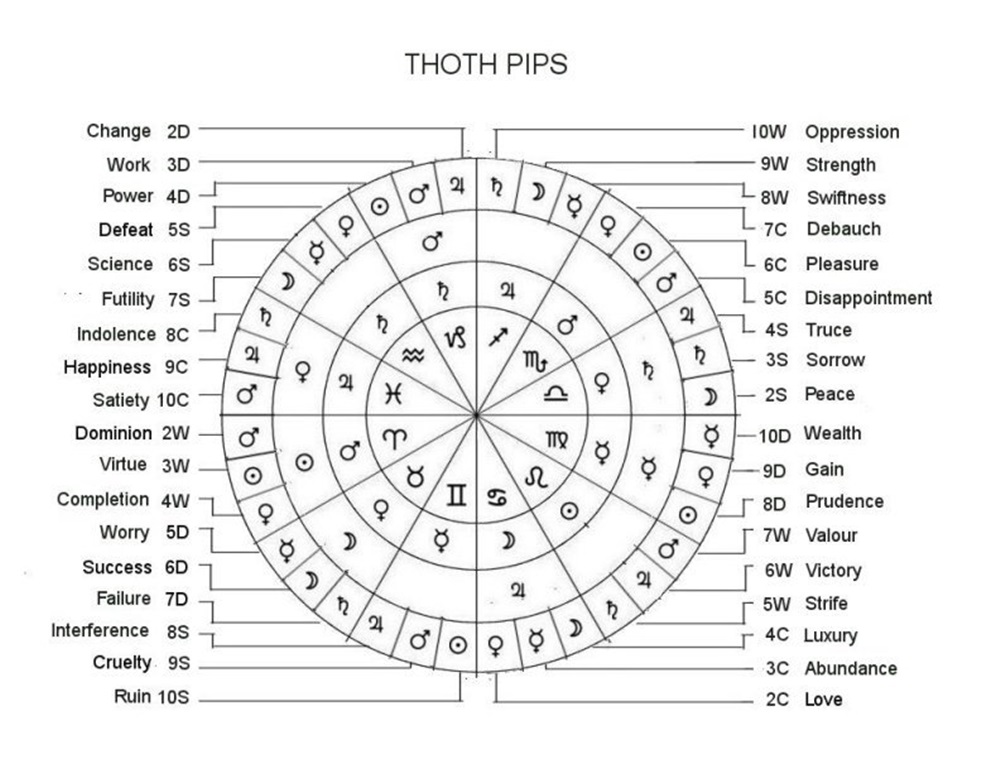
The series of 36 minor cards begins in Aries on or about March 21st of the astrological year and rotates counterclockwise month-by-month, carrying with it 12 court-card and 12 trump-card associations, while the four Aces and four Pages/Princesses have a broader reach. It opens with the 2 of Wands in March and closes with the 10 of Cups in February of the following year. (The historical arrangement is shown in the images below.) It’s important to remember that the zodiacal year and the calendar year are not aligned, so zero degrees of Aries – which is tied to the Vernal Equinox – does not arrive on March 1st but rather on March 21st, and all of the other cusps are offset from the calendar dates accordingly. (Referring to an astrological ephemeris will make this clear.)
The seven planetary trump cards (the Magician, the High Priestess, the Empress, the Wheel of Fortune, the Tower, the Sun and the World) do not have zodiacal correspondences but they can be included in the model according to their classical sign rulership. The three elemental trumps (the Fool as Air, the Hanged Man as Water and Judgement as Fire) are not assigned astrological attributes unless modern rulerships are applied (which I would only do in a pinch, so I won’t describe it here).
If they appear as the outcome card in a reading, the pip, court and trump cards related to a decan define a period of the year when the events and circumstances they foretell can be expected to transpire. As is generally assumed, each of the 36 decans on the wheel represents roughly ten days of time; so if, for example, the outcome card is the 5 of Cups, the matter would be resolved between the 21st and 31st of October. If it is Death, the entire zodiacal month is in play, and if it is the Ace or Page/Princess of Cups, the available span would be the 90-day quarter from September 21st to December 21st, with particular emphasis on the “Fixed” sign of Scorpio at its center that envelopes the same 30-day window as Death. (*Note that the court-card titles used in the illustration below are Golden Dawn/Thoth designations and not those of the Waite-Smith tarot; thus, if using the RWS deck, translate “Kt” into King, “K” into Knight and “Ps” into Page.)
In my own estimation, this approach often fails to pass the “giggle test.” Suppose a reading is performed on November 1st to predict when the querent might hear about a recent job application (a notification that would customarily happen within a couple of weeks). With the 5 of Cups as the outcome card, in the Golden Dawn system its location on the wheel would push the verdict out to the following October, or nearly a year later, which is patently absurd. There are a number of different timing methods that avoid zodiacal assumptions, but in most cases they don’t offer a significant improvement over the Golden Dawn method.
Here is a different way to apply the decans for timing, in which I disregard monthly sign transitions and look strictly at decanic intervals of time from the date of the reading: days, weeks, months or quarters up to and including one year. It bears some similarity to the astrological technique of “secondary progressions,” in which one day of planetary movement in an ephemeris equates to one year of life for predictive purposes. In the current proposal, rather than each decan symbolizing ten days, it could conceivably relate to any number of days up to ten, allowing for reliable shorter-range predictions using all 36 decans. It’s just a matter of changing the scale to one that produces a narrower window of opportunity.
The November 1st date of the job-application reading would fall close to the second decan of Scorpio, tying it to the 6 of Cups that overlays the first ten days of November, and each subsequent decan would address a segment of time that is ten days beyond its predecessor. At face value this would obviously run afoul of the same error I described above: eventually we will encounter a narrowly-framed scenario similar to a job application but we will receive an irrationally protracted completion date. As the wags in Maine sometimes say “You can’t get there from here.”
How about, when confronted with an imminent occurrence like a hiring action, we assign a “sliding scale” to the duration of each decan? Switching from a ten-day to a one-day period would mean that, if we receive the 6 of Cups as the outcome card for a November 1st reading, in the best case we can expect an answer within the next 24 hours rather than a week or more later, and if it happens to be the 5 of Cups from the previous decan, the worst-case outlook would envision a 36-day wait, or just over one month after it was submitted. Although both ends of the spectrum are slightly unrealistic, they are still within the realm of reason, and there are 34 other possibilities in between that will fit more comfortably within the anticipated range.
If the opportunity we are examining is slightly more delayed in its assumed arrival (e.g. 3-to-6 months), we could shift to a 5-day stretch for each decan, which would mean that, for a November 1st reading, the 6 of Cups as outcome card would deliver the awaited message within slightly less than one week of the session date, while – moving counterclockwise 35 decans from that point – the 5 of Cups would indicate 175 days (35×5) into the future (i.e. around six months rather than the 12 months it would normally signify). The first projection would be unlikely while the second one would be a stretch in the opposite direction, so a more logical denouement given the circumstances would be expressed by cards that fall somewhere between the two (such as the 6 of Pentacles in early May).
For even longer forecasts, I would stay with the conventional 10-day outlook for each decan since any prediction beyond one year becomes increasingly vulnerable to being invalidated by external conditions that could dramatically change the complexion of the situation, especially if we factor in the conflicting personal agendas of other interested parties.
It should be apparent that these date-ranges are fluid, not prescriptive, since their only purpose is to support a rational approach to timing that is sensitive to the temporal bias of the question (whether prompt, moderately deferred or remote). They aren’t intended to adhere rigidly to the zodiacal framework of the original model.
 Parsifal's Wheel Tarot & Astrology