AUTHOR’S NOTE: After previously analyzing the nature of the pentagram as it is used in tarot imagery, I decided to create a tableau that brings it to bear on a “personal power profile” that can be used for self-awareness or to assess the character of another party to the matter in question. This layout should be approached as if the individual being scrutinized is standing within the pattern looking out, similar to Leonardo da Vinci’s famous drawing of “Vitruvian Man” (who appears to be doing jumping-jacks, but we will ignore that for my purpose here and stick with the “splayed” posture).
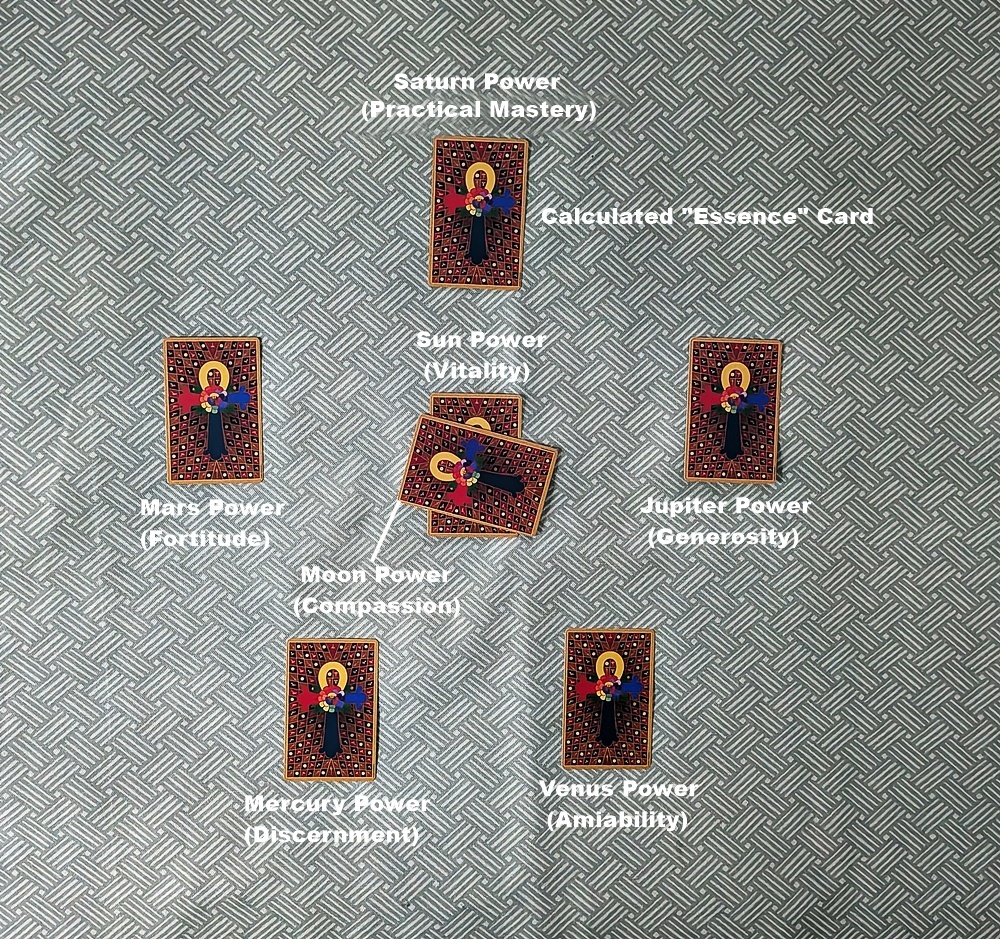
Except for the “Saturn” card, this array can be pulled in any order; in my own practice I will follow the astrological sequence in most cases: Sun, Moon, Mercury, Venus, Mars, Jupiter. The Saturn card is to be calculated last as an archetypal “essence” by summing the face values of the other six cards and reducing the total as necessary to come up with a trump card showing overall “worldly” competence.
The position meanings are self-explanatory based on the titles, and the relative prominence of any of them can be elevated if the random cards that land there are favorably attuned to their vibration according to various forms of “dignity,” or commonality of element, number, planetary signature or inherent nature. For example, “Mercury Power” exhibits the qualities of Air, the number Eight, astrological Mercury, and the faculties of intellect, so a card of similar nature that falls there would bolster those properties in the profile, creating what I think of as an “isometric” character map of greater and lesser promontories.
The simplest method would be to treat these parameters as revealing “strengths and weaknesses,” but that may be a little too tone-deaf for the subtleties I’m proposing here. A better idea would be to see them as expressions of “inclination” and “disinclination” toward consciously controlling the various functional demands of daily life (i.e. whether to squarely confront or sidestep them). Reversals may be used to show more recessive traits.
This method of “personality profiling” would seem to be particularly germane to one-on-one relationship matters where a querent wants to explore the likelihood of connecting successfully with another individual. In such cases it would be instructive to perform it for both the seeker and the object of affection to see whether any highlighted areas between them either dovetail in an encouraging fashion or diverge unsympathetically. There may be opportunities of the “opposites attract” kind, but I would look first for any convergence of their approach to personal priorities that would make for an immediate congruity of outlook.
Realistically, though, I have serious doubts about the effectiveness of tarot divination for the kind of “mind-reading” involved in dissecting a third party’s psychological attributes, so it may be best to perform this exercise only for the immediate client with a nod toward relationship dynamics and just tell them “This is how you’re likely to experience engagement with the other person.”
Below is an example reading for someone I know very well (wink, wink . . . ). Without paying strict attention to the Golden Dawn’s astrological correspondences (I have my own iconoclastic opinions about some of those), I decided to lay out the trump cards from a second deck as a “baseline” template that conveys my view of each of the factors. With the exception of the Sun (although I could have just as easily chosen the “Lust” card), I picked examples that display a central human figure as symbolizing a manifestation of the energy that is psychologically perceptive rather than philosophically profound. For instance, I prefer the Mars-ruled Aries association of the Emperor for the kind of physical prowess I’m talking about in the “Fortitude” position and not the direct connection of Mars to the Tower since as an astrologer I don’t see it as an inherently destructive force.
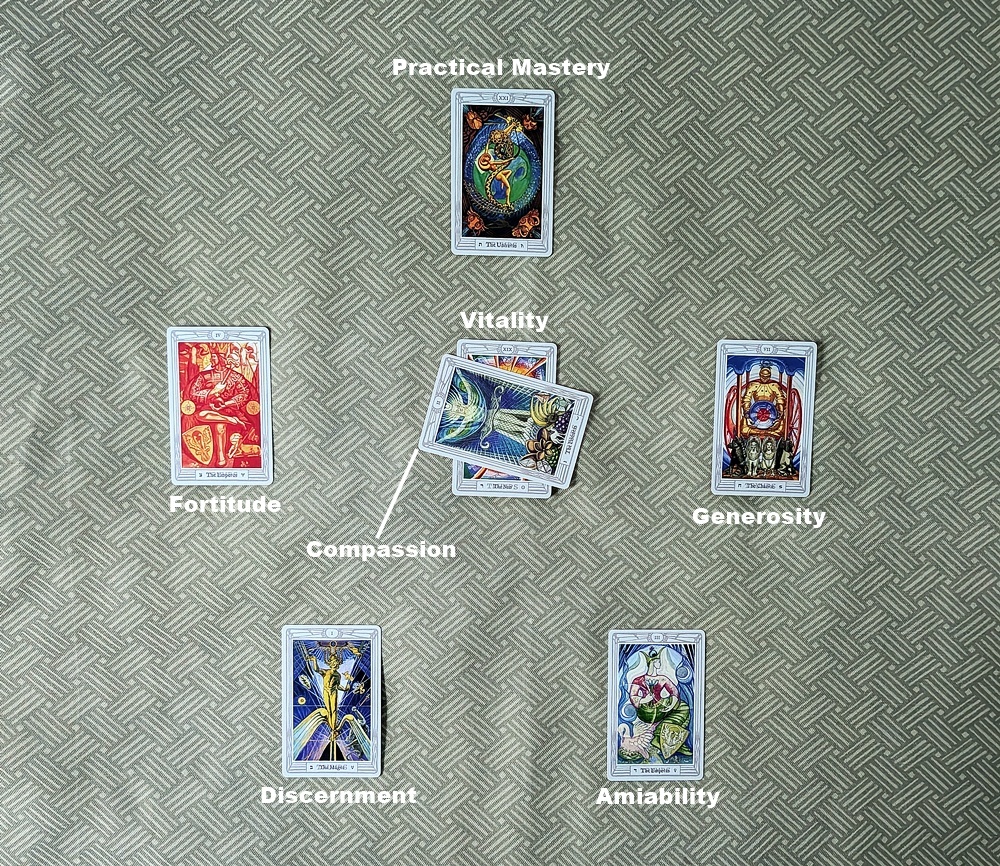
While shuffling the cards, I told the deck “Let’s be critical, shall we?” This is an attitude with which the Thoth tarot has absolutely no problem. I attempted to use reversals but it created a chaotic picture so I turned all of the cards upright.
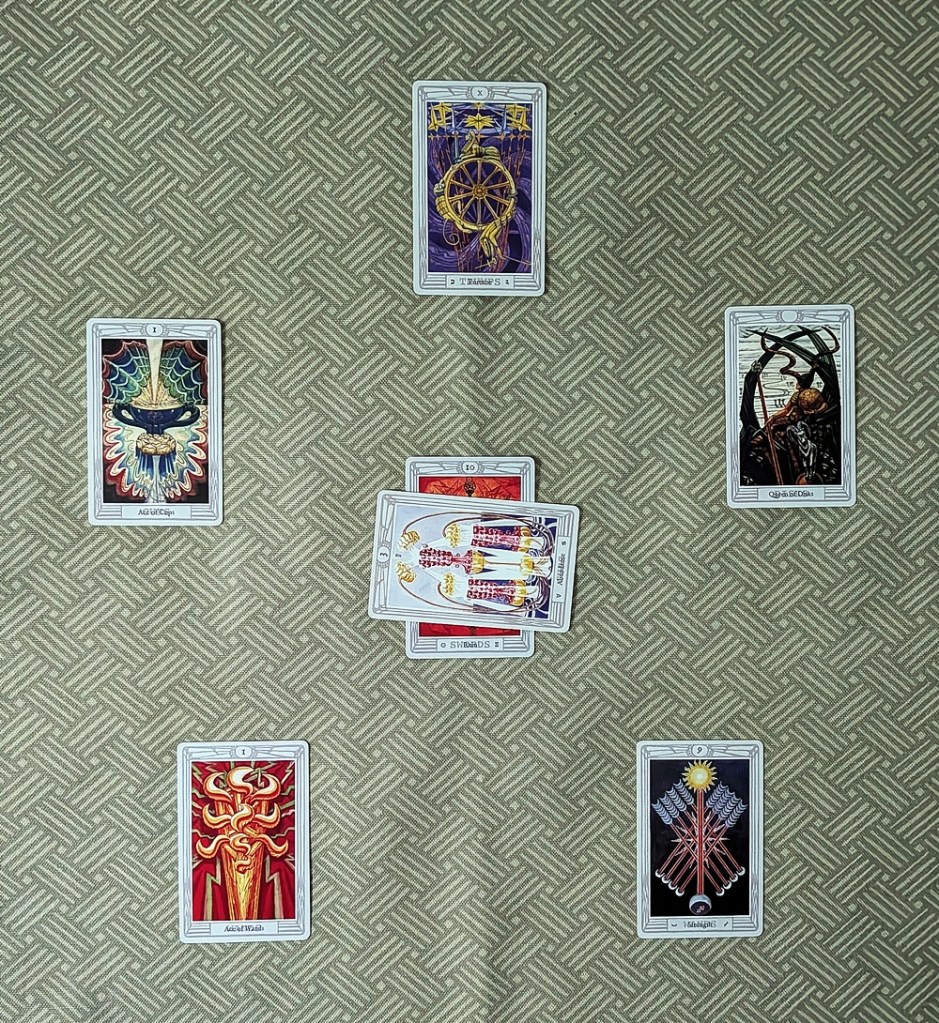
The 10 of Swords (Ruin) in the “Vitality” position suggests a wasteful dispersion of vital force, perhaps through nervous peregrinations of the “walk-around-aimlessly” kind. In real-life terms, this occasionally happens but it is not endemic. Still, the potential is always there for anxiety to seize the reins and produce vitiating insomnia.
The 3 of Cups (Abundance) in the “Compassion” position indicates the markedly openhearted disposition of Mercury in Cancer; there is nothing to hide and no reason to do so. It’s promotes a “heart-on-sleeve” approachability.
The Ace of Wands (Root of the Power of Fire) in the “Discernment” position tends to gloss over the details in the rush to make a point. The mind can be irrepressible even when it should be more circumspect. (From a related angle shown in the individual’s natal horoscope, there is a Jupiter-in-Sagittarius tactlessness to it.)
The 9 of Wands (Strength) in the “Amiability” position implies cheerfully adopting the Panglossian postulate that “Everything is for the best in this best of all possible worlds” just as long as the subject of the reading can call the shots. There is a veiled “superiority complex” here that doesn’t impress the aforementioned 3 of Cups since the two are “at war” elementally.
The Ace of Cups in the “Fortitude” position depicts robust emotional strength of character and is possibly the best card in this reading. Blended with the 3 of Cups, it makes for a greatly deepened reservoir of compassionate resourcefulness.
The Queen of Pentacles in the “Generosity” position is well-situated to “share the wealth” within prudent limits, and the querent has in fact informed immediate family member of the intent to do so while still alive.
The calculated essence card in the “Practical Mastery” position is the Wheel of Fortune. The best analogy I can offer for this indicator comes in the form of a verse from the Holy Modal Rounders’ song Dame Fortune:
“Throw your changes, hand, I’ll catch them.
If I can, I will use them well.”
I prefer to see this card as marginally optimistic rather than unbiased due to its Jupiter correspondence, so in this reading it imparts an uptick in enthusiasm for pursuing the mastery of practical affairs. Because the main “problem” card in this spread is the 10 of Swords and the Wheel of Fortune is another “Ten,” it may well overwrite the enervating influence of the lower-ranking card with its infectious positivism in a “don’t sweat the details” show of support. The ingratiating 3 of Cups also does its part, reminding me of the Pink Floyd lyric: “Everything under the Sun is in tune, but the Sun is eclipsed by the Moon” (this time in a good way that suggests pouring oil on troubled waters).
 Parsifal's Wheel Tarot & Astrology