AUTHOR’S NOTE: I’ve touched on this subject in written form on several occasions in the past, but this time I’m illustrating it with an annotated image for a specific example, and also applying it to an unconventional analysis of the Tower card. (All cards shown are from the Thoth Tarot, copyright of US Games Systems Inc, Stamford, CT.)
Split-level architecture – exemplified by the “raised ranch” – was a popular North American house design in 1950s suburbia: “rec-room” in the finished basement; kitchen and living areas on the main floor and bedrooms on the top level. (The three-tiered “club sandwich” analogy I was going to use is of an earlier vintage.) My approach to reading the tarot cards adopts a similar model with a different floor-plan: a large “living space” (70%) at the top; a tiny “meditation nook” (5%) at the bottom; and a modest “self-help exercise room” (25%) in the middle.
Approximately 70% of the time (depending on the context of the question), the cards in a spread will speak to mundane affairs and any likely events or circumstances attending them, or “What will happen, and how will it unfold?” In another 25% of my forecasts, the outlook will be depicted in psychological terms. (“How will I be mentally and emotionally affected by the developing situation, and how can I prepare for it?”) The least common focus (~5%) addresses broader, more far-reaching consequences of an impersonal, universal or spiritual kind, as in “What overarching conditions will alter my worldview or high-level understanding of the issue?” Most clients seek the first mode of interpretation but will acknowledge the second one when the practical avenue of inquiry reaches a dead-end; few will relate to the more rarefied viewpoint.
For this study I picked a random card to analyze in those three ways. It turned out to be the Thoth Knight (RWS King) of Swords. Although I didn’t use reversal, it could be applied to furnish a more nuanced response that offers an oblique vantage point. In such cases, the threefold applicability factor could also be turned on its head to some extent, with spiritual and psychological aspects playing a larger role in the matter, perhaps (if I were to guess) with a 25/25/50 breakdown that has “psychological implications” at the top since reversal is often seen as imparting an internal focus.
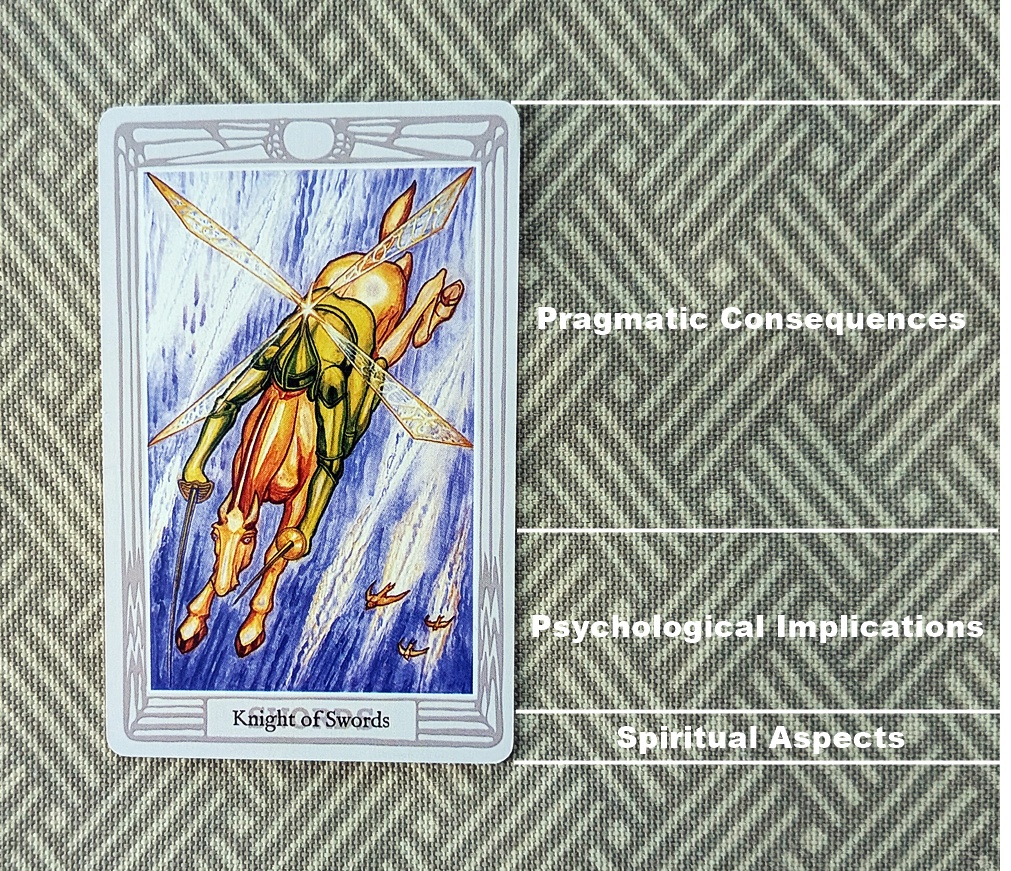
The “pragmatic consequences” of this Knight could amount to experiencing stiff resistance to one’s ideas or confronting a legal challenge. It could also present an opportunity to make an authoritative decision or pronouncement of some kind, or to take up an educational pursuit with the goal of greatly advancing one’s knowledge. It signifies “Fire of Air,” so vigorous mental expansion is indicated, with a caution against displaying intellectual arrogance or elitism.
In the realm of “psychological implications,” there could be a temptation to overthink every detail and make little progress with the overall objective. This Knight would rather make crafty “cat-and-mouse” maneuvers than trade direct blows with a worthy adversary. He could also be moving too fast for his own good and stumble over his own rhetoric. Overconfidence is always a risk.
The “spiritual aspects” of this Knight are vanishingly small; he is a solitary, single-minded thinker and doer, a stern arbiter of justice and not a mystic who is going to sit and ponder the abstract meaning of life. In a reading I doubt I would ever get to that point with this card.
On to the Tower. In Tarot Master-Class, Paul Fenton-Smith observed that, when the Tower appears as the “outcome” card in a spread, it’s a good idea to pull another card to reveal what area of life will be affected by its dire insinuations. This assumes that we are adhering to the popular perception that this card brings on traumatic conditions, although in my own experience I’ve found that while it might create the climate for a profound upset, it seldom hammers on that vulnerability in starkly painful ways; its mundane effects are usually much milder. Tarot author Alejandro Jodorowsky prefers to see it as offering a compelling motive and a commensurate opportunity to gain liberation from the sway of the previous Devil, going so far as to say to himself “What shall I celebrate today?” when it turns up.
Bringing it under the umbrella of the first half of this essay, I laid out the Tower in the same way I did the Knight of Swords, but I added a random card to each split to suggest how its nature might respond to the Tower’s stimulus. (I normalized the width of the three bands for the purpose of demonstration.)
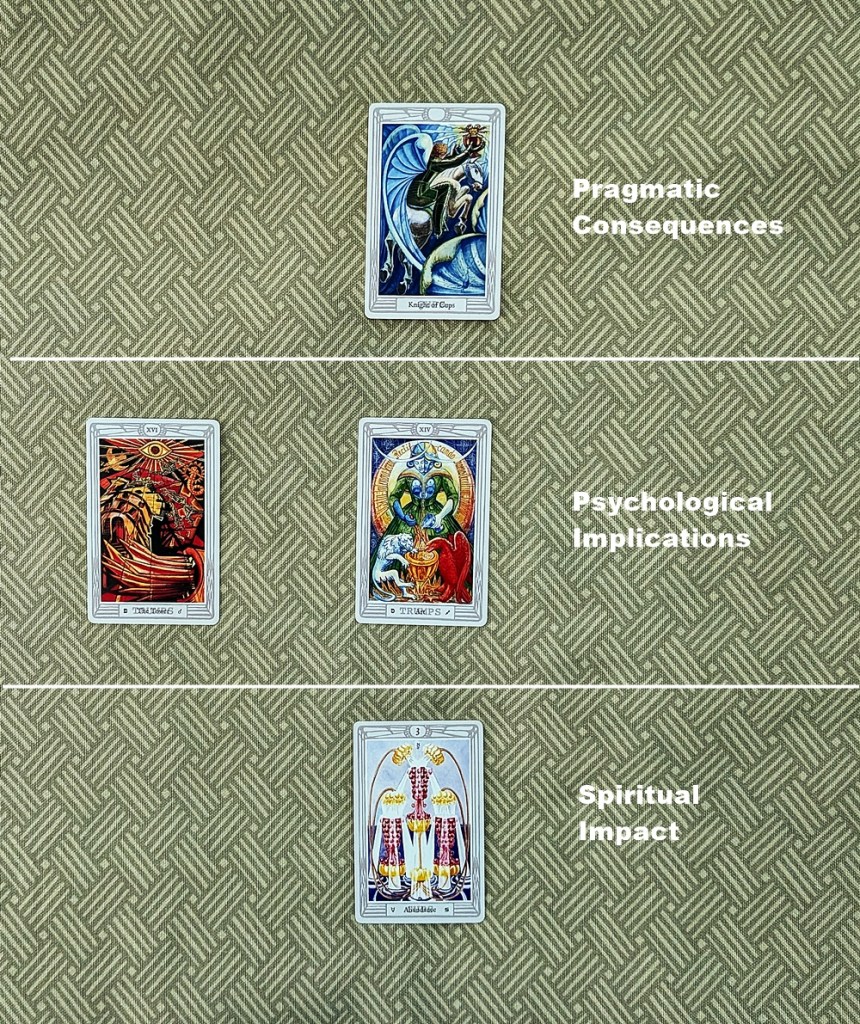
The Knight of Cups can be a lazy sybarite, and the swift “kick in the pants” delivered by the Tower would be a perfect antidote as long as the Knight’s whining doesn’t goad it into a harsher sentence. The virile energy of Mars is not necessarily a destructive force; often it will simply provide a shot of adrenaline when and where it’s most needed.
The Tower admonishes Art (aka Temperance) not to fuss too much over fine-tuning its attitudes and behaviors. Sometimes big bites are better than small ones, and one giant leap could be preferable to cautious step-wise advancement. Just be sure to vet the landing zone.
The 3 of Cups is another laid-back card that the Tower won’t allow to stagnate. Mars will bring the metaphysical environment to a brisk boil, so don’t be the complacent frog at the bottom of the deceptively cool pot, or Voltaire’s naive Candide to the insufferably imperturbable Dr. Pangloss. (Look it up, it’s short and well worth reading.) In the end, the dispirited knight may want to hide in his garden, but in this case a bed of thorns is no place to languish or the red won’t all be from the roses. Here, as in most such matches, the spiritual “velvet glove” is several sizes too small for the militant “iron fist,” so you may want to keep it in the drawer and wrestle with the martial energy on a more visceral level.
The Tower is the “300-pond gorilla in the room” in all three comparisons and only Art/Temperance has a chance of standing up to it as an equal (both are Fire trumps), but that would happen mainly through reliance on expedient compromise. With all of the others, navigating the interface would demand unilateral concessions (aka appeasement), with the lower-ranking and more pliant Water cards deferring to the “take-no-prisoners” Fire of the Tower. It may be best to beat a strategic retreat from the practical and spiritual arenas and fight it to a standstill at the mental/emotional level.
 Parsifal's Wheel Tarot & Astrology