AUTHOR’S NOTE: This array is a “prepared” layout that randomly selects 25 cards from the population of 78 to set up a more limited range of probable circumstances. It is an outgrowth of my extensive work with the Lenormand Grand Tableau spread.
Once the 5×5 arrangement is established, a second step locates the “starting point” and plots the developmental arc for a three-card (and potentially a five-card) run to read as the answer to the specific question. In this reading I’m relying on court-card facing or gaze as the key determinant for the flow of events. (I realize that it would be possible to lay out the whole deck in a 9×8+6 tableau similar to an 8×4+4 Lenormand GT, but I don’t have the space for it and I doubt that many readers do. At one time I did create experimental 36-card, 9×4 and 78-card, 6×18 “tarot tableaux” that used different “Significator” selection methods; both are linked at the end of this essay.)
Begin by shuffling a tarot deck and dealing the 25-card spread as shown in the photo below. Reversals may be used.
Remove the court cards from a second deck, one of which will act as the “pointer” and placeholder for the subsequent operation. Choose a court card to represent the querent or the topic of the reading and leave it in the sub-pack as the “Significator.”
Shuffle the 16 cards allowing for reversals. Then deal them face-up on top of the 25-card field in any order you like as long as you achieve roughly uniform coverage – interspersed in rows or columns from top-to-bottom or left-to-right; the same or similar in the opposite direction; distributed diagonally or scattered randomly – until the Significator shows up. (This card is not read as part of the narrative, it is simply a “locator.”) The card immediately beneath it is “Card #1 of the reading proper. Remove all of the other court cards from the pattern.
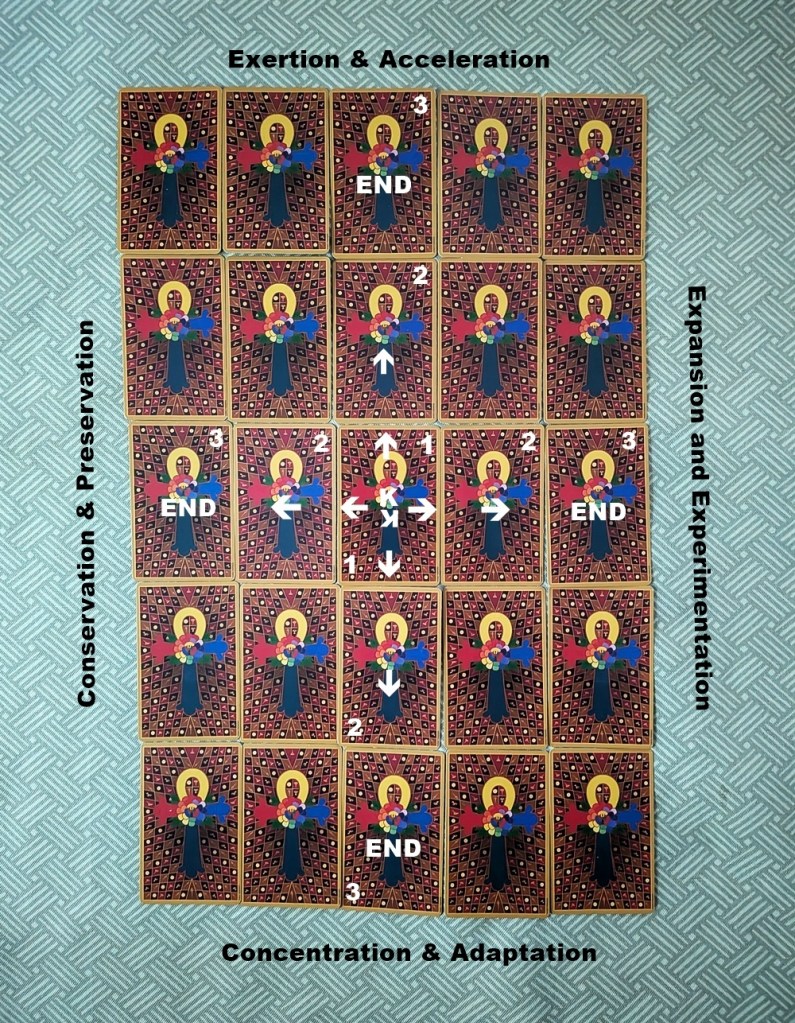
Determine whether the figure on the Significator is upright or reversed, and whether it is facing to the left or right of the scene. If it is upright and facing left, count two more cards above it and two more to the left of it to form a pair of three-card lines radiating out from its position; if it is facing right, do the same in that direction. If it is reversed and facing left, count two more cards below and two more to the left of it; if it is facing right, perform the two counts below and to the right, again creating a three-card line in each case. (If the figure appears to be gazing or gesturing diagonally, the count can proceed along the diagonal in that direction, although I didn’t diagram this option.)
Below is a demonstration showing a Knight that appeared in the exact center of the spread, in both upright and reversed versions, and the direction of the counting in the four scenarios described above. This is an ideal setup since there are three cards in all directions when moving from the center. (Another more-restrictive possibility will be described later.) All card backs are from the Retro-Thoth Tarot, privately published.
Turn over the five cards identified by the orientation of the Significator (one will be at the intersection and will therefore be shared by both lines). Examine the cards, deciding which of the runs – horizontal or vertical – best speaks to the question or topic, and read it as the primary narrative. The other run can be ignored or interpreted as a secondary story arc to fill in any gaps in the main reading. At the four edges of the array I have shown the overall thrust or situational focus for runs that evolve in each direction, and the two divergent paths can energize one or more of these zones to various degrees depending on Significator placement.
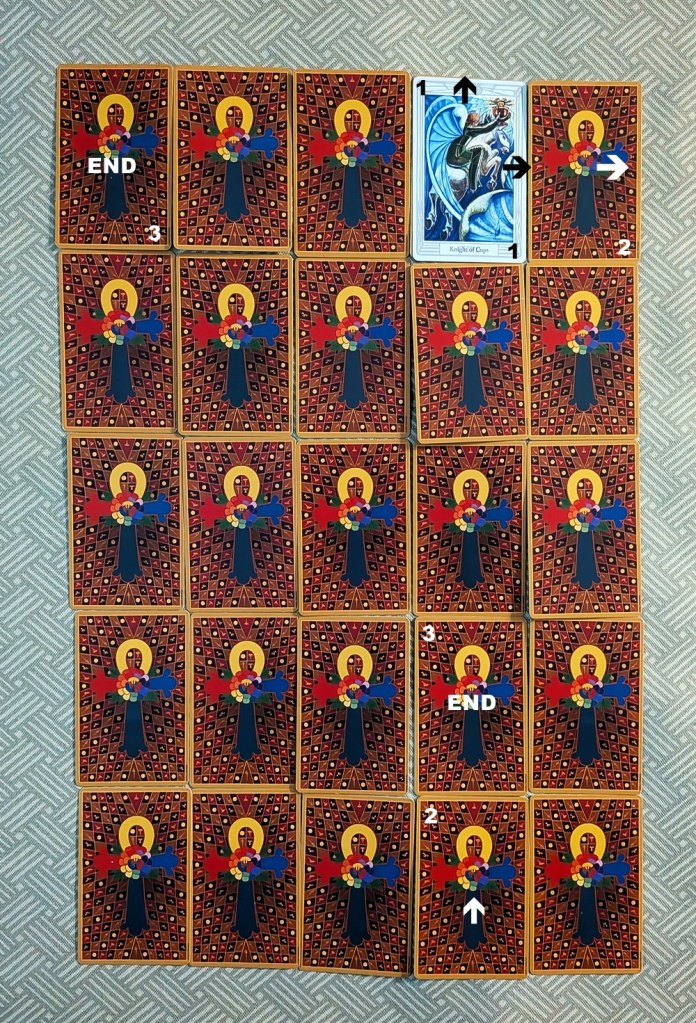
Below is what I consider to be a near-worst-case situation: the Significator (Knight of Cups) landed at the top of the layout and far to the right. It was upright and facing toward the right such that there were no cards above it and only one along its line-of-sight.
Rather than ending the count in failure, I decided to pick it up at the opposite end of the row and column, thus yielding the required set of three-card lines. In this instance, it was also possible to count an additional two cards in each run to make a pair of five-card lines, offering more detail to the forecast. (Card faces in the example spreads are from the Thoth Tarot, copyright of US Games Systems Inc, Stamford, CT.)
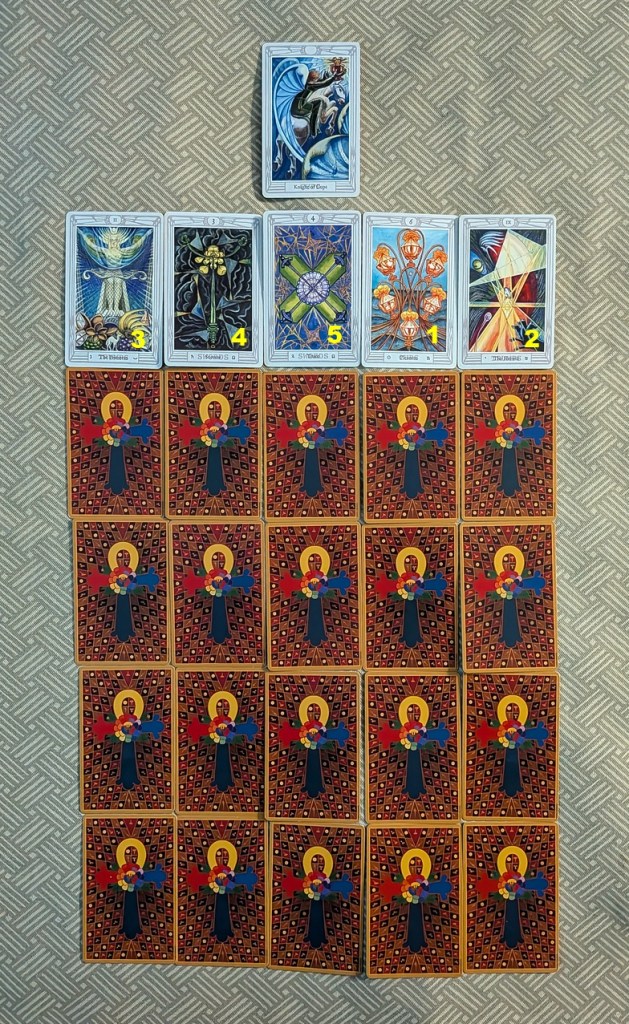
Below it is the result of the horizontal count; I didn’t photograph the vertical run before I gathered up the cards, but this will give you the idea. The three cards of the initial analysis are the 6 of Cups; the Hermit and the High Priestess, suggesting a placid interlude that will leave me scratching my head over the more imponderable implications of isolation and internalization.
However, the extended run presents no such ambiguity: the 3 of Swords and the 4 of Swords express only dismay, fatigue and resignation after a draining episode of spiritual duress. This situation plays out in the “Exertion & Acceleration” zone and spills over into the “Conservation & Preservation” arena, implying the need for a little “R&R” (rest and rehabilitation). If I had done the vertical line, it would have tapped into “Concentration & Adaptation” to reinforce that recovery scenario.
 Parsifal's Wheel Tarot & Astrology