AUTHOR’S NOTE: When it comes to designing line spreads for tarot reading, I typically employ an even number of cards only in situations that require a choice between two options, or when invoking the four classical elements represented by the suits. One thing I learned from Lenormand reading is that an odd-numbered line will always have a “hinge card” or turning-point in the middle that serves as a catalyst pointing toward the outcome. Three-card and five-card lines both serve the purpose quite well.
I think of the five-card line in terms of a wave: the matter begins, surges, crests, subsides and ends. The “crest of the wave” is where it is most amenable to being ridden toward a self-directed solution. Reversed orientation or an inconclusive “hinge” card can flatten the curve and make the “turn-around” less dramatic.
Here is a new spread to illustrate my point, followed by an example reading. I’m also toying with the idea of inverting the “wedge” for matters that have been trending poorly and rename the positions “How It Forms; How It Falters; How It Troughs or “bottoms out;” How It Rebounds; How It Recovers.” (All images are from the Chrysalis Tarot, copyright of US Games Systems Inc, Stamford, CT.*)
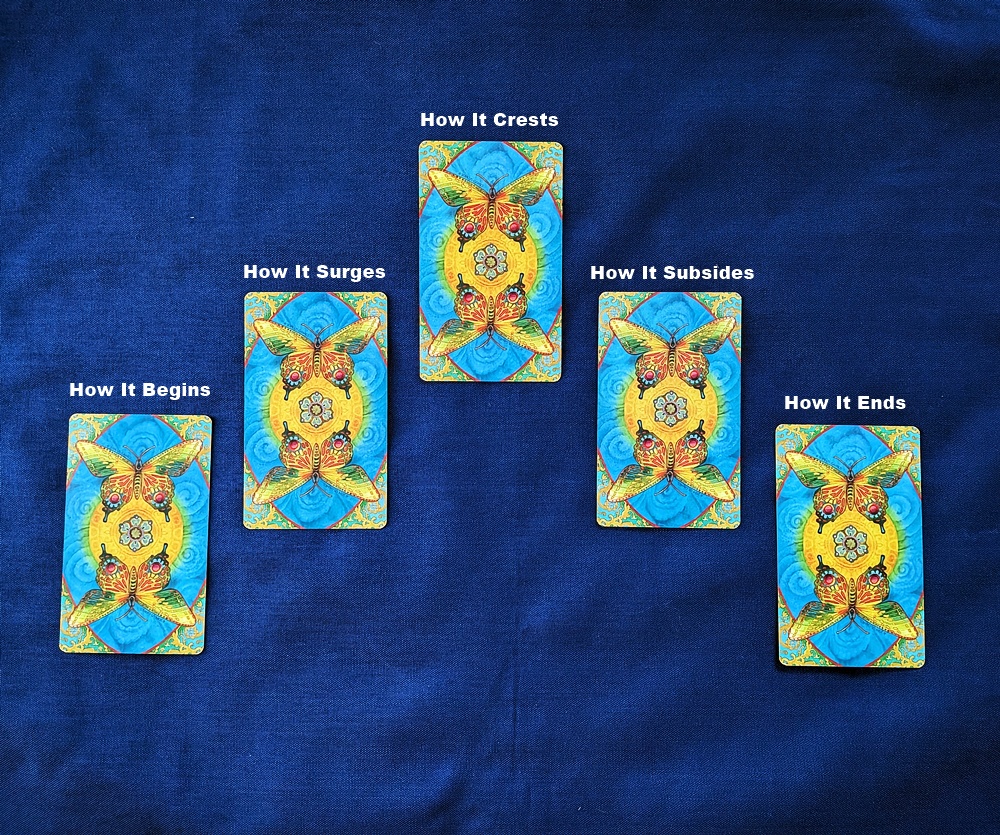
The question involves a situation that has been dormant for some time, and every so often I do another reading to see whether (and how) it might progress in the future. (Note that in this deck the suit of Scrolls equates to Swords, Stones to Pentacles, Mirrors to Cups and Spirals to Wands.)
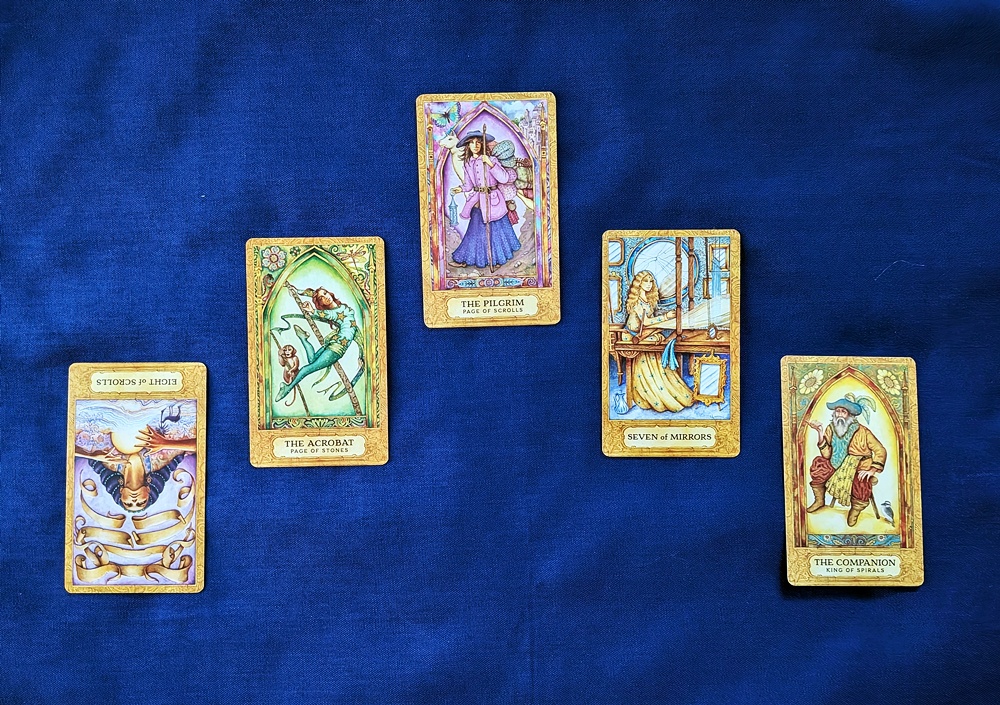
The reversed 8 of Scrolls suggests that communication on the matter has been at a standstill, due mainly to prevailing circumstances such as inertia and inconvenience, not reluctance. (The Thoth title for this card is “Interference,” but here that influence is oblique.)
The Acrobat (Page of Stones) implies “stepping out” in a purposeful way.
The Page of Scrolls expresses an openness to conversation. It may be time to broach the subject when the Page of Stones finally bestirs himself and shows up. These cards are elementally uncongenial, so there could be some miscommunication or misapprehension of intent with which to contend.
The 7 of Mirrors in this deck conveys “discernment, false reality and free will; the time draws neigh to weigh options and make your choice.” Hesitancy looms large in this scenario along with the risk of some deception.
As decisive Fire welcoming tentative Water into his lair, the King of Spirals is a boon companion who “turns positive intentions into reality” He is well-suited to cut through the confusion and indecision of the 7 of Mirrors with a steady (if slightly heavy) hand.
Because there is no “flattening” effect here except for the neutral beginning and the slightly off-putting 7 of Mirrors, the conclusion I reached about this reading is that “opportunity knocks” but there is uncertainty that must be overcome without exerting too much force.
*Note that, although it is presented as “tarot,” the Chrysalis reads more like an oracle deck (quite successfully, I might add), so the card titles and the descriptive text from its LWB (“little white book”) don’t align closely with tradition.
 Parsifal's Wheel Tarot & Astrology